
Zero Lab Treatment Information
Why melasma takes ten sessions or more
Hello, I am Dr. Dong Won Kim, Medical Director of Zero Lab Clinic, one minute from Hongdae (Hongik Univ.) Station Exit 1.
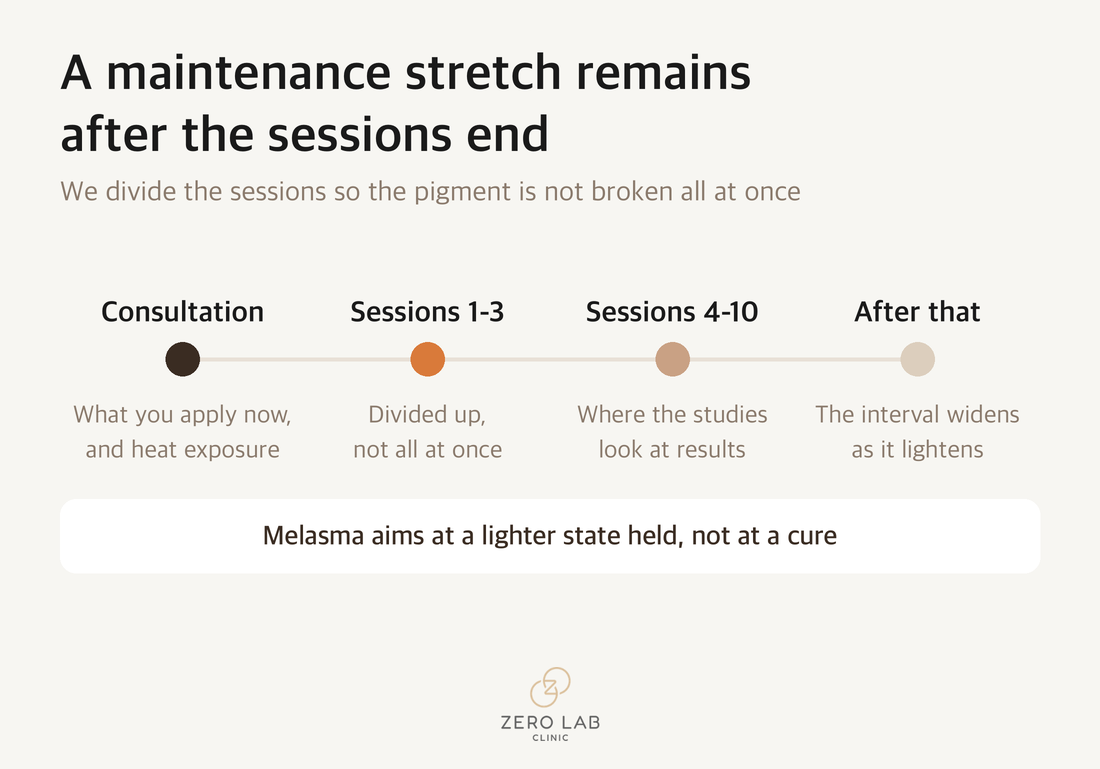
The question I hear most often in a melasma consultation is "how many sessions will it take." I start by saying you should count on at least ten. And I add one thing: that number of sessions is not the end.
Melasma is a difficult condition. Strictly speaking, there are a fair number of cases that do not get cured. That does not mean nothing can be done. We can improve it. But once improved, it comes back. So we call melasma not a disease we cure but a lesion we manage.
How the brown patches on a face are told apart I have set out separately. Today is what comes after that: why ten sessions, and why one thing on its own will not do.
Breaking the pigment takes sessions
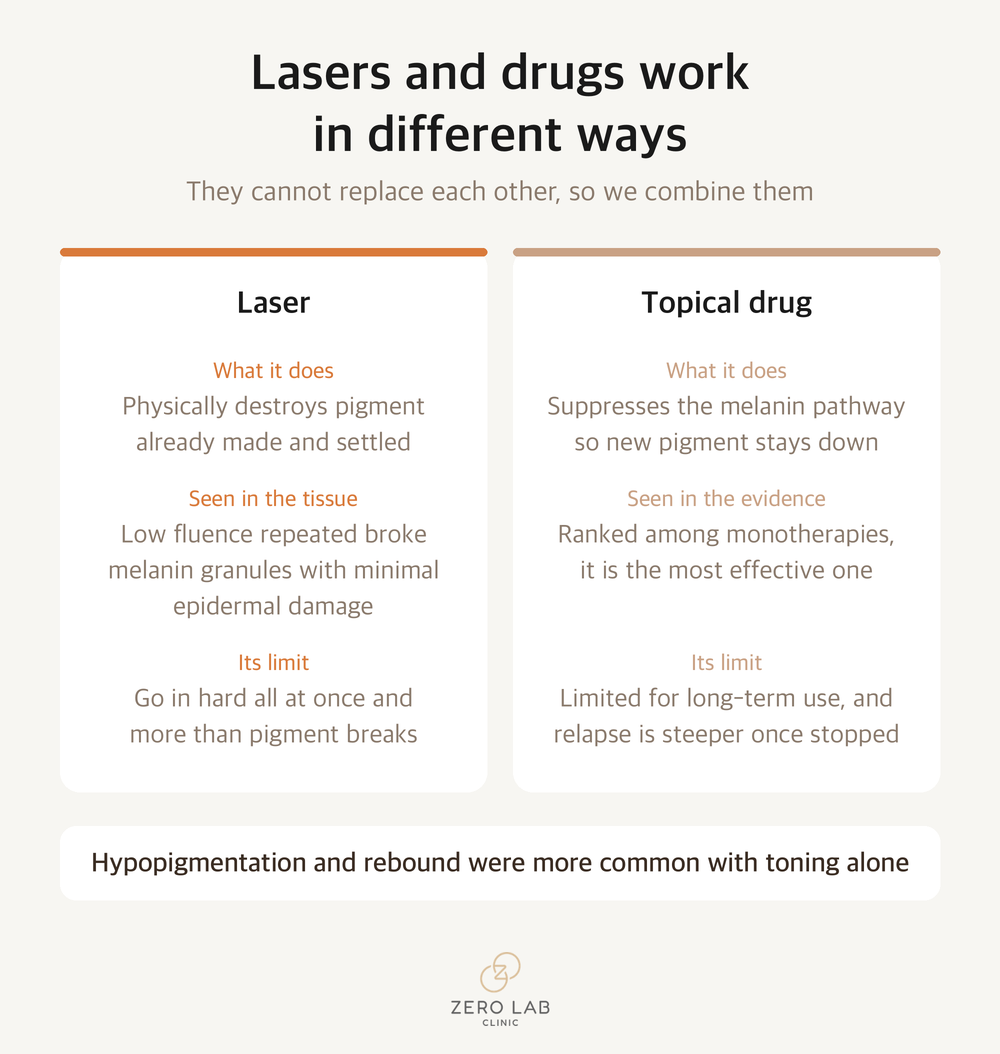
What a laser does to pigment is simple. It puts energy in and physically shatters the melanin granules. Where a topical suppresses the melanin production pathway, a laser breaks up pigment that has already been made and settled, and clears it out.
In Japan there is a study of eight patients with melasma on both sides of the face: one side had a low-fluence 1064nm QS laser once a week for four weeks, the other side a single QS ruby laser session, after which tissue was taken and examined under an electron microscope. On both sides melanin granules were confirmed to have been destroyed. On the ruby side, however, the morphological damage to epidermis and dermis was considerable, while on the low-fluence side epidermal disruption and cell damage were minimal. And the low-fluence side went longer before it recurred[1].
With eight patients the numbers are small. What it shows, though, is clear. Go in hard to break it all at once and things other than pigment break too. So we divide it up.
The session counts the studies work with are in the same range. At a clinic in Seoul, melasma patients were split into two groups and treated ten times, once a week , then assessed three months later[2], and other studies in Asian patients look at their results somewhere between five and ten sessions. The number ten is not one I decided; it came from there.
Neither one is enough as monotherapy
Let me be straight about something here. If you insist on ranking the monotherapies, the laser does not come out first.
An evidence-based review in an American journal pooled 113 randomized controlled and controlled clinical trials with 6,897 participants for comparison. Hydroquinone alone and triple combination cream were the most effective, and its conclusion was that chemical peels and laser and light treatments were equal to or worse than topical agents while carrying a higher risk of side effects[3].
That sentence is true. But two things have to be read alongside it.
First, the laser referred to there is not one single thing. What that review warned about is the high-fluence pigment lasers and the ablative and fractional families. They are the ones that leave melasma rebound and post-inflammatory hyperpigmentation, and they are the same as the ruby that did the greater damage in the electron microscope study above. What we use for melasma is low fluence, repeated.
Second, the drug that came out first has a price attached to it as well. Hydroquinone is still the standard, but one review sets out that with long-term use, local and systemic side effects including exogenous ochronosis and skin atrophy become a problem[4]. That is why it is a prescription-only drug here as well, with a limit on how long it may be used. Meaning it is not a drug you can stay on for life.
And then there is what happens when you stop. In Thailand, a study split the faces of 30 melasma patients in half and for 12 weeks applied triple combination cream on one side and a cosmetic containing alpha-arbutin and kojic acid on the other; at 12 weeks the pigment index and the severity score showed no difference between the two sides. But four weeks after stopping, the relapse was worse on the triple combination side (pigment index p=0.004, severity score p=0.045)[5].
It is a 30-patient pilot study, so it cannot settle the question on its own. But it points the same way as something I often say in consultation. Press hard and take it out fast, and what follows once you let go is steeper.
To put it plainly: the laser alone is not enough, and the drug alone is not enough. Melasma is a lesion that has to be approached with combination treatment.
The result changes when you combine them
That is how the evidence actually gathers.
Take the review of how the 755nm alexandrite picosecond laser is used in melasma. With the laser alone, 40% of participants had their melasma improve by 50-75%. But the group that also used topical tranexamic acid improved more than the laser-only group at both one month and three months after treatment(p<0.05), and patient satisfaction was higher as well. The group that used hydroquinone alongside, on the other hand, showed no difference from hydroquinone alone[6]. Meaning that even within combination therapy, the result turns on what you put on top.
The Korean data is more direct. In that study I mentioned, 58 patients who received low-fluence 1064nm toning only were compared with 56 who had microneedling radiofrequency added to the toning. The median fall in severity score was 2.9 in the combination group against 1.8 in the monotherapy group, and the proportion rated 'good' or better by the assessors was 68% against 54%. And what is worth noting is the safety. mottled hypopigmentation and rebound hyperpigmentation were in fact more common in the toning-only group[2].
Push the same number of sessions with one thing only, and that one thing has to carry more. Which is where the side effects come from, too. The point of this study is that combination is better not only in efficacy but in safety.
That is why we put the laser at the frame when we plan for melasma. Because the operator controls the fluence and the interval, a laser leans less on day-to-day adherence. What you apply and what you take are layers laid on top of it, and what goes on top depends on the state of the skin.
How do you divide toning and pico?
Since we have both laser toning and PicoSure toning at the clinic, I am asked this often. It is a question of which is better, and to answer first: for melasma itself, neither is superior.
In a prospective Korean study the faces of 20 melasma patients were split in half, with 1064nm picosecond on one side and 1064nm QS on the other, five sessions at two-week intervals; both sides improved significantly, and there was no difference between the two methods at any time point[7]. In a randomized study that varied the wavelength and followed 755nm pico against 1064nm QS out to two years, 755nm was no better either, and at the two-year point 58.82% on both sides had recurred or worsened[8].
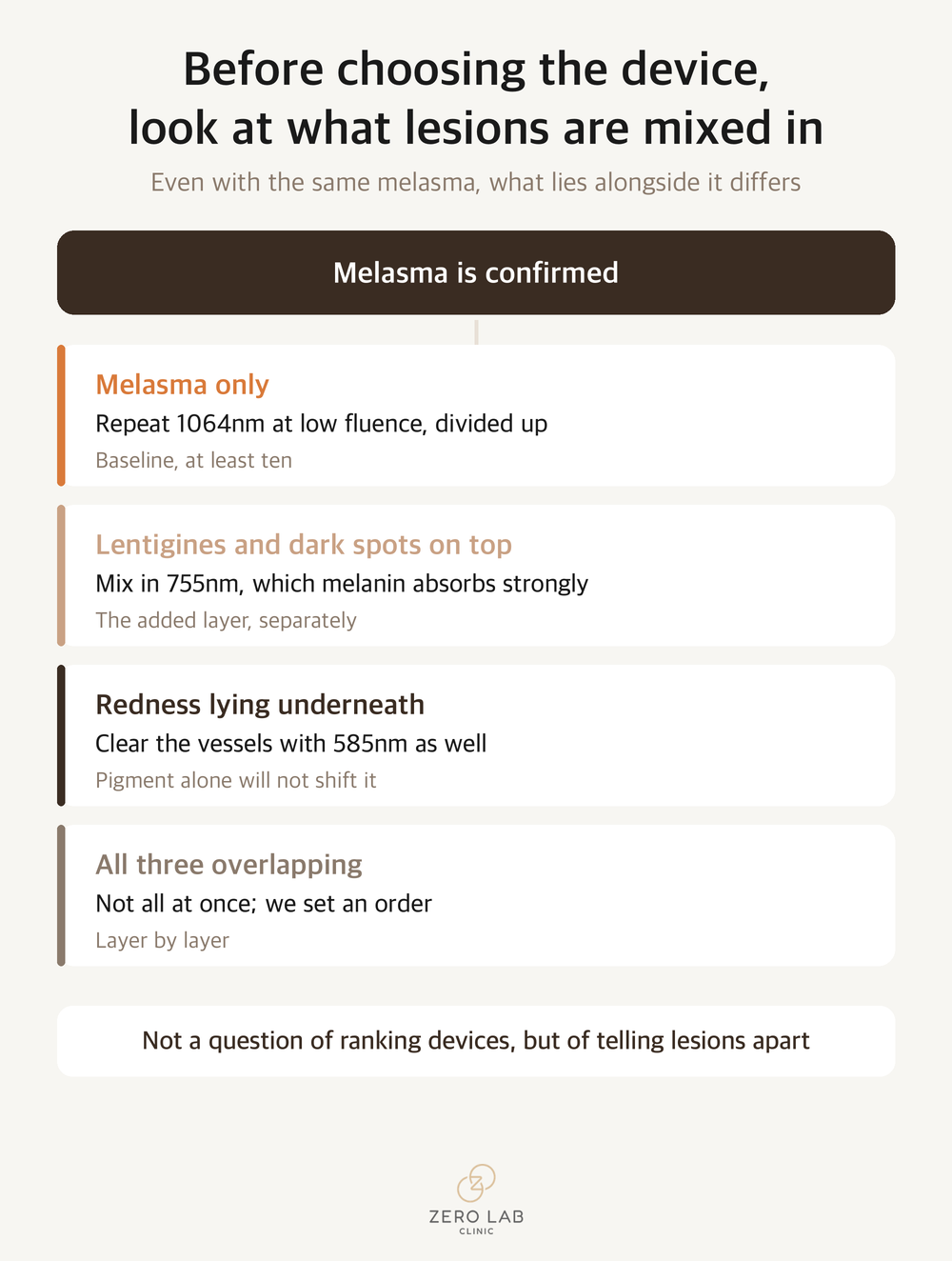
So we do not sort the devices into better and worse but by what mix of lesions is present . Where melasma alone is what lies there, repeated low-fluence 1064nm is the baseline. But as I explained in the earlier article, facial pigment often comes in overlapping layers. If a solar lentigo sits on top of the melasma, or dark spots are there with it, we mix in 755nm, which melanin absorbs strongly, and work on that layer separately. In a Taiwanese study where 20 Asian patients had 755nm pico three times at four- to six-week intervals, the spot index on the forehead improved significantly, and that too is about that layer[9].
Before choosing the device you have to look at what mix of lesions is there.
How far is the oral medication established?
What has been studied most in melasma over the past few years is oral tranexamic acid. It was originally used as a haemostatic agent, and came across once it was known to act on the pigment production pathway.
A meta-analysis pooling 22 randomized controlled trials with 1,280 patients sets out that tranexamic acid significantly lowers melasma severity[10]. A network meta-analysis that looked at dose separately analysed 6 randomized controlled trials with 599 patients and proposed 750mg a day for 12 weeks as optimal[11]. A higher dose is not better, though. In an Indian study splitting 50 patients with moderate or worse melasma into a 500mg-a-day group and a 1,000mg-a-day group, the proportion whose severity score fell by 75% or more at 12 weeks was 20% and 25%, with no difference (p=0.71)[12].
This is a prescription-only drug as well. And it is not a drug without side effects. The meta-analysis above reports gastrointestinal upset, skin irritation and menstrual irregularity[10]. We do not use it in anyone at risk of thrombosis. So it is decided after the history has been checked, not something we recommend at the outset.
Heat is as important an aggravating factor as ultraviolet
Everyone talks about ultraviolet. So today let me talk about heat.
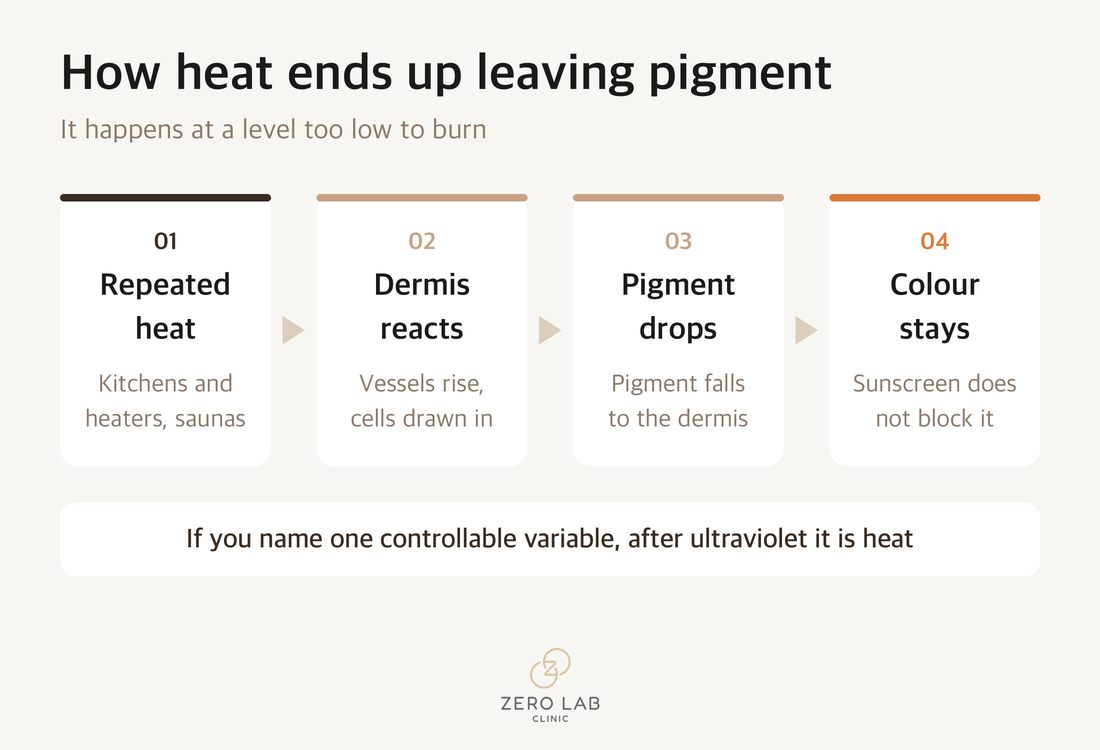
There is a condition called erythema ab igne. It comes from repeated, prolonged infrared exposure to the same spot, at a level too low to burn. In the tissue, dilated vessels, interface dermatitis and pigment incontinence are seen[13]. Pigment incontinence is pigment that should be in the epidermis dropping down and settling into the dermis.
It was originally described in people who cooked in front of wood stoves, but the heat sources have changed. Electric blankets, hot water mats, a laptop on the lap, a heat pack left on too long. And move it up to the face: in front of a gas hob, in front of a fryer, the moment the oven door opens, the seat in front of the winter heater, saunas and jjimjilbang.
The mechanism has been confirmed in human skin too. In skin exposed to infrared and heat, vessels in the dermis increased, inflammatory cells were drawn in, and enzymes that break down collagen rose[14]. In the photoaging article I cited this study for the elasticity story, but in melasma a different item catches the eye. A state where vessels increase and inflammation is circulating overlaps with what is seen in melasma lesions.
A study gathering 1,001 melasma patients across 10 centres throughout India reported that time at cooking fires and occupational heat exposure showed a significant correlation with melasma severity, which is the same picture (p=0.003)[15].
What matters here is that heat is not a problem for melasma alone. Heat is on the trigger list we ask about in facial redness consultations, and we ask the same of people who come in because their pores look slack. The three look like different concerns, but if you had to name one controllable environmental variable, after ultraviolet it is heat.
And heat is not blocked by sunscreen. There is no way round it other than moving away from it or cutting the time.
There is melasma with redness lying underneath
That we do not see melasma as a pigment-only problem is something I said in the earlier article. The part of it that actually leads to a procedure is the vasculature.
In the United States there is a retrospective analysis in which 11 patients whose melasma lesions also carried fine vascular erythema were selected with a spectrocolorimeter and treated on the same day, in sequence, with a 595nm pulsed dye laser and a 1927nm fractional low-powered diode laser. After an average of four sessions, 6 of the 11 patients (54%) improved by 50% or more, and no melasma rebound or post-inflammatory pigment change was observed. And the improvement in the melasma moved in step with the improvement in the erythema[16].
The evidence on wavelengths is building too. A review pooling the studies that applied low-level light therapy to melasma sets out that several wavelengths including the 585nm and 590nm amber band act on tyrosinase activity and the pigment production pathway to reduce melanin content, and at the same time reduce erythema and neovascularisation and improve the condition of the dermis[17]. This review too, though, adds the caveat that better designed clinical trials are needed.
The Cynergy MPX we use is a device that fires a 585nm pulsed dye laser and a 1064nm long pulse in sequence from one unit. It is the same device we use for facial redness, but in melasma the purpose is different. We are not going in to take the colour out; we are going in to clear the vessels lying underneath so that the pigment comes back up more slowly.
Among the people whose melasma is particularly stubborn there are some where, if you press on it, the colour blanches and returns slowly - people who have redness lying underneath as well. In those cases aiming at the pigment alone does not work well. Going along with redness treatment does help in some of them.
The order we set
Pulling all of this together, an order falls out.
- We look first at what you are applying now. If there is something to be stopped, that comes first
- We block the aggravating factors first. Two of them: ultraviolet and heat
- We build the frame with the laser. Low fluence, divided up, at least ten times
- We add wavelengths according to the layers that are mixed in. If dark spots and lentigines are there too, we treat them separately
- We lay the topicals on top. We decide them by separating what needs a prescription from what does not
- We add an oral drug if it is needed. We check the history and then decide
- If redness is lying underneath, we look at the vessels as well
- As it lightens, we widen the interval. We do not bunch the sessions together
What happens if you leave out step 2 and start from step 3 is something we have seen many times over. It comes back up faster than it comes out.

What we check in consultation
If you come to us for melasma, we ask the following. Having it ready beforehand makes the consultation far faster.
1) When it first came up, and whether there was a change at the time such as pregnancy or taking a hormonal medication
2) Everything you are currently putting on your face - bringing it in is fastest
3) How much of the day you spend in front of heat (kitchen, heater, sauna, jjimjilbang)
4) How many times a day you apply sunscreen
5) The procedures you have had before and how you reacted at the time
6) How it changes with the season
I am asked a lot when the melasma will be gone. My answer is always the same. There are ways to take it out fast. Those ways usually do not last. Ten will sound like a long run, but those sessions are divided up precisely so that the pigment is not broken all at once. Melasma is not a disease you erase but one where you hold on to a lighter state, and planning on that basis leaves you less disappointed.
Treatments covered in this article
Prices and booking
References
[1] Omi T, Yamashita R, Kawana S, et al. Low Fluence Q-Switched Nd:YAG Laser Toning and Q-Switched Ruby Laser in the Treatment of Melasma: A Comparative Split-Face Ultrastructural Study. Laser Ther. 2012;21(1):15-21. DOI: https://doi.org/10.5978/islsm.12-OR-03
[2] Kwon HH, Choi SC, Jung JY, Park GH. Combined treatment of melasma involving low-fluence Q-switched Nd:YAG laser and fractional microneedling radiofrequency. J Dermatolog Treat. 2019;30(4):352-356. DOI: https://doi.org/10.1080/09546634.2018.1516858
[3] McKesey J, Tovar-Garza A, Pandya AG. Melasma Treatment: An Evidence-Based Review. Am J Clin Dermatol. 2020;21(2):173-225. DOI: https://doi.org/10.1007/s40257-019-00488-w
[4] Gonzalez N, Perez M. Natural Cosmeceutical Ingredients for Hyperpigmentation. J Drugs Dermatol. 2016;15(1):26-34. PMID: 26741379
[5] Tantanasrigul P, Sripha A, Chongmelaxme B. The Efficacy of Topical Cosmetic Containing Alpha-Arbutin 5% and Kojic Acid 2% Compared With Triple Combination Cream for the Treatment of Melasma. J Cosmet Dermatol. 2025;24(1):e16562. DOI: https://doi.org/10.1111/jocd.16562
[6] Pulumati A, Jaalouk D, Algarin YA, Nouri K. The role of 755-nm alexandrite picosecond laser in melasma management. Arch Dermatol Res. 2023;316(1):60. DOI: https://doi.org/10.1007/s00403-023-02794-0
[7] Hong JK, Shin SH, Park SJ, Seo SJ, Park KY. A prospective, split-face study comparing 1,064-nm picosecond Nd:YAG laser toning with 1,064-nm Q-switched Nd:YAG laser toning in the treatment of melasma. J Dermatolog Treat. 2022;33(5):2547-2553. DOI: https://doi.org/10.1080/09546634.2022.2033674
[8] Zhou Y, Li Y, Hamblin MR, Wen X. Comparison of 755-nm picosecond alexandrite laser versus 1064-nm Q-switched Nd:YAG laser for melasma: A randomized, split-face controlled, 2-year follow-up study. Lasers Surg Med. 2024;56(3):263-269. DOI: https://doi.org/10.1002/lsm.23763
[9] Chen YT, Lin ET, Chang CC, et al. Efficacy and Safety Evaluation of Picosecond Alexandrite Laser with a Diffractive Lens Array for Treatment of Melasma in Asian Patients by VISIA Imaging System. Photobiomodul Photomed Laser Surg. 2019;37(9):559-566. DOI: https://doi.org/10.1089/photob.2019.4644
[10] Calacattawi R, Alshahrani M, Aleid M, et al. Tranexamic acid as a therapeutic option for melasma management: meta-analysis and systematic review of randomized controlled trials. J Dermatolog Treat. 2024;35(1):2361106. DOI: https://doi.org/10.1080/09546634.2024.2361106
[11] Wang WJ, Wu TY, Tu YK, et al. The optimal dose of oral tranexamic acid in melasma: A network meta-analysis. Indian J Dermatol Venereol Leprol. 2023;89(2):189-194. DOI: https://doi.org/10.25259/IJDVL_530_2021
[12] Bhattacharjee R, Hanumanthu V, Thakur V, et al. A randomized, open-label study to compare two different dosing regimens of oral tranexamic acid in treatment of moderate to severe facial melasma. Arch Dermatol Res. 2023;315(6):1831-1836. DOI: https://doi.org/10.1007/s00403-023-02549-x
[13] Harview CL, Krenitsky A. Erythema Ab Igne: A Clinical Review. Cutis. 2023;111(4):E33-E38. DOI: https://doi.org/10.12788/cutis.0771
[14] Cho S, Shin MH, Kim YK, et al. Effects of infrared radiation and heat on human skin aging in vivo. J Investig Dermatol Symp Proc. 2009;14(1):15-19. DOI: https://doi.org/10.1038/jidsymp.2009.7
[15] Sarkar R, Jagadeesan S, Basavapura Madegowda S, et al. Clinical and epidemiologic features of melasma: a multicentric cross-sectional study from India. Int J Dermatol. 2019;58(11):1305-1310. DOI: https://doi.org/10.1111/ijd.14541
[16] Geddes ERC, Stout AB, Friedman PM. Retrospective analysis of the treatment of melasma lesions exhibiting increased vascularity with the 595-nm pulsed dye laser combined with the 1927-nm fractional low-powered diode laser. Lasers Surg Med. 2017;49(1):20-26. DOI: https://doi.org/10.1002/lsm.22518
[17] Galache TR, Sena MM, Tassinary JAF, Pavani C. Photobiomodulation for melasma treatment: Integrative review and state of the art. Photodermatol Photoimmunol Photomed. 2024;40(1):e12935. DOI: https://doi.org/10.1111/phpp.12935
The 17 papers above are indexed in PubMed. This article is general medical information; decisions about an individual's condition are made through consultation.
This article was written directly by Zero Lab Clinic to provide medical information. Results of any procedure vary with individual skin condition, and side effects are possible. Please decide on a procedure only after an in-person consultation with a doctor.