

Zero Lab Skin Lecture
Eighty percent of skin ageing comes from sunlight
Hello, I am Dr. Dong Won Kim, Medical Director of Zero Lab Clinic, one minute from Hongdae (Hongik Univ.) Station Exit 1.
There is one thing I never leave out at the end of a consultation. Please wear sunscreen. I say it several times a day.
I say it to the person who came about pigment, to the person bothered by wrinkles, to the person whose pores have widened. They all came in with different concerns, and the last thing I say is always the same. Sometimes I catch a look that says "here we go again" .
So why does sunscreen matter this much? Because of photoaging.
That is what I want to talk about today. I will leave out how each of these is treated; I have written about that separately under each heading. Instead I will speak only about why this is worth preventing.
It may not be your age
"Isn't it just because I'm getting older?" It is the line I hear most in consultation. It is half right.
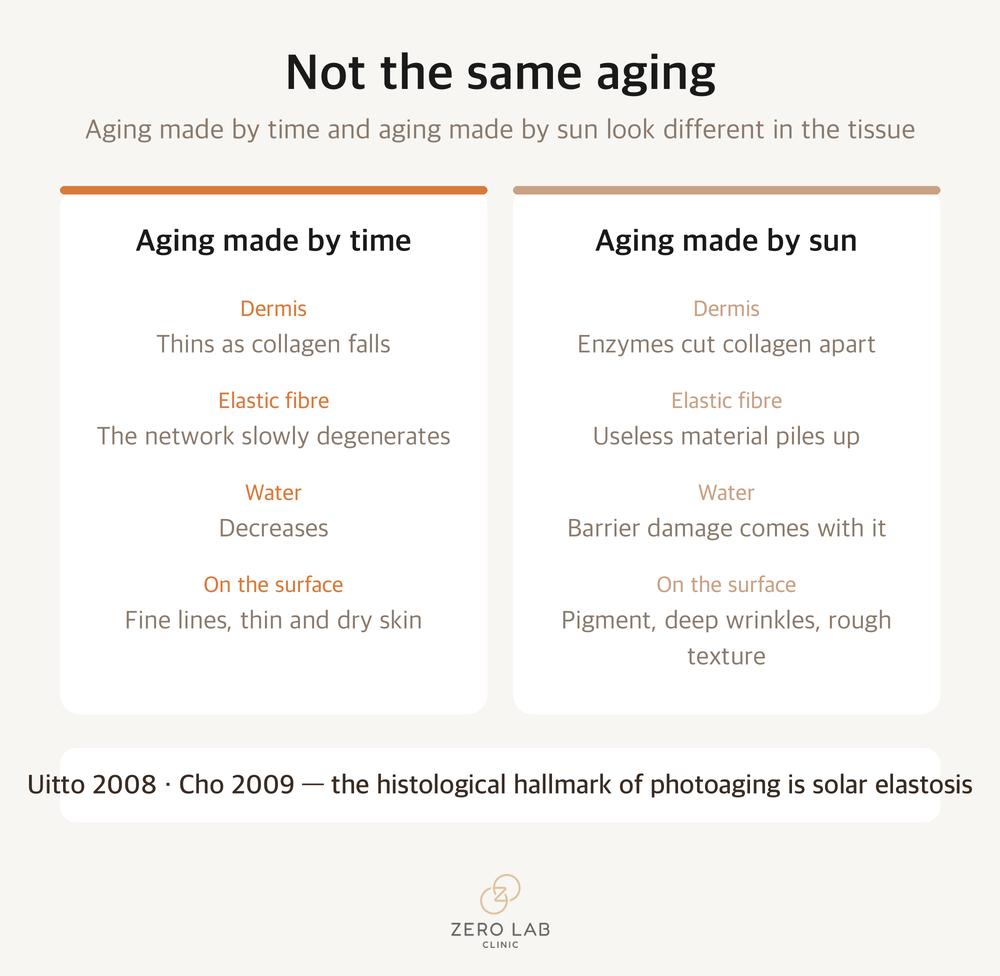
Skin ages along two paths, one made by time and one made by sunlight, and under the microscope the two look nothing alike. How much sunscreen to use and how often to reapply it is covered separately in Sunscreen: reapplying matters more than the number.
Aging made by time is a matter of loss. Collagen falls and the dermis thins, the network of elastic fibres slowly unravels, and water is lost. It grows thinner and drier.
Photoaging is the opposite. Something accumulates.
A review of elastin and collagen describes the histological hallmark of photoaging as a massive build-up of elastic fibre material in the upper and mid dermis. It is called solar elastosis[1].
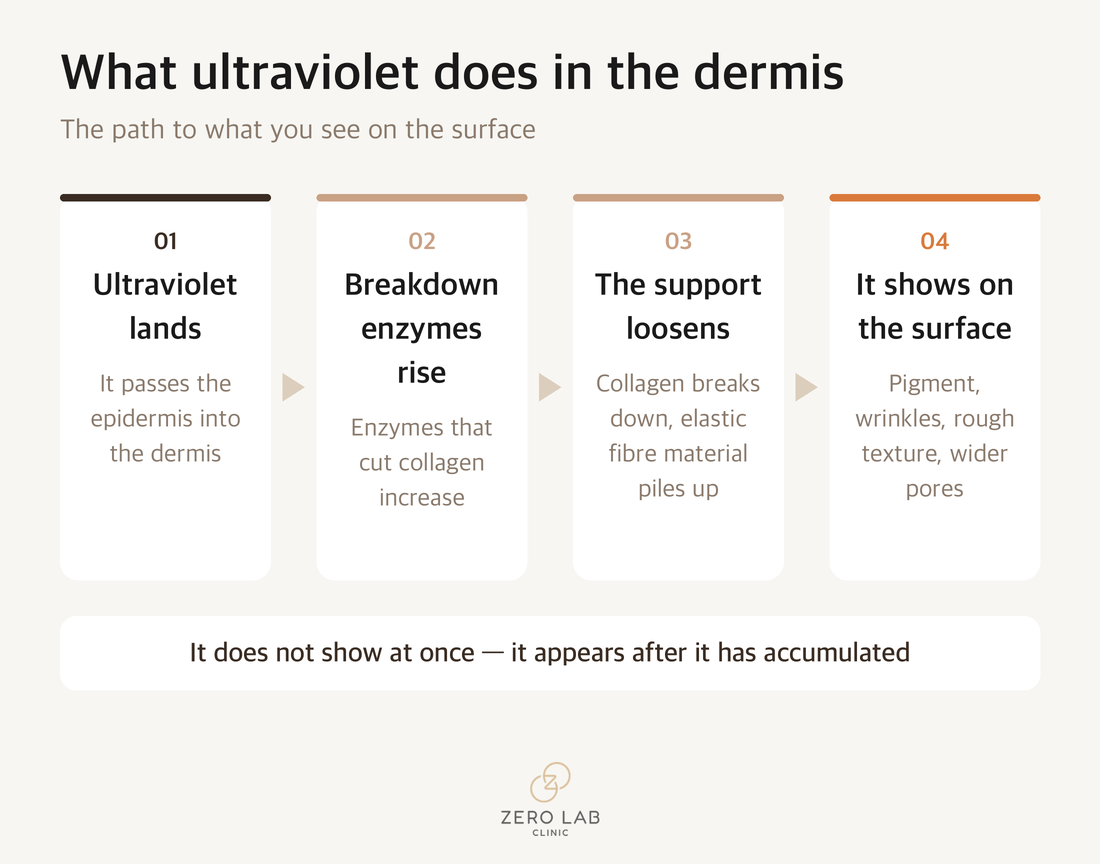
This is where many people get confused, and I did too when I first learned it. You would think long sun exposure wears elastic fibre away, but in fact ultraviolet light switches the elastin gene on[1]. More of it is made, and it is useless. The problem is not that the skin has thinned but that the wrong thing has filled it in.
Sunlight is not only ultraviolet either. In direct sun the skin's temperature climbs to nearly 40 degrees. Infrared and heat widen the vessels in the dermis, draw in inflammatory cells, and raise the enzymes that break collagen down, which loosens the structure that holds the skin up[2]. What sunscreen blocks is ultraviolet; this side comes straight through. That is why in midsummer I tell people not to trust sunscreen alone but to add a hat or a parasol.
Eight tenths of facial aging
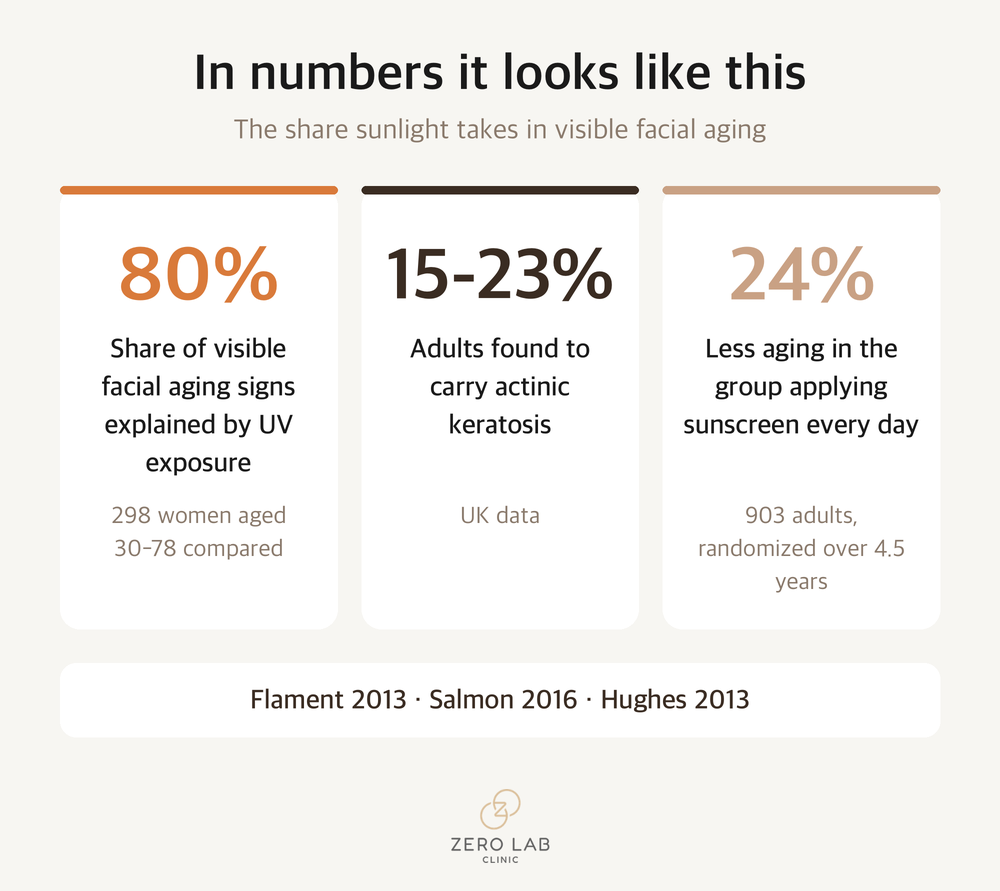
One study divided 298 women aged 30 to 78 into two groups: 157 who enjoyed the sun and 141 who avoided it. Twelve trained assessors scored their faces on 22 items and compared them decade by decade.
ultraviolet exposure accounts for about 80% of the visible signs of facial agingwas the conclusion[3]. The remaining 20% is time and what you were born with.
What makes this study useful, though, is not the figure of 80%. The results split by sign.
Same sunlight, different results
Pigment is the most direct. In that study, uneven pigmentation was greater in the sun-exposed group however the age bands were cut[3]. Melasma or dark spots, either one is hard to explain with ultraviolet light left out.
And yet pigment is not sunlight's doing alone. A recent study of solar lentigines pooled two East Asian cohorts (2,964 and 2,954 people) with one white cohort and found that variants in the telomerase reverse transcriptase gene were associated with solar lentigines[4].
Some people tell me they went on the same trip as everyone else and only they came back with spots. They have a point.
Wrinkles and texture are half and half. In the same study both were influenced by time and by sunlight alike[3]. That is why people of the same age differ so widely.
Sagging is another matter.
Between the two groups, ptosis showed no difference[3]. That one belongs to time. No amount of sunscreen stops what gravity pulls down. If somewhere tells you it stops that too, it is worth taking with a grain of salt.
That does not mean elasticity has nothing to do with sunlight. The solar elastosis above is elastic fibre in a degenerated state[1], and it has been confirmed in human skin that heat and infrared loosen the structure supporting the dermis[2]. Elastic fibre losing its quality and a face coming down are two different things.
Pores are on the list as well. A review of pore treatments lists ultraviolet exposure alongside age, sex and genetics as things that affect pore size[5]. When the elasticity around a pore drops, what was round takes on a shape drawn downward. That is a separate path from looking wide because of sebum.
Not only what you can see is left behind
So far this has been about what the mirror shows.
There is a condition called actinic keratosis. It is a rough, scaly lesion on epidermis that has taken ultraviolet light for a long time, and it feels like sandpaper under a finger. UK data put it in 15-23% of adults, with the risk of turning malignant at under 0.5% per lesion per year, and 20-30% of lesions clearing on their own[6].
And here I have to add an important caveat. Those figures are UK data. Skin cancer risk differs a great deal with how much pigment the skin carries, that is, with skin phototype.
One study exposed volunteers with white skin and Black skin to the same solar-simulating radiation and compared the tissue. In the white skin, DNA damage, an influx of inflammatory cells and activation of the breakdown enzymes linked to photoaging all appeared, whereas in the Black skin, apart from DNA damage in the upper epidermis, these changes were largely absent. What made the difference was pigment. The authors wrote that this explains why more pigmented skin is less susceptible to sunburn, photoaging and skin cancer[11].
East Asian skin carries more pigment than white skin, so this protection works to some degree. Taking skin cancer figures straight from Western data to alarm you would be going too far. Skin cancer is in fact not a common cancer in Korea.
Two things still need saying. First, less often does not mean never. If a rough patch of scale stays for a long time or keeps growing, that is something to have looked at.
Second, pigment and wrinkles are a different story. East Asian skin gets less skin cancer, but in exchange melasma and dark spots come up far more readily. It is because the cells that make pigment respond more eagerly. In the West a conversation about ultraviolet light heads toward skin cancer; in our consulting room it always heads toward pigment, and this is why.
So you can worry less about skin cancer. And you should worry more about pigment.
Let me add one thing about damage you cannot see. Lesions invisible to the eye can be up to ten times as many as the visible ones, and the damage does not sit at a single point: cells altered in a similar way may be spread through the surrounding area. Because the whole field has changed, it is called field cancerization[7]. Erase one visible spot and the field is still there.
So reducing exposure comes before removing one pigment spot or one patch of scale. The same paper writes that patients should have this concept explained to them and be followed regularly[7].
It is not too late to start now
People tell me they have already had twenty or thirty years of sun, so what is the use now. There is an answer.
A randomized trial split 903 adults under 55 into four groups and followed them for four and a half years. The group assigned to apply sunscreen daily showed no measurable progression of aging over the study period, and 24% less than the group left to its own judgement[8]. These numbers come from people already in middle age.
It shows over short periods too. In a study that scored women's faces in winter and again in summer, the unprotected group worsened on ten items in six months. Five of those were marked enough to exceed the precision of the scoring scale. The group applying daily saw less of that change[9].
One season.
A review of sunscreens likewise names broad-spectrum protection covering both UVB and UVA, applied regularly and in sufficient amount, as a requirement for preventing skin cancer and photoaging[10].
What has accumulated is hard to reverse. The rate at which more accumulates does change. And it takes nothing difficult or expensive.
What I look at in consultation
Pigment, wrinkles or pores, I do not look only at the state you are in now. I look with you at how much more is set to accumulate. With the same treatment, continued exposure changes how fast it comes back.

If a rough patch of scale has stayed a long time or keeps growing, I look at that spot before any cosmetic treatment. What you thought was pigment and meant to erase may be something else.
Most of the aging you see on a face is made by sunlight. Pigment directly, wrinkles and texture half from time and half from sun, elastic fibre by way of degeneration. Pores are in there too, and beneath all of it damage you cannot see lies more widely still.
The question I am asked most is which treatment works best. I always say the same thing. Treatment differs by item, but the way to prevent them overlaps into one, and let that one go and whatever you do will come back. That is why I raise this before I talk about treatments.
How to apply sunscreen, how brown spots are covered, and why pores are not finished in one go are each written up separately. The differences between sunscreen formulations I will continue in the next article.
References
[1] Uitto J. The role of elastin and collagen in cutaneous aging: intrinsic aging versus photoexposure. J Drugs Dermatol. 2008;7(2 Suppl):s12-16. PMID: 18404866
[2] Cho S, Shin MH, Kim YK, et al. Effects of infrared radiation and heat on human skin aging in vivo. J Investig Dermatol Symp Proc. 2009;14(1):15-19. DOI: https://doi.org/10.1038/jidsymp.2009.7
[3] Flament F, Bazin R, Laquieze S, et al. Effect of the sun on visible clinical signs of aging in Caucasian skin. Clin Cosmet Investig Dermatol. 2013;6:221-232. DOI: https://doi.org/10.2147/CCID.S44686
[4] Peng Q, Liu Y, Huels A, et al. Genetic variants in telomerase reverse transcriptase contribute to solar lentigines. J Invest Dermatol. 2023;143(6):1062-1072. DOI: https://doi.org/10.1016/j.jid.2022.11.016
[5] Parvar SY, Amani M, Shafiei M, et al. The efficacy and adverse effects of treatment options for facial pores: a review article. J Cosmet Dermatol. 2023;22(3):763-775. DOI: https://doi.org/10.1111/jocd.15502
[6] Salmon N, Tidman MJ. Managing actinic keratosis in primary care. Practitioner. 2016;260(1797):25-29. PMID: 29016090
[7] Filosa A, Filosa G. Actinic keratosis and squamous cell carcinoma: clinical and pathological features. G Ital Dermatol Venereol. 2015;150(4):379-384. PMID: 26099352
[8] Hughes MCB, Williams GM, Baker P, Green AC. Sunscreen and prevention of skin aging: a randomized trial. Ann Intern Med. 2013;158(11):781-790. DOI: https://doi.org/10.7326/0003-4819-158-11-201306040-00002
[9] Flament F, Gautier B, Benize AM, et al. Seasonally-induced alterations of some facial signs in Caucasian women and their changes induced by a daily application of a photo-protective product. Int J Cosmet Sci. 2017;39(6):664-675. DOI: https://doi.org/10.1111/ics.12427
[10] Bens G. Sunscreens. Adv Exp Med Biol. 2014;810:429-463. DOI: https://doi.org/10.1007/978-1-4939-0437-2_25
[11] Rijken F, Bruijnzeel PLB, van Weelden H, Kiekens RCM. Responses of black and white skin to solar-simulating radiation: differences in DNA photodamage, infiltrating neutrophils, proteolytic enzymes induced, keratinocyte activation, and IL-10 expression. J Invest Dermatol. 2004;122(6):1448-55. DOI: https://doi.org/10.1111/j.0022-202X.2004.22609.x
The 11 papers above are indexed in PubMed. This article is general medical information; decisions about an individual's condition are made through consultation.
This article was written directly by Zero Lab Clinic to provide medical information. Results of any procedure vary with individual skin condition, and side effects are possible. Please decide on a procedure only after an in-person consultation with a doctor.