

Zero Lab Skin Lecture
Sunscreen: reapplying beats the number
Hello, I am Dr. Dong Won Kim, Medical Director of Zero Lab Clinic, one minute from Hongdae (Hongik Univ.) Station Exit 1.
"I use SPF 50, so why did I still burn?" It is a question I hear often. The answer is usually not the product but the amount. The SPF number itself is assigned on the assumption that a certain amount has been applied, and few people apply that much. Today I want to start from what SPF actually measures, then go through how much protection is lost when the amount falls short, and why reapplying is more realistic than trying to put on a lot at once — with the research behind it.
What does SPF actually measure?
Let me start with the definition. SPF is not a direct measurement of how much ultraviolet light passes through. how many times more ultraviolet light it takes to make the skin turn red. It is the ratio of the minimal dose of ultraviolet light that produces erythema on protected skin to the same minimal dose on unprotected skin.
So SPF 30 does convert to "blocks 97% of ultraviolet light," but that 97% is a figure derived by inverting one-thirtieth; it is not the definition itself. And it matters that the criterion is erythema. Erythema is caused mainly by UVB, so SPF is in practice a UVB measure. UVA, which is more closely tied to photoaging, is handled separately by PA, which I will come to below[4].
Once this definition is in place, everything that follows connects into one line. the "how many times" figure is a value obtained at a fixed amount of product.
One of the few cosmetics whose effect has been confirmed in a trial
Before I get to the limits of the number, there is something I want to make clear. Among things you put on your skin, few are as clearly proven as sunscreen.
There is a randomized trial that divided 903 adults under 55 into four groups and followed them for 4.5 years. The group assigned to apply sunscreen daily showed no measurable progression of skin aging over the study period, and aged 24% less than the group left to their own discretion (relative odds 0.76, 95% CI 0.59–0.98)[5]. In the same trial, beta-carotene supplements had no overall effect on aging.
Not many cosmetic items have had anti-aging confirmed by a trial of this design. So if we are putting things in order, using sunscreen properly comes before choosing which serum to use. What follows is not a claim that the product is weak, but about the point where a good product does not get used for what it is worth.
SPF is a number that assumes an amount
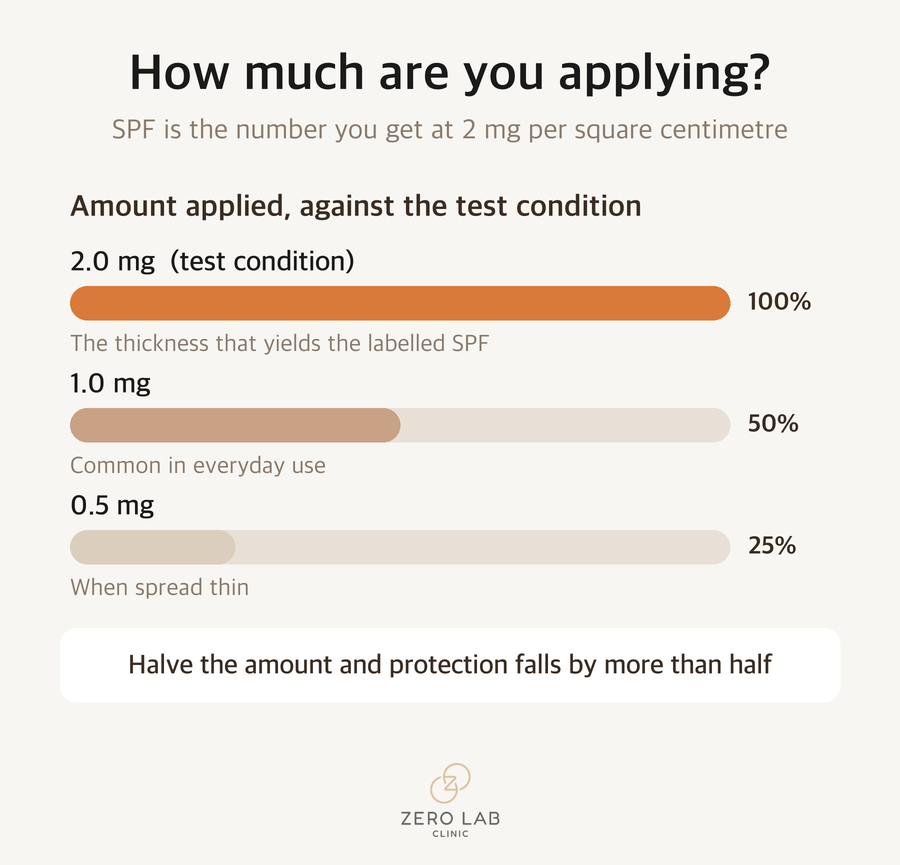
SPF is measured with the product applied at a thickness of 2 mg per square centimeter of skin. The problem is the amount people actually use. A review of real-world sunscreen use reports that the amount applied under everyday conditions is roughly 0.39 to 1.0 mg, often less than half the test condition[1].
The same review goes one step further. It points out that the current labelling method, given how people actually apply sunscreen, leads to an overestimation of a product's protective effect, and that as a result consumers may mistakenly believe it is safe to stay in the sun longer[1].
Higher SPF loses more when the amount falls short
This is the part many people miss. It is easy to assume that "even if I apply a bit less, SPF 50 should still give me something like SPF 25." In practice it is not that simple.
There is a study from three regions of China in which 120 participants tested SPF 4, 15, 30, and 55 products at four application thicknesses from 0.5 to 2.0 mg. The results showed that for the lower SPFs (4 and 15), the relationship between amount applied and protection was linear, while for the higher SPFs (30 and 55) it was exponential[2]. Put simply, the higher the SPF, the more steeply protection falls as the amount decreases.
| Product grade | Relationship between amount and protection | What happens in real use |
|---|---|---|
| Low SPF (4-15) | Close to linear | Protection declines gradually as amount drops |
| High SPF (30-55) | Exponential | Protection declines more steeply than expected |
The authors concluded that consumers may in fact receive lower protection than expected from high-SPF products[2]. That is why choosing a product with a large number on it is not, by itself, grounds for reassurance.
Do not convert the SPF number into time
The calculation that "SPF 30 means I last 30 times longer" is also far from reality.
A study measuring commercial sunscreens under in-service conditions found that on a day with a very high UV index, an SPF 30 product allowed the minimal erythema dose to be reached in just 35 minutes. Even an SPF 50 product, which in theory should hold for several hours, reached the same point within 1 hour under Australian summer conditions at a UV index of 12[3]. In other words, the same product has a completely different effective duration depending on how strong the UV is that day.
SPF and PA block different things
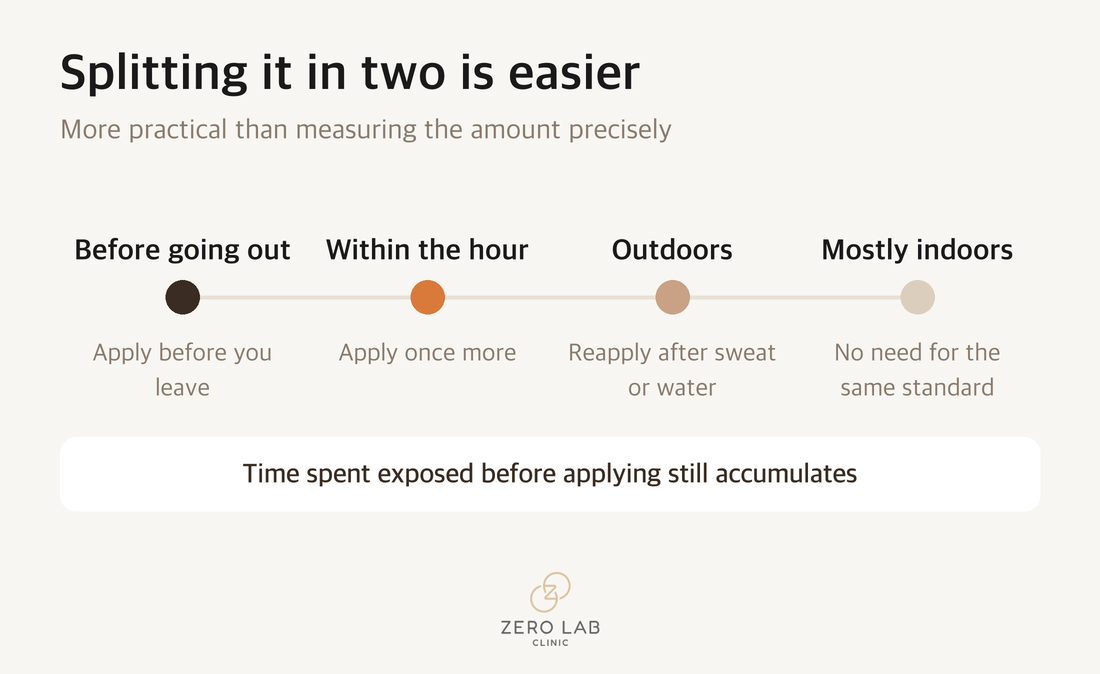
There is one more distinction worth making. SPF indicates the degree of UVB protection, measured against erythema — the reddening and burning of skin. UVA protection, by contrast, is relatively less standardized in how it is measured, so methods such as persistent pigment darkening and critical wavelength are used instead[4]. How to tell whether brown patches that have already appeared are melasma is covered in Not every brown patch is melasma.
UVA penetrates deep into the dermis and is the wavelength range linked to photoaging, so if your concern is elasticity or pigmentation, it is right to check the UVA marking rather than looking only at the SPF number. The same review concludes that broad-spectrum protection covering both UVB and UVA, together with regular application in sufficient amount, is essential for preventing skin cancer and photoaging[4].
So here is what we recommend
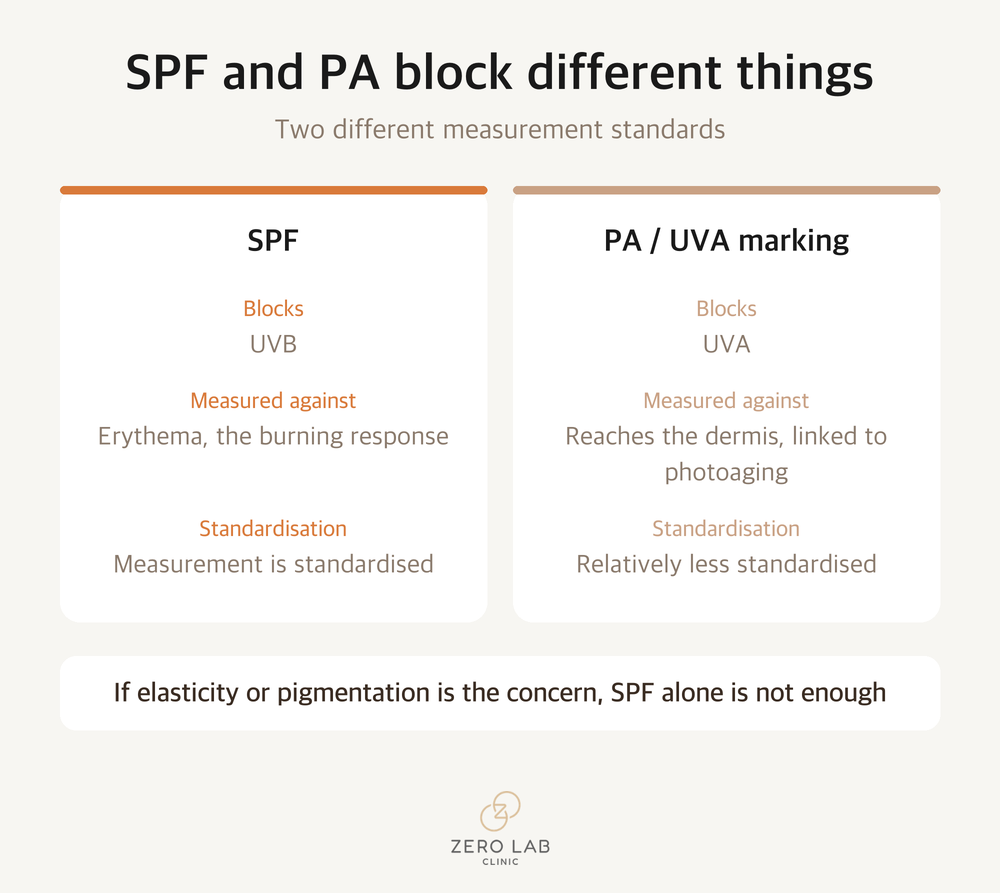
Rather than teaching people to "apply the full recommended amount," the authors of the review cited above propose something far simpler: apply before going out into the sun, and apply once more within the hour[1]. Measuring the amount precisely is not realistic, so splitting it into two applications to make up the total is easier to stick to.
When to reapply has also been calculated. In a study that modelled ultraviolet exposure using realistic application amounts and how well the product stays on the skin, reapplying about 20 minutes after going out in the sun resulted in less ultraviolet exposure than reapplying two hours later(60–85% of it). The authors recommend applying 15 to 30 minutes before going out, then reapplying 15 to 30 minutes after sun exposure begins[6].
The problem is that this advice is not well followed. In a survey of 4,837 adults at ski areas, 73.2% said they applied sunscreen before going out, but only 20.4% said they reapplied, and only 4.4% followed all of the advice[7]. Getting started is far easier than putting on one more layer.
What we add in consultation is this. The areas that get missed in practice are the ones hands reach less easily — in front of the ears, the sides of the neck, around the eyes — and any time already spent exposed before applying sunscreen still accumulates[1]. Nor is there any need to hold a day spent entirely indoors to the same standard as a day with long outdoor activity.
Some people avoid sunscreen out of concern about vitamin D, and this is documented somewhat differently. Vitamin D synthesis is inhibited when sunscreen is applied at the recommended 2 mg thickness, but not at the under-1.5 mg thickness that actual users apply[4]. In real-world use, the concern can be set aside.
The question I am asked most is which SPF to use. My answer is always the same: the number matters less than how many times you reapply. Sunscreen is a product whose effect has been confirmed in a trial, and that effect is a value obtained at a fixed amount of product. But few people apply that much. Measuring the amount precisely is not something people keep up, so once before going out and once again soon afteris the realistic answer. This makes more difference than raising the number.
Measuring the amount once gives you a feel for it. The amount needed for the whole face is more than people expect, and once you know that, choosing a number becomes a secondary question.
I have not covered formulations in this article. The difference between chemical (organic) and physical (inorganic) sunscreens, and how the form — stick, spray, cushion — changes how much actually goes on, need their own space, so I will cover them in a separate article. The same goes for what ultraviolet light breaks down in the dermis and the specific pathways of photoaging.
Washing works on the same principle, so cleansing and the skin barrier are covered separately.
Treatments covered in this article
Prices and booking
References
[1] Petersen B, Wulf HC. Application of sunscreen — theory and reality. Photodermatol Photoimmunol Photomed. 2014;30(2-3):96-101. DOI: https://doi.org/10.1111/phpp.12099
[2] Liu W, Wang X, Lai W, et al. Sunburn protection as a function of sunscreen application thickness differs between high and low SPFs. Photodermatol Photoimmunol Photomed. 2012;28(3):120-126. DOI: https://doi.org/10.1111/j.1600-0781.2012.00650.x
[3] Cooray NP, Li E, Konstantinov K, et al. The dynamic behaviour of sunscreens under in-service conditions. J Photochem Photobiol B. 2022;230:112435. DOI: https://doi.org/10.1016/j.jphotobiol.2022.112435
[4] Bens G. Sunscreens. Adv Exp Med Biol. 2014;810:429-463. DOI: https://doi.org/10.1007/978-1-4939-0437-2_25
[5] Hughes MCB, Williams GM, Baker P, Green AC. Sunscreen and prevention of skin aging: a randomized trial. Ann Intern Med. 2013;158(11):781-790. DOI: https://doi.org/10.7326/0003-4819-158-11-201306040-00002
[6] Diffey BL. When should sunscreen be reapplied? J Am Acad Dermatol. 2001;45(6):882-885. DOI: https://doi.org/10.1067/mjd.2001.117385
[7] Buller DB, Andersen PA, Walkosz BJ, et al. Compliance with sunscreen advice in a survey of adults engaged in outdoor winter recreation at high-elevation ski areas. J Am Acad Dermatol. 2012;66(1):63-70. DOI: https://doi.org/10.1016/j.jaad.2010.11.044
The seven papers above are indexed in PubMed. This article provides general medical information; decisions about an individual's condition are made through consultation.
This article was written directly by Zero Lab Clinic to provide medical information. Results of any procedure vary with individual skin condition, and side effects are possible. Please decide on a procedure only after an in-person consultation with a doctor.