

Zero Lab Skin Lecture
Cream, stick, spray or cushion — which sunscreen should you use?
Hello, I am Dr. Dong Won Kim, Medical Director of Zero Lab Clinic, one minute from Hongdae (Hongik Univ.) Station Exit 1.
Sunscreen: reapplying beats the number— in that piece I put the question of formulation off, because it needed a piece of its own. Today is that piece.
I am often asked this during a sunscreen consultation. "Is one without a white cast better, or one with it?" But when it comes to choosing a formulation, this question has little to do with what actually decides the outcome. What matters is how much you apply.
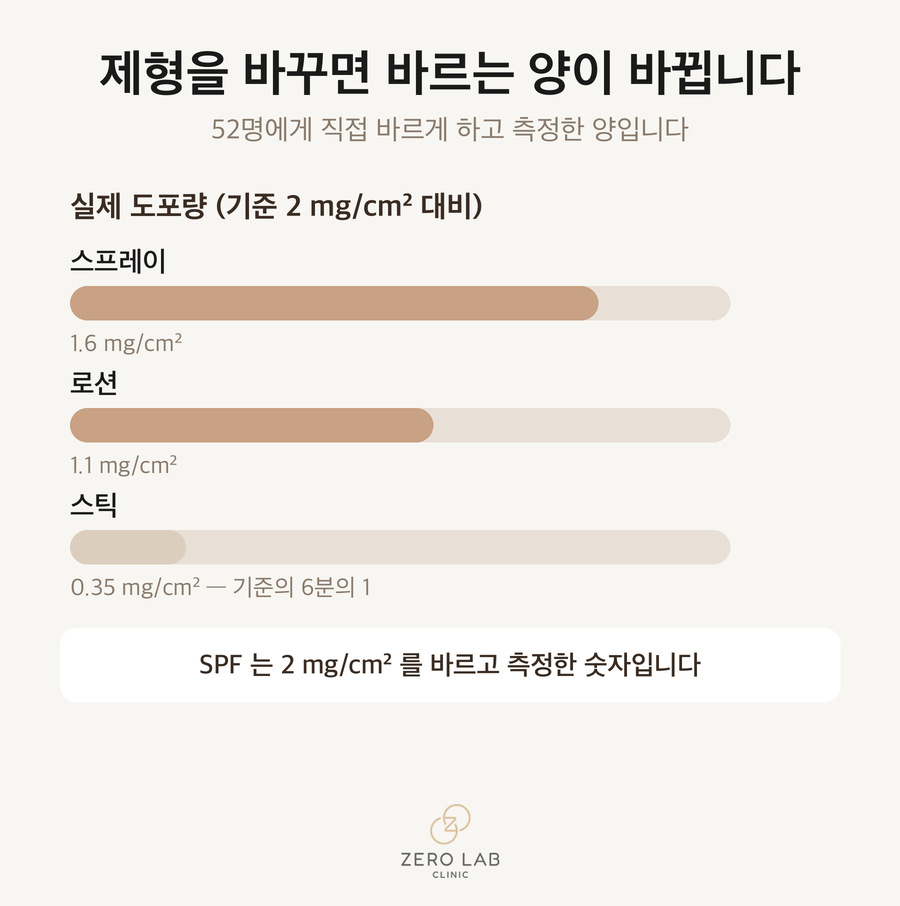
The amount that actually goes on differs by formulation
This is the most important number in this piece.
There is a study in which 52 people applied lotion, spray and stick themselves, and the amount actually delivered was measured[1].
| Formulation | Amount actually applied |
|---|---|
| Spray | 1.6 mg/cm² |
| Lotion | 1.1 mg/cm² |
| Stick | 0.35 mg/cm² |
The amount at which SPF comes out as labelled is 2 mg/cm². The stick is one sixth of that. Even set against the lotion it is one third.
With the same sunscreen, changing the formulation changes not the ingredients but the amount. As I said in the earlier piece, SPF is what is measured after applying the standard amount, so when the amount changes the SPF changes.
Hardly anyone reaches the reference amount to begin with
It is worth seeing alongside this that sticks are not the only problem.
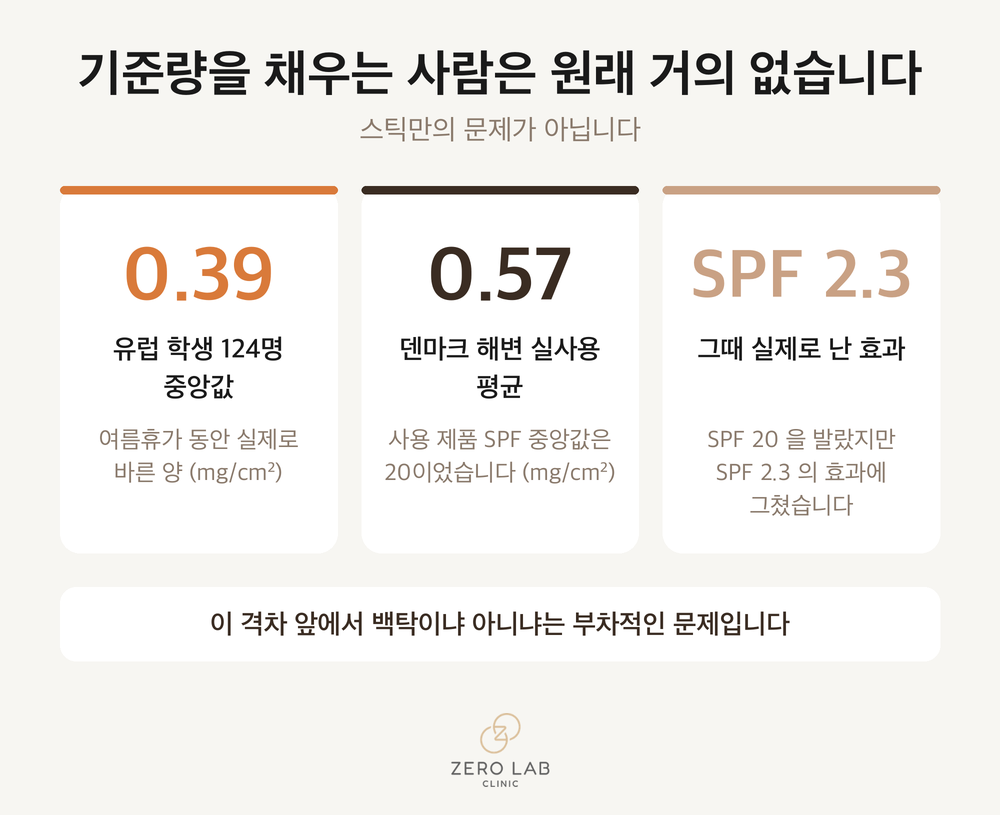
In a randomised controlled trial that measured how much 124 European students used over their summer holiday, the median thickness applied was 0.39 mg/cm². There was no difference by sex, skin type, region or SPF[2].
Data measured on actual users on a Danish beach is more direct. The average was 0.57 mg/cm², and the effective SPF actually working at that point averaged 2.3. The median SPF of the products people were using was 20[3].
It means they had applied an SPF 20 product but got no more than the effect of SPF 2.3.
That is why, when I explain sunscreen, I do not put the white cast forward as the criterion for choosing. I explain it with the amount you apply as the criterion.
With a stick, the spots you miss stay invisible
A stick goes on in a smaller amount, and there is one more problem on top of that. Most of them leave no white cast, so the areas you have covered and the ones you have not are indistinguishable.
Missing spots is itself common, whatever the formulation. In a study that photographed 31 volunteers under black light, 20% of the body surface was left entirely uncovered after one application. A second overlapping layer brought it down to 9%[4].
The same holds on the face. In a study that photographed 84 participants with an ultraviolet camera, the area around the eyelids was missed particularly often, and the participants did not know they had missed it[5].
Neither on the body nor on the face can you check this by eye. With a stick there is no white cast either, so checking is harder still.
That is why we do not recommend a stick sunscreen on its own. A stick suits reapplication. Use it to reinforce the places that sweat off easily, such as the nose, the cheekbones and the ears.
With a spray the issue is inhalation, not the amount
I often hear it said of sprays that "they go on thin," but in the study above they in fact delivered more than the lotion(1.6 vs 1.1)[1]. That said, I could not confirm how the portion that drifted into the air was accounted for in that figure. So I will not tell you that sprays go on in greater amounts.
What really calls for care with sprays lies elsewhere.
In a study that measured the particle size of 78 cosmetic sprays, the proportion of respirable particles under 10 µm splits like this[6].
| Delivery type | Respirable particle fraction |
|---|---|
| Pump | 0.5% on average |
| Gas-propelled | 15.25% on average |
A thirty-fold difference.
It is easy to assume that "the particles are large, so even if you breathe them in they are caught in the nose," but that is not so. The droplets are large right after spraying, yet one study reported that as the propellant evaporates what finally remains is a solid particle on the order of 75 nm in diameter[7]. The US FDA has also proposed particle-size testing and flammability testing as requirements for sunscreen sprays, to reduce unintended inhalation.
So the standard we pass on is this. Use sprays on the body, outdoors, and do not spray them directly onto the face. If you do need to use one on the face, it is better to dispense it into your hand and apply it that way. And rather than using a spray on its own from the start, it belongs as reinforcement, misted over a cream you have already applied.
There is no evidence on cushions — and I will say so plainly
The cushion type (a sponge compact you pat onto the skin) is used a great deal in Korea, but I could not find a paper that measured how much it delivers. I searched from several angles, and there is no study indexed in PubMed.
I cannot write about something that is not there as though it were, so I am setting it down as it is. How much a cushion goes on, and whether the protection factor holds when it is patted over makeup, are things we cannot give you in numbers either.
There are, however, two clues that hint at the direction.
One. In the 84-person study seen earlier, moisturisers containing SPF gave significantly worse coverage than dedicated sunscreens. The unapplied area over the whole face was 11.1% for the dedicated products against 16.6% for the SPF moisturisers, and on the eyelids 14.0% versus 20.9%[5]. A cushion doubles as a cosmetic, so it falls into the same category, but this was not a study that tested cushions themselves.
Two. Puff hygiene is worth pausing on. In a study that cultured cosmetics that were in use, 79~90% were contaminated with bacteria, and it was particularly high in makeup sponges. 93% had never once been cleaned, and 64% were still in use after being dropped on the floor[8]. This too was not a study that examined cushion puffs directly.
To put it together, there is no evidence on which to say "a cushion goes on this much." That said, the 2 mg/cm² reference is a figure set under conditions of spreading a liquid by hand, so it is hard to assume that patting it on fills that reference as it stands. If you use a cushion, do not regard your protection as finished with that alone; it is safer to keep it as a means of reapplying.
How far should all-in-one products be credited?
Let me add one more thing at this point. Many men use an all-in-one product that holds toner, lotion and sunscreen in one bottle. I tend to recommend them too.
The reason is simple. Applying something is better than applying nothing. There are people who stop applying once the steps add up, and for them a product that finishes in one bottle is the product that actually gets applied.
Its limits, though, should be clearly understood in use. That is exactly what the 84-person study above shows — a product that doubles as sunscreen has poorer coverage than a dedicated product[5]. And all-in-one products usually have a lower SPF than dedicated ones as well.
So the standard we set is this. An all-in-one product is meaningful on days you spend mostly indoors. If the exposure amounts to the commute and a seat by the window, this is enough. On the other hand, on days when outdoor activity runs long, an all-in-one on its own falls well short. On such days, apply a dedicated sunscreen separately, and plan as far as reapplying partway through.

Is the one with a white cast better?
Here I think I should give you an honest answer.
We have not confirmed a direct comparison in people showing that, at the same SPF and the same amount, a product with a white cast does better.
What has been confirmed is this. In a study that kept the same UV filter composition and changed only the vehicle across five versions, the formulation significantly governed the SPF. But the variable was not the white cast; it was viscosity and the continuity of the oil phase. When viscosity was low the film laid down thin and the SPF was low, and a continuous oil phase produced the thickest film and the highest SPF. Rubbing for longer reduced film thickness and SPF, and pressing hard brought the SPF down[9].
"Formulation creates the effect" is correct. The reason for it, though, is not the white cast.
Nor does the white cast map one-to-one onto ingredient class. In a study that compared inorganic and organic filters directly, MBBT is an organic filter, yet because it is in particle form it produces a white cast[10]. The division "white cast means inorganic, no white cast means organic" does not actually hold.
The study also looked at how far the two ingredients travel in the skin, and over 90% of both were recovered in the first 15 tape strippings. The remaining 10% did not enter living tissue either, staying in the skin furrows and at the openings of open pores[10]. Inorganic or organic, they are alike in staying on the surface and doing their work— that is what it means.

Staying power is not simple either. It is true that inorganic filters do not break down, but in exchange there is a separate issue: they have photocatalytic activity and so generate reactive oxygen species. Recent studies have been moving toward suppressing this part with coatings. Conversely, what is known to have low photostability is one specific ingredient, avobenzone, not organic filters as a whole.
The standard we pass on in consultation
You can set the order for choosing a formulation like this.
- The base is a cream or a lotion. This is where you decide the mainstay that covers the whole face
- The stick is for reinforcement. Use it to go over places that rub off easily, such as the nose, cheekbones, ears and hairline
- The spray is for the body outdoors, for misting over. Do not spray it directly onto the face
- Keep the cushion as a means of reapplying. Do not regard your protection as finished with that alone
- Whether there is a white cast comes last. With sunscreen, whether your hand reaches for it every day comes before the ingredient list. A product you end up applying every day is better than one you stop applying because the white cast feels like too much

If outdoor activity runs long, you have to reapply
Let me add one last thing. Whichever formulation you choose, one application does not finish it.
A randomised controlled trial that observed 98 children aged 7~12 at the beach is the evidence on this point. At 6 hours of exposure, erythema protection was similar between one application and four. But once it stretched to 8 hours, the single-application group had a higher incidence and severity of erythema than the five-application group[11].
When exposure is short the difference does not show; when it runs long, they diverge.
On when to reapply, there is also a calculation that differs from the commonly repeated "every 2~3 hours." In a model that reflected the actual amount applied and how well the product stays on the skin, reapplying 20 minutes after going out into the sun reduced the ultraviolet received to 60~85% of what you take when reapplying at 2 hours[12]. It is a modelling study, so I am careful about carrying it over as it is, but applying once more right after exposure begins is clearly better in direction than putting it off.
In closing
Many people ask which is better, with a white cast or without. My answer is this.
How much you apply and how often you reapply matters far more than the difference the white cast makes. People who applied SPF 20 at the beach in fact saw no more than the effect of SPF 2.3. In front of that gap, the ingredient class is only a secondary matter.
If the white cast bothers you enough that you put off applying, it is better to apply plenty of a product without one and reapply often. If outdoor activity runs long you have to reapply anyway. A formulation is not something you choose by weighing its effect; it is something you use differently according to the situation.
EVE Skin Analysis — details
Skincare Pass
References
[1] Novick R, Anderson G, Miller E, Allgeier D, Unice K. Factors that influence sunscreen application thickness and potential preservative exposure. Photodermatol Photoimmunol Photomed. 2015;31(4):212-223. DOI: https://doi.org/10.1111/phpp.12171
[2] Autier P, Boniol M, Severi G, Doré JF. Quantity of sunscreen used by European students. Br J Dermatol. 2001;144(2):288-291. DOI: https://doi.org/10.1046/j.1365-2133.2001.04016.x
[3] Heerfordt IM. Sunscreen use at Danish beaches and how to improve coverage. Dan Med J. 2018;65(4):B5476. PMID: 29619938
[4] Heerfordt IM, Torsnes LR, Philipsen PA, Wulf HC. Sunscreen use optimized by two consecutive applications. PLoS One. 2018;13(3):e0193916. DOI: https://doi.org/10.1371/journal.pone.0193916
[5] Lourenco EAJ, Shaw L, Pratt H, et al. Application of SPF moisturisers is inferior to sunscreens in coverage of facial and eyelid regions. PLoS One. 2019;14(4):e0212548. DOI: https://doi.org/10.1371/journal.pone.0212548
[6] Berrada-Gomez MP, Bui B, Bondarenko H, Ferret PJ. Particle size distribution in the evaluation of the inhalation toxicity of cosmetic spray products. Regul Toxicol Pharmacol. 2023;139:105359. DOI: https://doi.org/10.1016/j.yrtph.2023.105359
[7] Chen BT, Afshari A, Stone S, et al. Nanoparticles-containing spray can aerosol: characterization, exposure assessment, and generator design. Inhal Toxicol. 2010;22(13):1072-1082. DOI: https://doi.org/10.3109/08958378.2010.518323
[8] Bashir A, Lambert P. Microbiological study of used cosmetic products: highlighting possible impact on consumer health. J Appl Microbiol. 2020;128(2):598-605. DOI: https://doi.org/10.1111/jam.14479
[9] Sohn M, Hêche A, Herzog B, Imanidis G. Film thickness frequency distribution of different vehicles determines sunscreen efficacy. J Biomed Opt. 2014;19(11):115005. DOI: https://doi.org/10.1117/1.JBO.19.11.115005
[10] Mavon A, Miquel C, Lejeune O, Payre B, Moretto P. In vitro percutaneous absorption and in vivo stratum corneum distribution of an organic and a mineral sunscreen. Skin Pharmacol Physiol. 2006;20(1):10-20. DOI: https://doi.org/10.1159/000096167
[11] Odio MR, Veres DA, Goodman JJ, et al. Comparative efficacy of sunscreen reapplication regimens in children exposed to ambient sunlight. Photodermatol Photoimmunol Photomed. 1994;10(3):118-125. PMID: 7947191
[12] Diffey BL. When should sunscreen be reapplied? J Am Acad Dermatol. 2001;45(6):882-885. DOI: https://doi.org/10.1067/mjd.2001.117385
The 12 papers above are indexed in PubMed. This article provides general medical information; decisions about an individual's condition are made through consultation.
This article was written directly by Zero Lab Clinic to provide medical information. Results of any procedure vary with individual skin condition, and side effects are possible. Please decide on a procedure only after an in-person consultation with a doctor.