
Zero Lab Skin Lecture
Turning red, and staying red
Hello, I am Dr. Dong Won Kim, Medical Director of Zero Lab Clinic, one minute from Hongdae (Hongik Univ.) Station Exit 1.
Facial redness is a difficult condition. I say this at the very start of a consultation.
By patient numbers it is not a large group. But it is a steady one. It does not arrive in waves the way acne or pigment does, yet a few people come every month without fail. And most of them have already been somewhere else before they reach us. Quite a few say it has been going on for years.
The reason it is difficult is plain: turning red is itself normal. Heat turns you red, alcohol turns you red, embarrassment turns you red. The vessels widen, they go back to where they were, and that is the end of it. So the line between what is still normal and what needs treating is blurred.
That is why the first thing I ask in a consultation is not "when did it start" but "is it red right now".
Today I will set out how we tell passing redness from redness that stays, what can and cannot be done about the redness that stays, and why we divide the work between two wavelengths - with the research behind it.
The vessel does not widen. It fails to come back
What happens under the skin when you flush is simple. Small vessels in the dermis widen and blood flow rises. That is why the colour comes up.
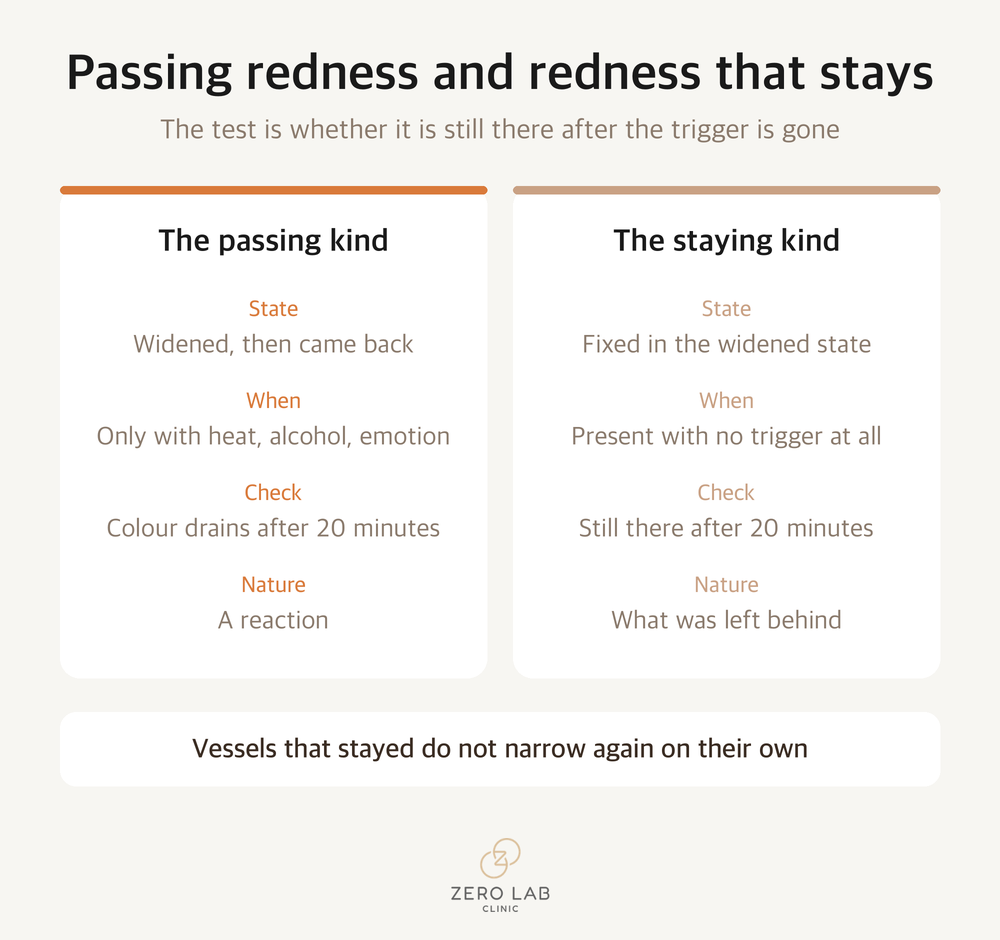
Normally, when the trigger goes the vessels return to their original calibre. But when this happens often and for long enough, the force that brings them back weakens. Some vessels stay fixed in the widened state, and those are what you see as thread veins. Once a vessel has settled that way, it does not narrow again on its own.
A distinction appears here: red only when something provokes it and red even when nothing provokes it are different states. The first is a reaction; the second is what was left behind. It is also a test you can run in front of a mirror. If ten or twenty minutes after washing the colour is still there, you are in the second group.
Most of the people who come to us are this kind
Many people hear redness and think of rosacea first, but the mix we actually meet in the clinic is different.
Most of the people who come to us have vessels that widened and stayed that way. The cheeks and the sides of the nose are permanently flushed, and up close you can see a few thread veins. There are no bumps and no pustules. Less an inflammatory disease than vessels that have settled into place.
Why this distinction matters is that what can be done about it is different. Vessels that stayed behind can be reduced with light. A state driven mainly by inflammation calls for a different approach. So telling them apart comes first.
That is also why rosacea comes up below. Not because it is the field we mainly work in, but because it is what has to be ruled out.
When it is given the name rosacea
When redness lasts and bumps or pustules come up with it, we think of rosacea. It is a chronic inflammatory disease of the central face, and reported prevalence worldwide ranges from 1% to 20% depending on the report[1].
It is usually pictured as a story about blood vessels, but it is in fact far wider than that.
And there is one more thing. Rosacea does not arrive in a single form. In some people redness and thread veins dominate; in others, bumpy papules and pustules do. There is also a form in which the nose thickens. The same diagnosis looks this different from the outside, so it is easy to think "this isn't rosacea" and let it pass. It is not rare to meet someone who has been treating it as acne for years.
A review of signalling in rosacea describes the disease as a tangle of genetic, environmental, immune, microbial and neurovascular factors. Toll-like receptor 2, the antimicrobial peptide LL37, mTOR, interleukin-17 and transient receptor potential (TRP) channels are involved, and these wake macrophages, neutrophils, mast cells and vascular endothelial cells and make them pour out inflammatory mediators[1].
Another review puts the skin barrier in front of all that. It divides the pathophysiology of rosacea into three - abnormality of the barrier and its permeability, innate and adaptive immunity, and the neurovascular system - and names the cathelicidin pathway, TRP channels, mast cells and the NLRP3 inflammasome as the targets current treatment aims at[2].
The language has turned difficult, but the point is single. The widened vessel is the result, and immunity, nerves and the barrier are tangled up on top of it. Erasing the vessels alone leaves the cause behind. It is the same structure as what I said about melasma when writing about pigment.
The barrier has given way first
This can be seen in numbers.
There is a study from China that gathered 60 rosacea patients, 20 patients with seborrhoeic dermatitis and 40 normal controls and ran irritation tests - a lactic acid sting test and a capsaicin test. In the rosacea patients both tests were positive significantly more often. And even at baseline, before any test, transepidermal water loss and the erythema index were higher than in the controls[5].
What deserves more attention is the correlation. The higher the irritation test score, the higher the transepidermal water loss[5]. It means that how far the barrier is leaking and how sensitive the skin is to irritation move together.
So when I look at redness in the clinic, I start by asking about cosmetics. How often you exfoliate, how many steps your cleansing takes, what temperature the water is. When the barrier has thinned, the products you have always used become irritants. Cleansing and the barrier are set out separately in Are You Washing Your Face Right?
What pulls the trigger
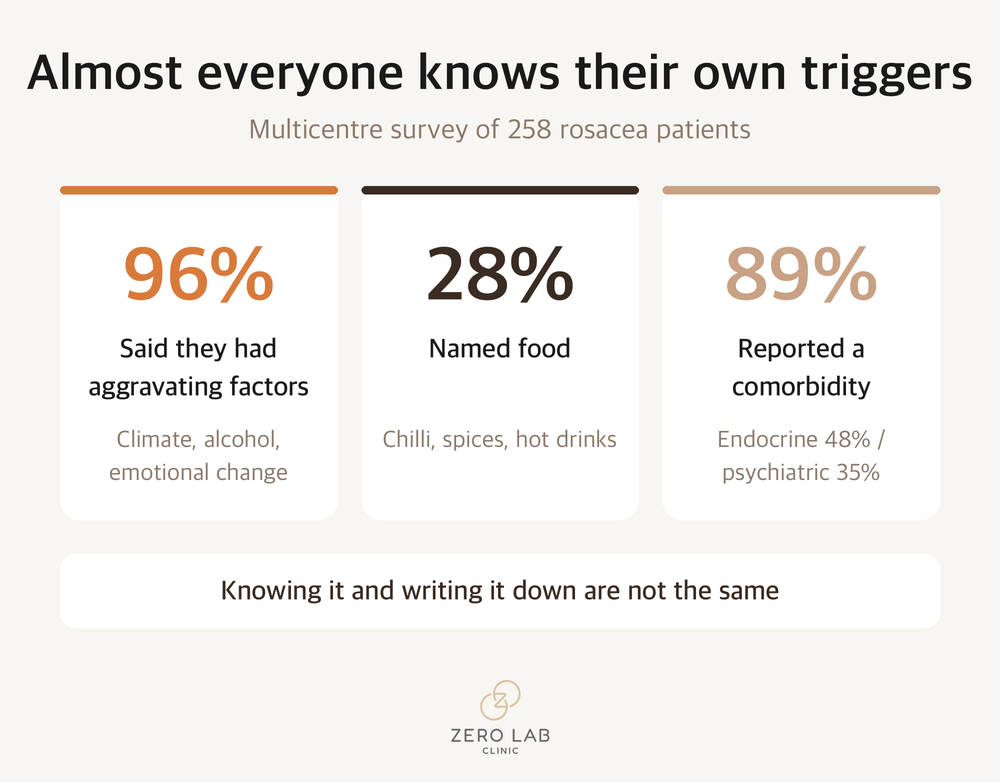
There is a multicentre study from Brazil that gathered 258 rosacea patients and surveyed aggravating factors. The results are fairly clear.
96% said they had aggravating factors. The commonest were climate exposure, alcohol and emotional change. 28% named food, and among those chilli, spices and hot drinks were frequent. 89% also reported a comorbidity - endocrine 48%, psychiatric 35%, cardiovascular 31%, gastrointestinal 28%[4].
What I want to stress here is not the ranking but the figure 96%. Almost everyone knows their own triggers. Yet when I ask in consultation, few have written them down. They are in memory, not on record.
To add the ones we see often in Korea: saunas and jjimjilbang, hot soup, the seat in front of the heater, and the gap between summer air conditioning and winter outdoors. Ultraviolet light goes without saying.
One thing I would not want misunderstood. Avoiding every trigger is not the goal. That is a way of shrinking your life. Knowing which triggers are yours, and starting with the ones you can change, is the realistic path.
Some redness was made by a steroid
Let me touch on this briefly. It is a route we see now and then in the clinic.
When a topical steroid is used on the face for a long time because of itching or a rash, redness and papules appear that are hard to tell from rosacea. It is called rosacea-like dermatitis. In a Japanese study analysing 44 cases of rosacea-like dermatitis, 22 cases were due to a topical steroid, 8 to an ointment of the calcineurin inhibitor class, and 8 to using the two in sequence[6].
The problem with this state is that stopping makes it worse. The redness comes up, so it goes back on; applying settles it; stopping brings it up harder. Once you are inside that loop it is hard to get out alone.
This is not the field we mainly work in. We do prescribe topical treatment when it is needed, but most of the redness that comes to us is the vascular kind I described above. Still, if it is not sorted out, the procedure goes to the wrong place. So when someone comes with redness I always ask "what have you been putting on your face". Prescribed or not, people are using a leftover ointment more often than you would expect. Bringing it with you is quickest. There is no need to strain to remember the name.
Why we divide the work between two wavelengths
First, something to be clear about. Rosacea is not a disease that is cured. A review dealing with immune dysregulation and neuroinflammation also writes that several treatments exist but there is no cure, and sets out trigger management as one axis of treatment[3].
That said, the redness and thread veins that remain can be reduced with light. On this side the evidence has piled up reasonably well.
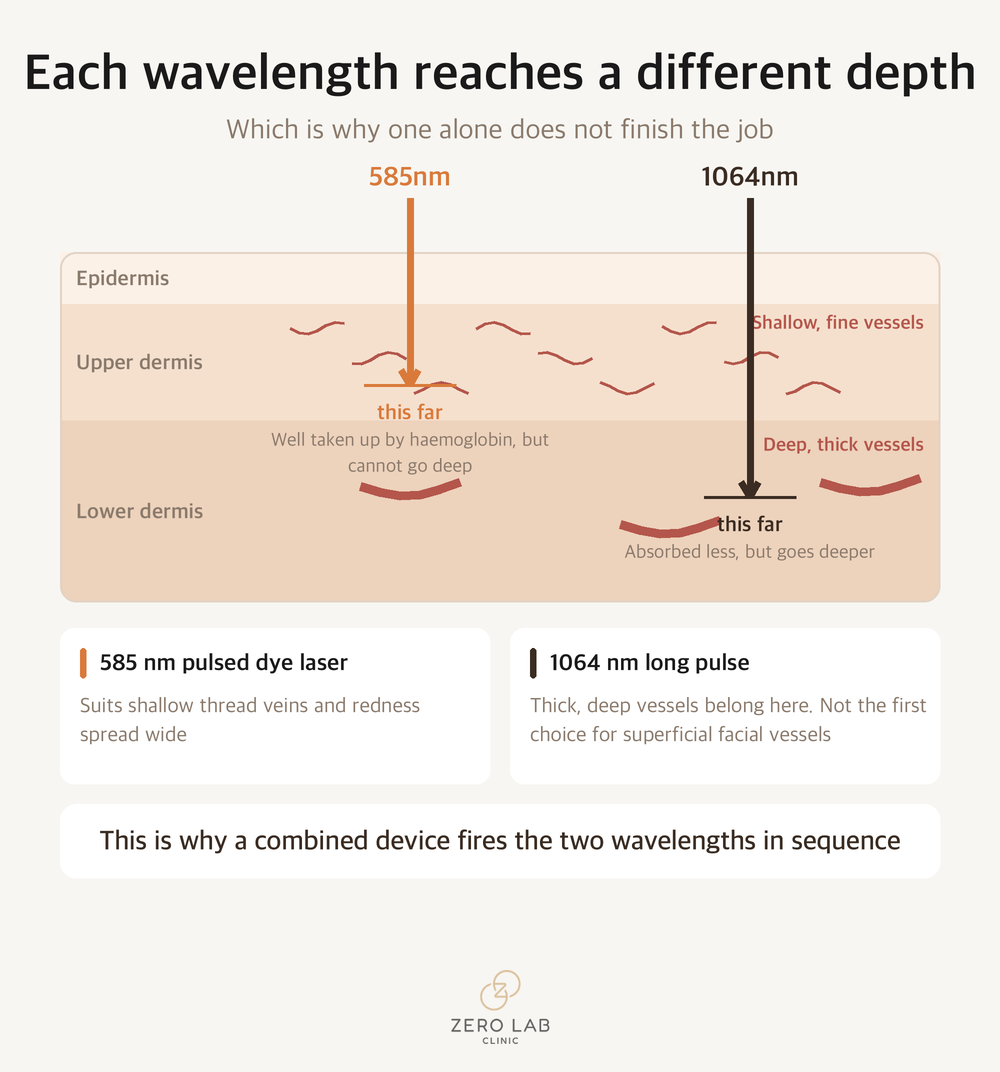
We use two wavelengths: the 585 nm pulsed dye laser (PDL) and the 1064 nm long pulse. One alone does not cover everything, so we divide the work.
The short wavelength is well taken up by haemoglobin but cannot go deep. It suits shallow thread veins and redness spread over a wide area. The long wavelength is the opposite. It is absorbed less but goes deeper. Thick, deep vessels belong here.
In numbers it looks like this. In a retrospective study in which the long-pulsed 1064 nm was used on 255 people, 125 of the 130 with facial thread veins (97%) clearly improved or cleared. But the conclusion of the same paper carries a caveat: for superficial facial vessels, where depth is not the problem, it is not the first choice[10]. It means that although it works well, it is not what you reach for first - and that is exactly why we divide the work between wavelengths.
There is Korean data too. Among 116 people with photoaged skin, in the 43 who received the long-pulsed Nd:YAG, the proportion reporting improvement in redness was 50%, with elasticity 36% and pigment 45%[11].
And there is a way of combining the two wavelengths in one device and firing them in sequence. The Cynergy MPX we use is of that class. In a study in which 15 people were treated five times at one-month intervals with this combined device, the items that improved most clearly were thread veins and diffuse erythema, followed by pigment and blemishes. It was maintained at three-month follow-up[12].
There is also a randomised study that compared the pulsed dye laser and IPL on the left and right sides of the face; after three sessions erythema, thread veins and the symptoms patients felt all fell significantly on both sides, and there was no difference between the two[7]. It says the name on the device does not decide the result.
Going harder is not the answer
A recent study on intensity shows this part well.
80 people were randomised to compare pulse durations of 6 and 10 milliseconds with the pulsed dye laser. Improvement in erythema was the same on both sides. But oedema and purpura were more frequent with 6 milliseconds[8]. It means the shorter, harder route did not work any better and only added bruising.
I said the same thing about pores and about melasma. What decides the result is not the device but at what intensity and over how many sessions you go.
But there is an order
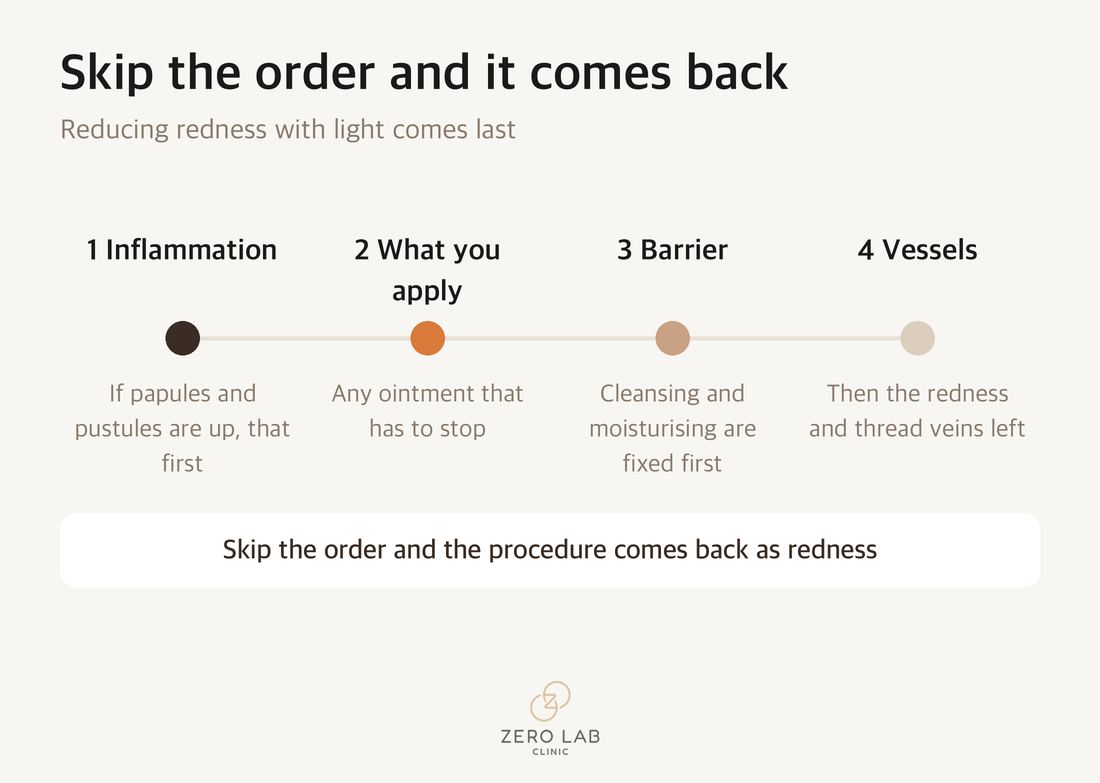
Reducing redness with light comes after the inflammation has settled. Aiming at vessels alone while papules and pustules are up only adds irritation. The same goes for a state in which the barrier is leaking.
So the order we work in is this.
1. Whether inflammation is up right now - if it is, that is settled first
2. Whether there is something among what you are applying that has to stop
3. How far the barrier is leaking - cleansing and moisturising are fixed first
4. Then we look at the redness and thread veins that are left
Skip the order and the irritation the procedure gives comes straight back as redness.
Sun protection has no exceptions
In a study comparing 120 rosacea patients with 120 controls, the rosacea patients scored significantly higher on sun protection behaviour and had a stronger intention to keep it up[9]. It means many are already doing it.
For people with redness, products based on mineral ingredients such as zinc oxide or titanium dioxide are often less irritating. That said, it varies by product, and the one that does not sting when you apply it is the one that suits you. The amount to apply and how often to reapply are set out in Sunscreen: reapplying beats the number.
What we check at the consultation
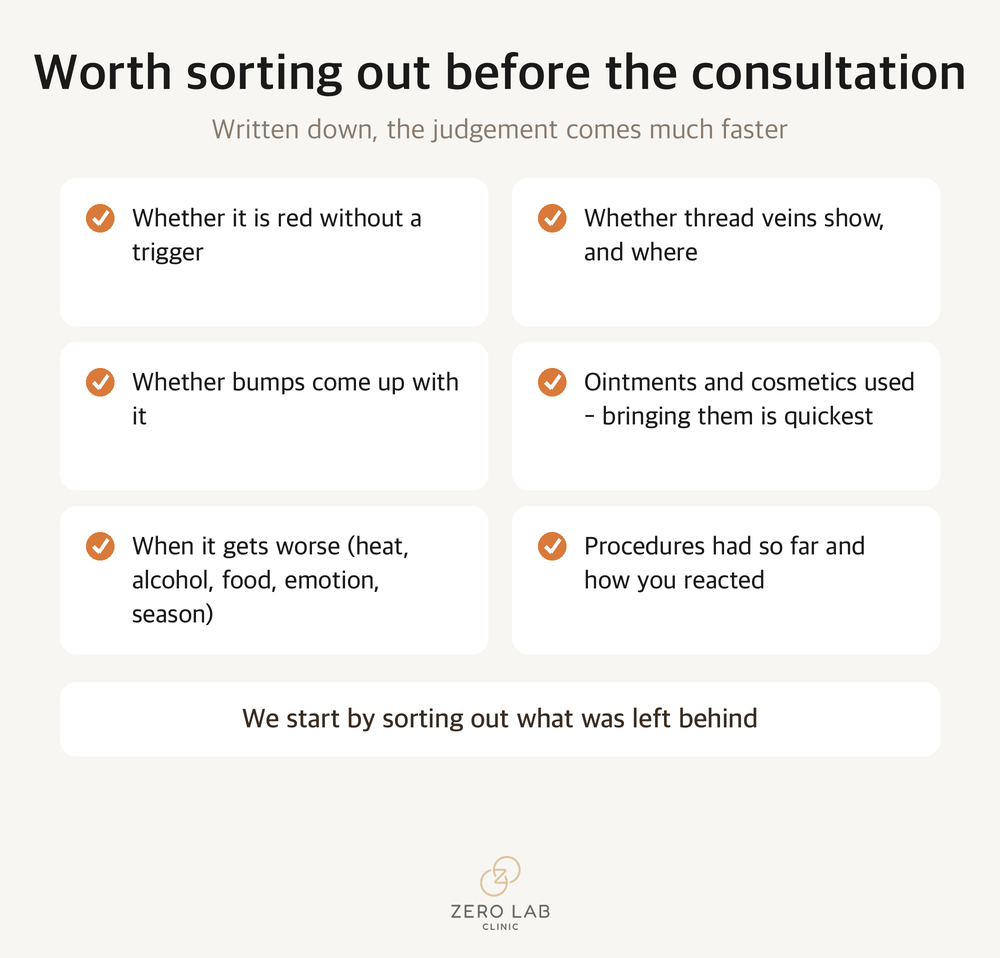
When someone comes with redness, these are what I ask first. Sorting them out in advance makes the consultation far quicker.
1) Whether it is red even without a trigger, or only when there is one
2) Whether thread veins are visible, and if so where
3) Whether bumps or pustules come up with it
4) The ointments and cosmetics you have been applying to your face - bringing them with you is quickest
5) When it gets worse (heat, alcohol, food, emotion, season)
6) The procedures you have had so far and how you reacted at the time
As I said at the start, people who come with redness have often already been somewhere else. If there is a record of what was done, at what intervals, and how it went, we can avoid repeating the same thing.
The question I am asked most is whether the redness can be removed. I always answer in two parts. Vessels that stayed widened can be reduced. The tendency to flush easily is something we manage. Expect the two mixed together and you will be disappointed; look at them separately and what can be done becomes clear.
Pigment and the barrier overlap with redness often, so each has been dealt with separately.
Treatments covered in this article
Prices and booking
References
[1] Yang F, Wang L, Song D, et al. Signaling pathways and targeted therapy for rosacea. Front Immunol. 2024;15:1367994. DOI: https://doi.org/10.3389/fimmu.2024.1367994
[2] Fisher GW, Travers JB, Rohan CA. Rosacea pathogenesis and therapeutics: current treatments and a look at future targets. Front Med (Lausanne). 2023;10:1292722. DOI: https://doi.org/10.3389/fmed.2023.1292722
[3] Tu KY, Jung CJ, Shih YH, Chang ALS. Therapeutic strategies focusing on immune dysregulation and neuroinflammation in rosacea. Front Immunol. 2024;15:1403798. DOI: https://doi.org/10.3389/fimmu.2024.1403798
[4] Bonamigo RR, Barea P, Peruzzo J, et al. Clinical-demographic profile, aggravating factors, comorbidities, and quality of life in patients with Rosacea: a Brazilian multicenter study. An Bras Dermatol. 2025;100(5):501160. DOI: https://doi.org/10.1016/j.abd.2025.501160
[5] Hu M, Tu Y, Man MQ, et al. Rosacea and seborrheic dermatitis differentially respond to lactic acid sting and capsaicin tests in Chinese women. J Cosmet Dermatol. 2023;22(12):3505-3510. DOI: https://doi.org/10.1111/jocd.15878
[6] Teraki Y, Hitomi K, Sato Y, Izaki S. Tacrolimus-induced rosacea-like dermatitis: a clinical analysis of 16 cases associated with tacrolimus ointment application. Dermatology. 2012;224(4):309-14. DOI: https://doi.org/10.1159/000338693
[7] Neuhaus IM, Zane LT, Tope WD. Comparative efficacy of nonpurpuragenic pulsed dye laser and intense pulsed light for erythematotelangiectatic rosacea. Dermatol Surg. 2009;35(6):920-8. DOI: https://doi.org/10.1111/j.1524-4725.2009.01156.x
[8] Liu T, Liu Y, Meng X, et al. Beyond efficacy: pulse duration is crucial for adverse events in pulsed dye laser therapy for rosacea. J Dermatolog Treat. 2026;37(1):2665064. DOI: https://doi.org/10.1080/09546634.2026.2665064
[9] Akin G, Akarsu S, Avcı C. How Does Illness Perception Affect the Quality of Life and Sun Protection Behaviors of Rosacea Patients? Photodermatol Photoimmunol Photomed. 2024;40(5):e12998. DOI: https://doi.org/10.1111/phpp.12998
[10] Ozyurt K, Colgecen E, Baykan H, Ozturk P, Ozkose M. Treatment of superficial cutaneous vascular lesions: experience with the long-pulsed 1064 nm Nd:YAG laser. ScientificWorldJournal. 2012;2012:197139. DOI: https://doi.org/10.1100/2012/197139
[11] Lee YB, Shin JY, Cheon MS, Oh ST, Cho BK, Park HJ. Photorejuvenation using long-pulsed alexandrite and long-pulsed neodymium:yttrium-aluminum-garnet lasers: a pilot study of clinical outcome and patients' satisfaction in Koreans. J Dermatol. 2012;39(5):425-9. DOI: https://doi.org/10.1111/j.1346-8138.2011.01465.x
[12] Berlin AL, Hussain M, Goldberg DJ. Cutaneous photoaging treated with a combined 595/1064 nm laser. J Cosmet Laser Ther. 2007;9(4):214-7. DOI: https://doi.org/10.1080/14764170701632893
The 12 papers above are indexed in PubMed. This article is general medical information; decisions about an individual's condition are made through consultation.
This article was written directly by Zero Lab Clinic to provide medical information. Results of any procedure vary with individual skin condition, and side effects are possible. Please decide on a procedure only after an in-person consultation with a doctor.