

Zero Lab Skin Lecture
Are You Washing Your Face Right?
Hello, I am Dr. Dong Won Kim, Medical Director of Zero Lab Clinic, one minute from Hongdae (Hongik Univ.) Station Exit 1.
I did not expect to end up writing this much about washing your face. But cleansing is the question I get asked most often in the consultation room. People tell me it is just a matter of working up a lather with a foaming cleanser and rubbing it in, and yet I often see patients whose breakouts drop noticeably once they change nothing but the way they wash. On the other hand, there are many people who have this part wrong and are breaking down their own skin barrier. Today I will go through how to wash properly, from the underlying principle to the practical steps, together with the research behind it. If your skin still feels tight underneath even after washing, it is worth also reading Oily but tight — that is dehydrated skin alongside this one.

How your cleansing routine affects the skin barrier
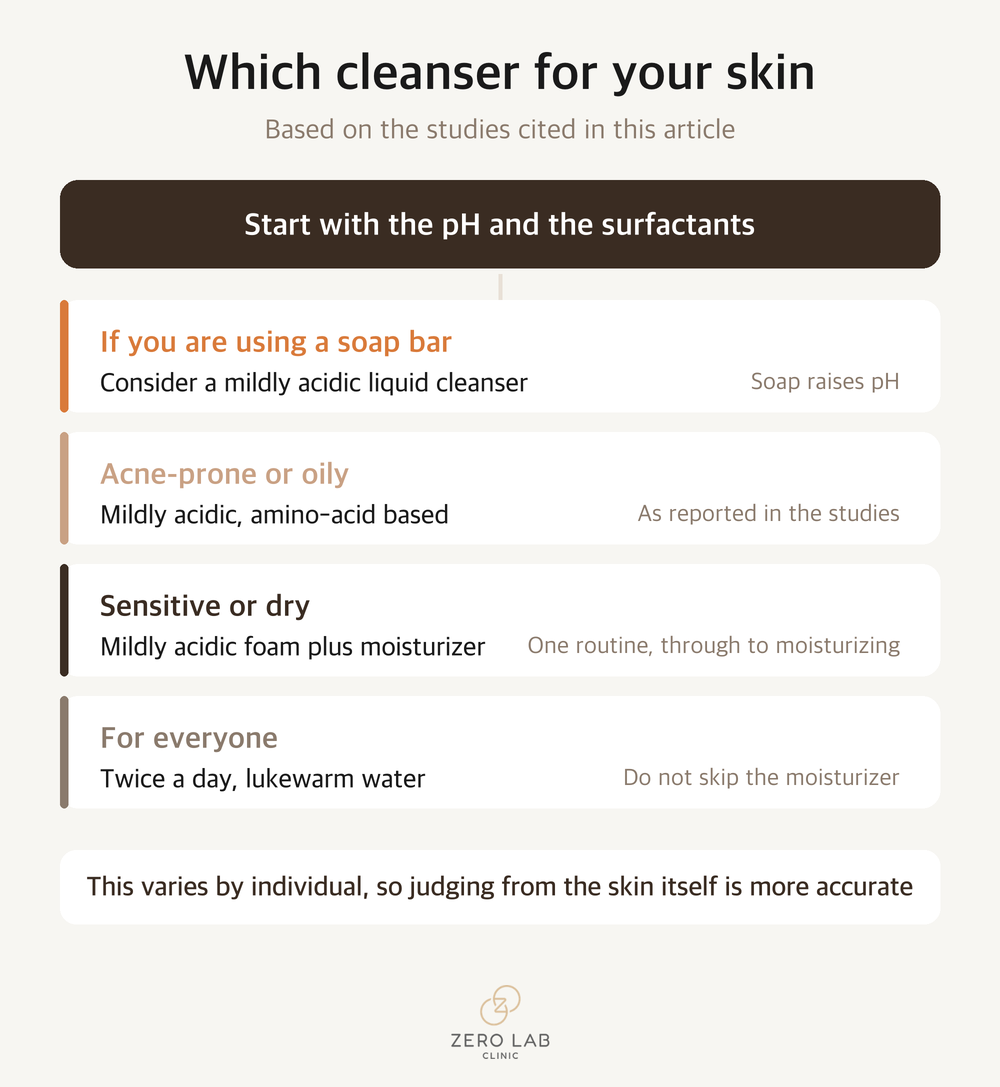
Washing your face is not simply a process of rinsing off dirt. The surfactants in a cleanser act directly on the sebum film and the moisture barrier at the skin surface. There is research showing that soap raises skin pH sharply toward alkaline and damages the barrier the most, while mildly acidic liquid cleansers cause far less pH change and far less barrier damage[1]. That is why, when we explain how to wash, we ask you to start by checking the pH of the cleanser itself and what kind of surfactant it uses.
How many times a day, and how should you wash?
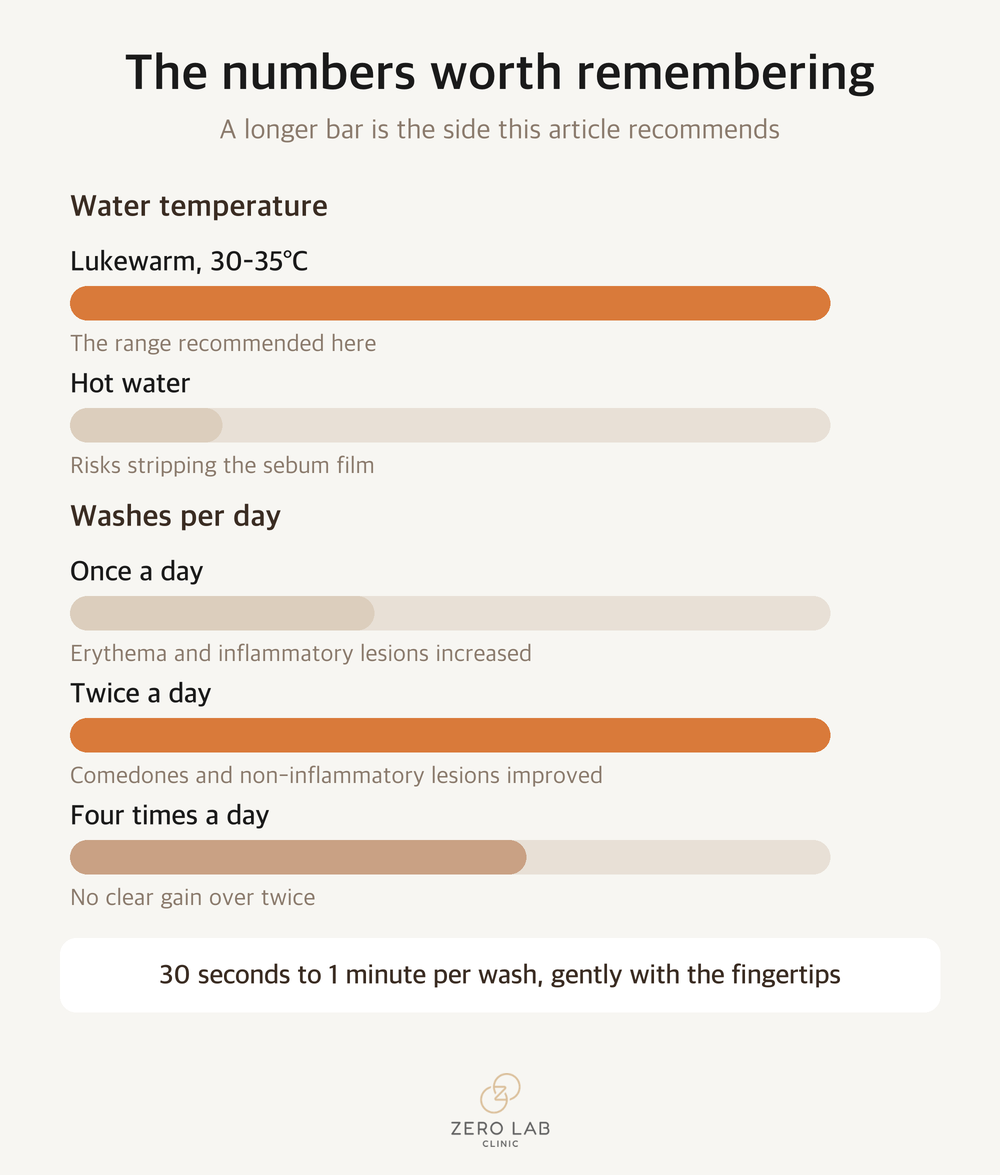
How often to wash is another point people frequently get confused about. In a randomized controlled trial in adult men with acne, the group that washed twice a day with a mild cleanser showed significant improvement in comedones and non-inflammatory lesions, while the group that washed only once a day actually saw an increase in erythema and inflammatory lesions[2]. Going up to four times a day brought no clear additional improvement over twice. This is the evidence behind the basic rule we give in consultations: “twice a day, with a mild cleanser.” It means that washing more is not the answer.
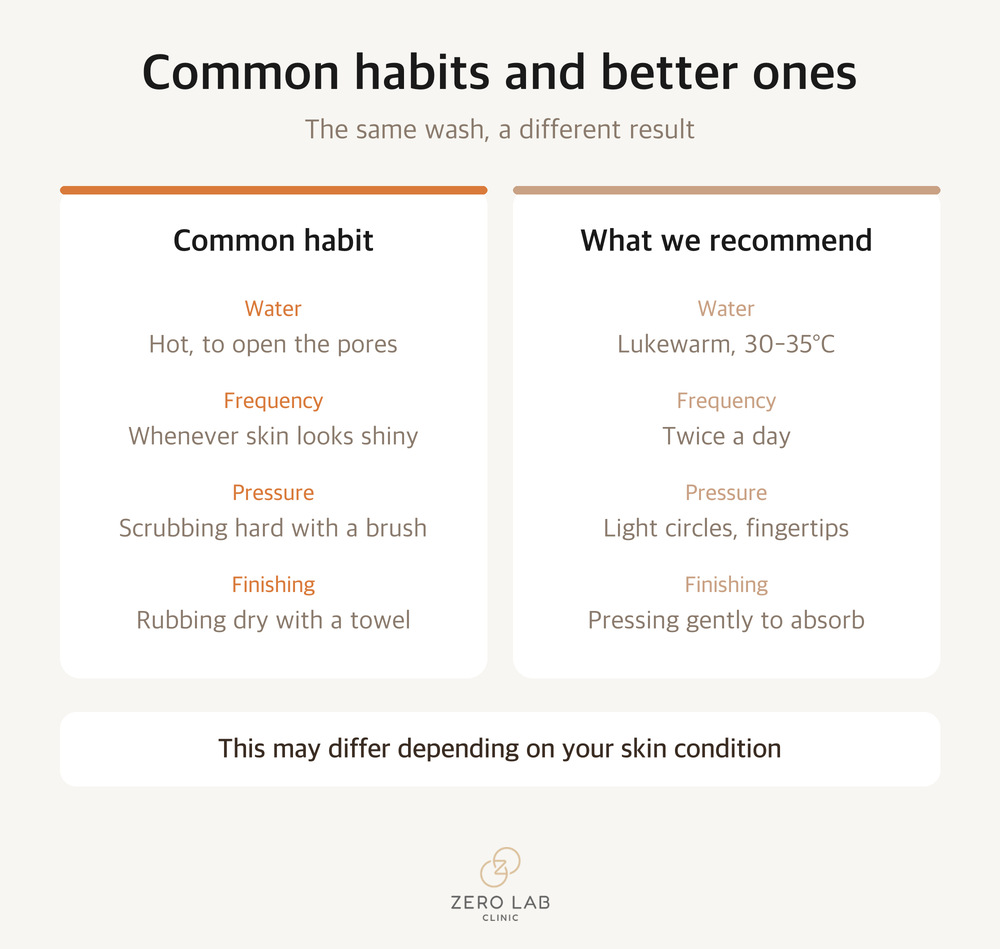
| Category | Common habit | What we recommend |
|---|---|---|
| Water temperature | Open the pores with hot water | Wash with lukewarm water (30–35°C) |
| Washing frequency | Every time the skin looks shiny | Twice a day, morning and evening |
| How hard you rub | Rub hard with the hands or a cleansing brush | Gently, with the fingertips, in small circles |
| Finishing up | Rub the face dry with a towel | Press a towel gently to blot the water |
The five cleansing steps we recommend at Zero Lab Clinic
- Wet the whole face lightly with lukewarm water. Hot water strips too much of the sebum film and can leave the skin drier instead
- Take only about a 500-won coin's worth of cleanser and work up the lather in your palms first
- Massage gently with your fingertips in small circles — forehead, nose, cheeks, then chin — for only 30 seconds to a minute
- Rinse thoroughly with lukewarm water so that no cleanser is left along the hairline and jawline
- Blot the water off by pressing and patting with a towel, not by rubbing
The cleanser should be chosen differently for each skin type
For acne-prone and oily skin, a recent study found that a mildly acidic amino acid cleanser containing both salicylic acid and ceramides improved sebum, facial redness and pore texture while the barrier measures improved along with them[3], and in sensitive, dry adult acne skin there are also results showing that a routine combining a mildly acidic foaming cleanser with a moisturizer raised ceramide levels in the stratum corneum while improving acne[4]. Rather than changing the cleanser alone, it makes more sense to treat the whole routine — through to moisturizing after washing — as part of how you cleanse.
These habits are how people break down their own skin barrier
- The habit of double cleansing with a cleansing oil and a foaming cleanser every single time
- The habit of using an exfoliating scrub every day
- The habit of leaving the skin as it is after washing, with no real moisturizing
- The habit of washing several times a day because breakouts are on your mind
I am asked several times a day which cleanser is the better one. My answer is always the same. How you wash comes before the product. Cleansing looks like a small thing, but it is a habit that accumulates twice a day, so its effect on skin condition is larger than people expect. That said, the same routine does not suit every skin. Put the product you are using now, how often you wash, and your water temperature side by side, and where things went off usually becomes clear. When you cannot judge it on your own, you are welcome to bring in the products you have been using.
Care after the barrier has already broken down is covered separately in the articles on scars and lifting.
Treatments covered in this article
Prices and booking
References
[1] Kuehl BL, Fyfe KS, Shear NH. Cutaneous cleansers. Skin Therapy Lett. 2003;8(3):1-4. PMID: 12858234. https://pubmed.ncbi.nlm.nih.gov/12858234/
[2] Choi JM, Lew VK, Kimball AB. A single-blinded, randomized, controlled clinical trial evaluating the effect of face washing on acne vulgaris. Pediatr Dermatol. 2006;23(5):421-7. DOI: https://doi.org/10.1111/j.1525-1470.2006.00276.x
[3] Ai Levin Y, Lyu Y, He X. Improvement of overall skin condition in acne and oily prone skin with an amino acid cleanser containing salicylic acid, glucuronolactone, and ceramides. J Cosmet Dermatol. 2026;25(3):e70759. DOI: https://doi.org/10.1111/jocd.70759
[4] Isoda K, Seki T, Inoue Y, et al. Efficacy of the combined use of a facial cleanser and moisturizers for the care of mild acne patients with sensitive skin. J Dermatol. 2014;42(2):181-8. DOI: https://doi.org/10.1111/1346-8138.12720
The 4 papers above are indexed in PubMed (PMC).
Some of the images in this article were generated with AI.
This article was written directly by Zero Lab Clinic to provide medical information. Results of any procedure vary with individual skin condition, and side effects are possible. Please decide on a procedure only after an in-person consultation with a doctor.