

Zero Lab Skin Lecture
Oily but tight — that is dehydrated skin
Hello, I am Dr. Dong Won Kim, Medical Director of Zero Lab Clinic, one minute from Hongdae (Hongik Univ.) Station Exit 1.
"Dehydrated skin" — I hear this phrase several times a day in consultations. Yet the state people mean by it differs from one person to the next.
One person means the tightness after washing, another the flaking on skin that is shiny, another makeup lifting, another a stinging, touchy feeling underneath. The same word, pointing at different places.
That is because the word has no definition to begin with. Dehydrated skin is not a medical diagnosis. And yet there must be a reason it is used this widely. I take it to be a word people made because they were going through something real and had no name for it.
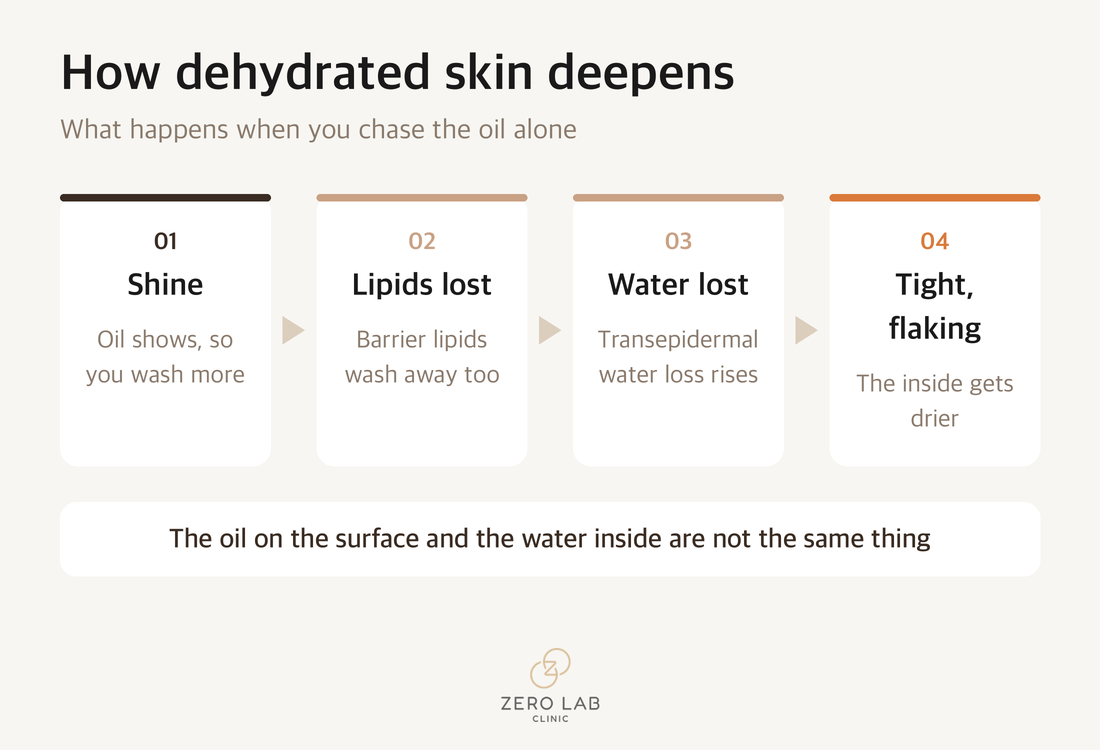
The form I hear most often is this one. "I have oily skin, but it feels tight underneath." The forehead and nose shine by lunchtime, yet after washing the skin feels stiff and makeup lifts. Products that control oil make it tighter; more moisturizer makes it shinier. It sounds like a contradiction, but measure it and it is not.
Today I want to follow this word all the way down to what it actually points at. Once you separate out the measures we take on skin, it becomes surprisingly clear. In many cases water is already being taken away at the washing stage, and I have written about that side separately in Are You Washing Your Face Right?.
Dehydrated skin is not a diagnosis
I said the word has no definition, but even so, the state it points to becomes clear once you measure it.
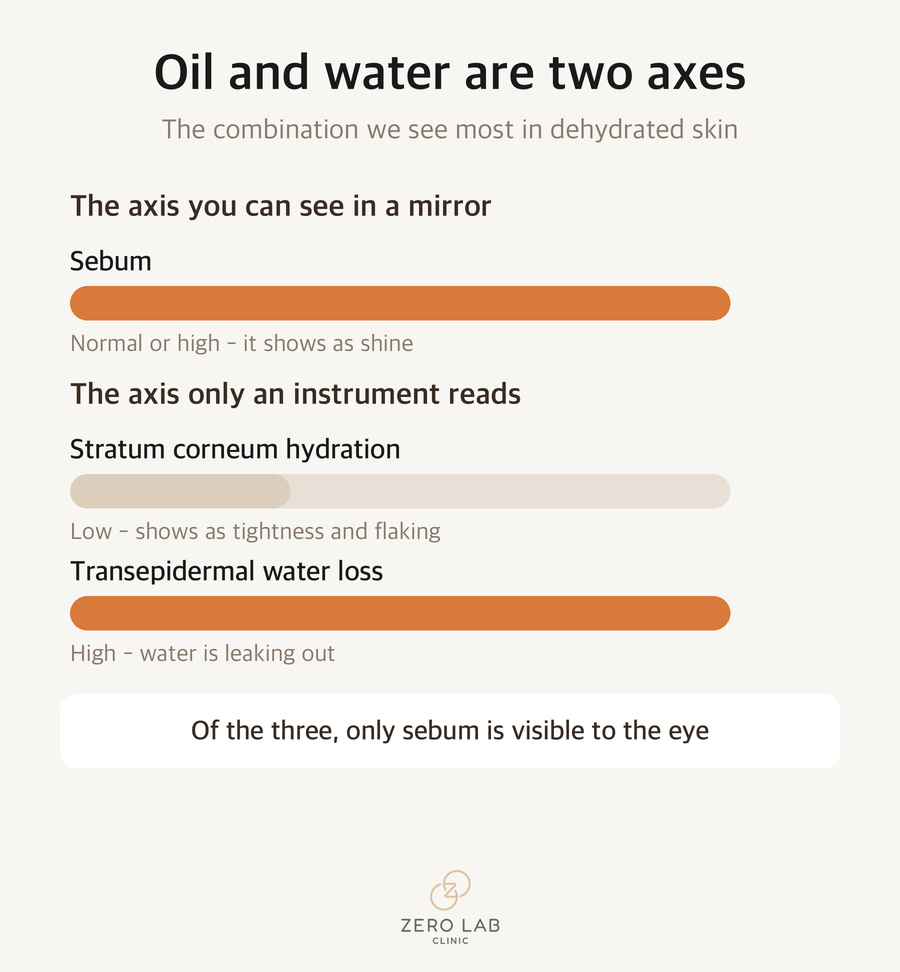
There are three main measures we take on skin.
| Measure | What it measures | Typical value in dehydrated skin |
|---|---|---|
| Sebum | The amount of oil on the skin surface | Normal or high |
| Stratum corneum hydration | The amount of water the stratum corneum holds | Low |
| Transepidermal water loss (TEWL) | The amount of water escaping out of the skin | High |
In other words, oil is coming out, water is short, and what there is keeps leaking. Look only at the surface and it reads as oily skin; the person feels tightness. Both are true.
There is one thing to note here. Of the three measures, the only one you can check in a mirror is sebum. Shine is visible and it comes off on your fingers. Stratum corneum hydration and transepidermal water loss, on the other hand, take an instrument to read, and on the outside they show only as indirect signs — tightness, flaking, makeup lifting.
So the judgement "I have oily skin" is easily made from the one axis you can see. The care follows that one axis too. I think this is where the wide use of the phrase comes from. It means you are feeling, in your own body, that the other two axes are there and moving on their own.
Oil and water really do move separately
Let me show with numbers that this is not wordplay.
There is a study in Shaanxi Province, China, that measured 14 facial skin parameters in 481 people. The comparison by sex is interesting. Men had more sebum than women, yet their stratum corneum hydration was lower and their transepidermal water loss was higher[1]. You would think the oilier side would also hold more water, but it did not.
A study that followed the seasons points the same way. In a study measuring the cheeks of 72 women across the four seasons, stratum corneum hydration and sebum were highest in summer and lowest in winter, while transepidermal water loss was the opposite, highest in winter[2]. And in the same study, transepidermal water loss showed no correlation with pigment or erythema measures in any season. Each measure goes its own way.
It splits by area too. In a Japanese study looking at before and after long-term mask wearing, in summer the cheek was higher than the perioral area in both hydration and sebum, while in winter transepidermal water loss on the cheek rose and that value correlated positively with the degree of scaling[3].
To put it together, even within a single face it differs by area and by season. Set a care policy on the single sentence "I have oily skin" and there will be stretches where it goes wrong.
Getting worse in winter is not your imagination
Many people tell me it gets worse every winter, and the indoor environment takes effect faster than you would expect.
There is a randomized study in Korea that measured facial and arm parameters after 6 hours of exposure to a heated indoor space in winter. In 6 hours, skin temperature, pore, roughness, redness and wrinkle values all rose significantly, and on the arm transepidermal water loss increased significantly. In the same study, the side that applied a ceramide cream did better than the side that did not, in elasticity, pores, texture and wrinkles[4].
What is interesting is that on the face, transepidermal water loss did not jump as much as on the arm. The authors read this as sebum secretion acting as a kind of defence on the face. It is part of why the face looks less dry than the arm, and at the same time why dehydrated skin is noticed late on the face.
"It feels hydrated" and "the barrier has recovered" are different
This is the part I most want to convey today.
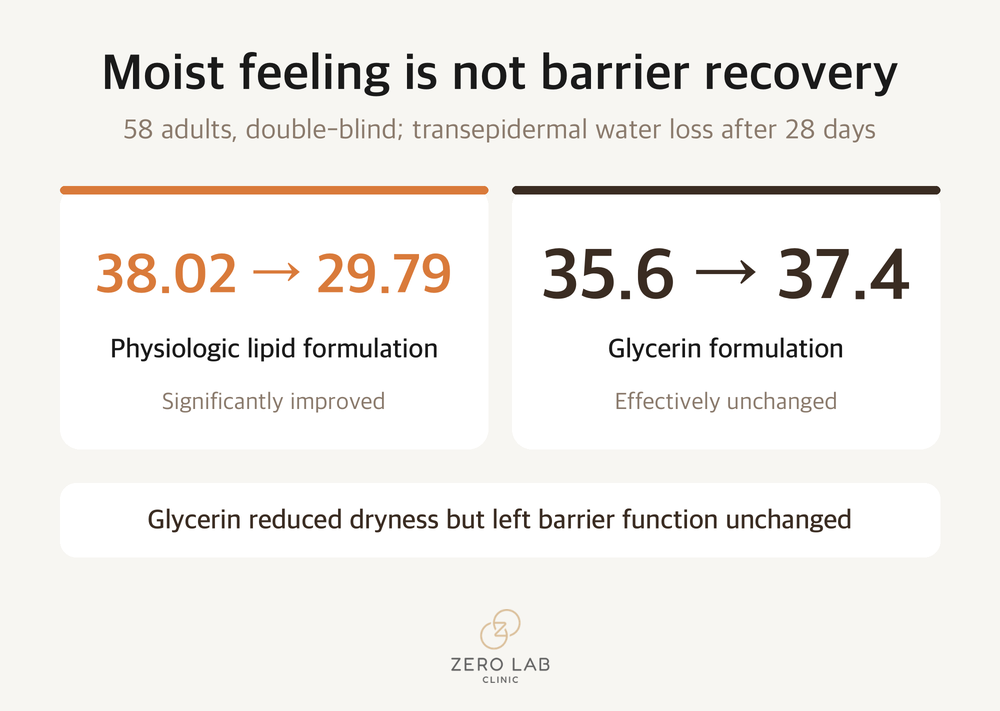
In a double-blind study of 58 adults, one arm received a formulation containing physiologic lipids, and the other a commonly prescribed glycerin-based formulation, applied for 28 days. The results diverged.
On the physiologic lipid side, transepidermal water loss measured after 20 tape strips improved significantly from 38.02 to 29.79, and the response to an irritant fell as well. On the glycerin side the same measure went from 35.6 to 37.4 — effectively no change. The authors' conclusion reads like this. the glycerin formulation reduced dryness but did not affect barrier function[5].
What this result says is clear. Feeling moist after applying something, and the skin actually losing less water, are two different things. If dehydrated skin keeps coming back, you may have been filling only the first of the two.
So we look at the two together
Seeing moisturizing only as "filling with water" is half the picture. We explain it in two axes.
① The filling side — ingredients that let the stratum corneum hold water
The stratum corneum contains substances called natural moisturizing factor (NMF). They are water-attracting substances such as amino acids, urea, lactate, PCA and electrolytes, and they regulate the water content of the stratum corneum. A recent review moves beyond a view focused on ceramides alone and concludes that these natural moisturizing factors are just as important for hydration[6].
② The holding side — ingredients that refill the barrier lipids
Physiologic lipids, ceramides among them, belong here. In the study above, this is the side that actually moved the barrier measure[5]. In the mask study too, the ceramide composition ratio showed a negative correlation with transepidermal water loss[3].
Both axes are needed. With only the ingredients that draw water in, and a weak layer to hold it, skin is moist for a moment and then drains again. The other way round, laying on a thick oily formulation alone leaves you shiny while the inside stays as it was. In dehydrated skin, these two are exactly what people run into.
So what should I choose
Since we are on ingredients, let me touch on products briefly. It is also the question I am asked most in consultation.
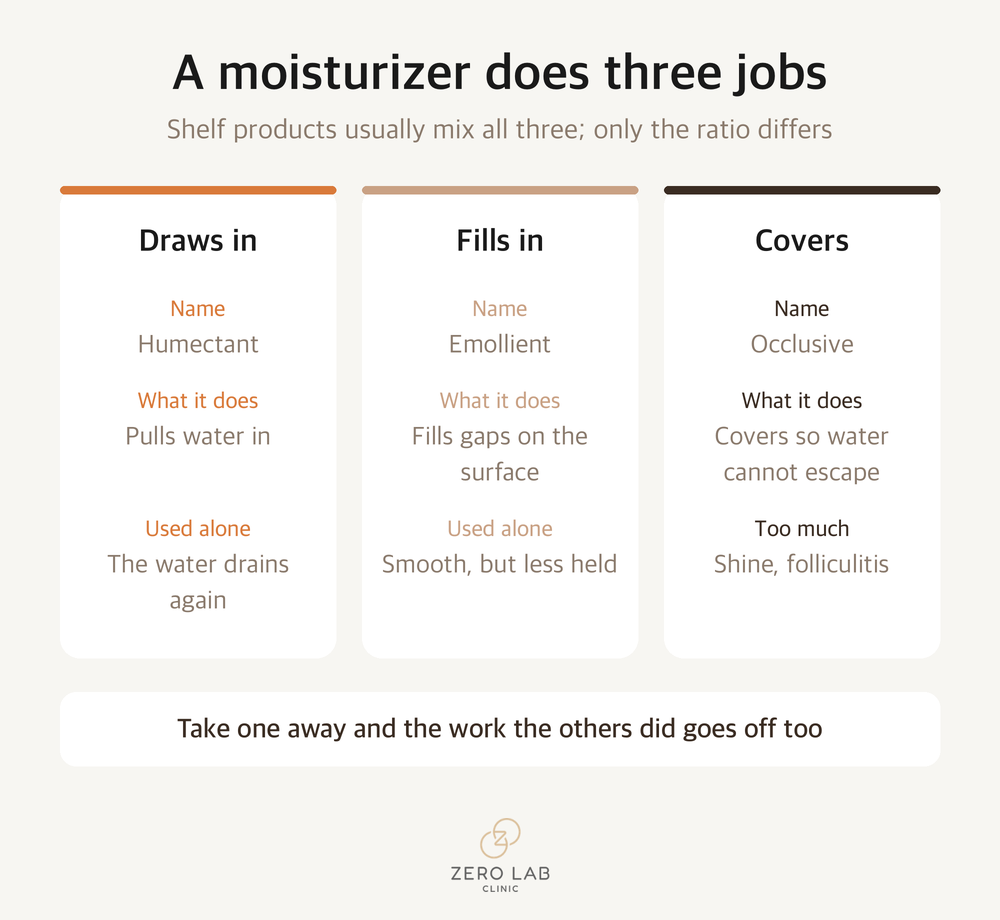
Divided by how they work, moisturizers fall into three groups. those that draw water in (humectants), those that fill the gaps on the surface and smooth it (emollients), and those that cover so the water cannot escape (occlusives)[7]. Products on the shelf usually mix all three, and only the ratio differs.
So I hear "I changed moisturizer and nothing changed." The formulation changed, but the ratio chosen was similar. A recent review on barrier repair makes the same point: the reason moisturizers differ in effect is that their composition differs, and it concludes that formulations designed to resemble the lipid lamellar structure of the stratum corneum help when the barrier has broken down[8].
When you actually choose, this much is enough to look at.
One. Do not use something with only water-drawing ingredients on its own. As we saw, that alone does not move the barrier measures[5]. There has to be a step that covers it.
Two. If you drop the occlusive because you dislike the shine, the water you put in drains straight out. If you are oily, go thin with a light formulation instead of a heavy one, but it is better not to drop the covering step. That said, too much occlusion can cause folliculitis[7], so if acne is flaring, reduce the thickness first.
Three. Do not leave it long after washing. Applying after the water has dried means it has already gone.
Four. More than the ingredient list, how your skin responds after a few days is the accurate guide. Look at whether the tightness has eased and whether makeup lifts less. The moist feeling right after applying is, as I said above, a different story.
Why moisturizing should not be dropped even on oily skin
Among people with acne or a lot of sebum, some skip moisturizer on purpose. Why put more on when it is already oily. I understand it, but the direction is off.
What the studies above say is that more sebum does not mean stratum corneum hydration rises with it[1][2]. Sebum is the oil covering the surface; holding water in the stratum corneum is done by natural moisturizing factor and barrier lipids[6]. The roles are different.
And when the barrier has thinned, the same stimulus feels sharper. In the double-blind study above, the side using the physiologic lipid formulation saw the barrier measures improve while the response to irritants and the redness fell along with it[5]. Turned around, it means that when the barrier is down, even the products you always use can sting or turn you red.
If you are treating acne or using a retinoid, this matters more. I have written about that side separately, and it is worth reading together.
It matters more if you have a treatment coming up
This is the part I particularly want to say from the clinic's side.
Treatments that put a stimulus on the skin, such as lasers and peels, run differently depending on the state of the barrier at the start. When a stimulus goes into an already loose barrier, the redness lasts longer and the flaking is worse at the same intensity. If recovery is slow, there is more room for pigment to be left behind.
So when we plan a pigment or pore treatment, if the tightness or flaking is marked, we tend to recommend putting a few weeks into moisturizing first. It is not that we want to postpone the treatment; it is that what you get from the same treatment changes.
The finding above, that the side whose barrier recovered became less sensitive to irritation[5], is the basis for that judgement. Put it together with the fact that 6 hours in a heated indoor space in winter already moves the measures[4], and the few weeks around a treatment have to be looked at including the environment.
These habits make dehydrated skin worse
Patterns I see often in the clinic.
- Washing several times a day because of the shine. When the lipids wash away, water leaves faster
- Layering only products aimed at removing oil
- Scrubbing physically and often because of the flaking
- Applying only watery products and not covering them
- Turning the heating up in winter without touching the humidity
How to wash itself is covered in a separate article, and it is worth reading together.
What we check in consultation
When you come in for dehydrated skin, I ask the following. Having it ready makes it much faster.
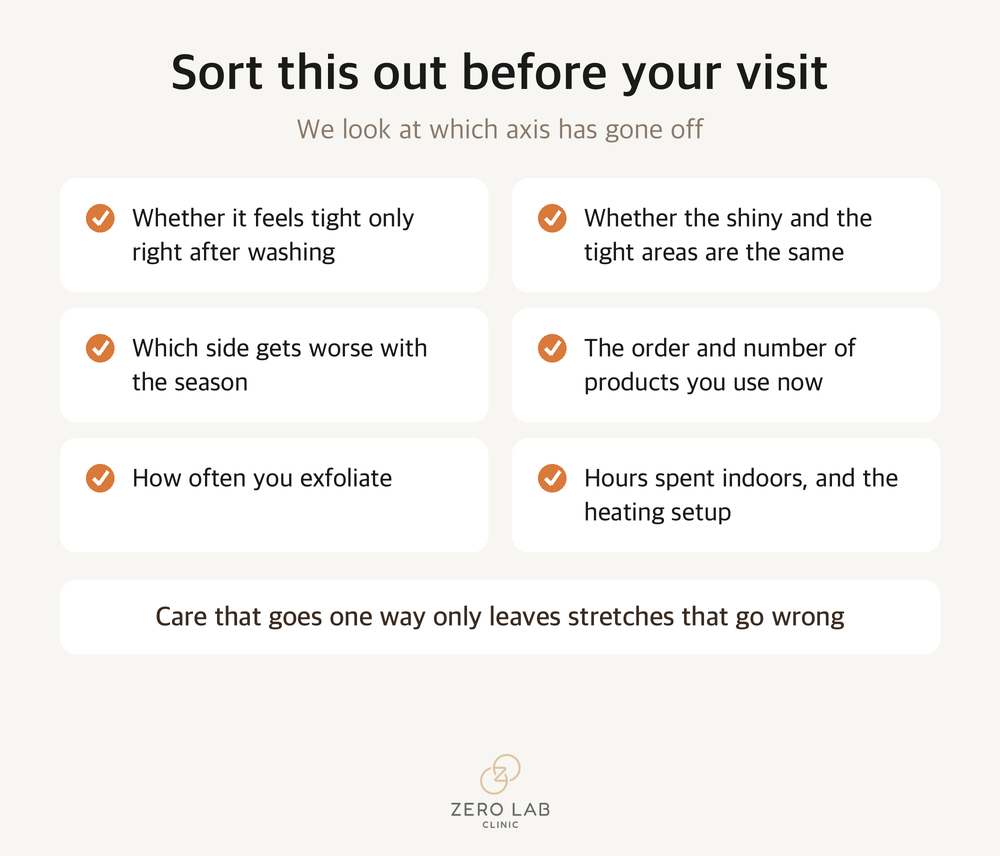
1) Whether the tightness is only right after washing, or all day
2) Whether the shiny areas and the tight areas are the same or different
3) Which side gets worse with the season
4) The order and number of products you use now
5) How often you exfoliate
6) How long you spend indoors, and the heating and cooling environment
People ask me to settle it as either oily or dry. I cannot answer that way. Because the measures move separately, care that goes in only one direction will go wrong somewhere. Write down those six and it usually becomes clear which side is short — the one that removes oil, or the one that holds water.
Inflammation on top of it is another problem, so acne and pigment are covered separately.
Treatments covered in this article
Prices and booking
References
[1] Huang F, Wang X, Zhang M, et al. Correlating facial skin parameters with age and gender in population of Shaanxi Province, China. J Cosmet Dermatol. 2024;23(4):1386-1395. DOI: https://doi.org/10.1111/jocd.16113
[2] Yang J, Tu Y, Man MQ, et al. Seasonal variations of epidermal biophysical properties in Kunming, China: A self-controlled cohort study. Skin Res Technol. 2020;26(5):702-707. DOI: https://doi.org/10.1111/srt.12857
[3] Nakamura T, Yoshida H, Haneoka M, Nakamura S, Takahashi Y. Season- and facial site-specific skin changes due to long-term mask wearing during the COVID-19 pandemic. Skin Res Technol. 2022;28(5):749-758. DOI: https://doi.org/10.1111/srt.13196
[4] Park EH, Jo DJ, Jeon HW, Na SJ. Effects of winter indoor environment on the skin: Unveiling skin condition changes in Korea. Skin Res Technol. 2023;29(6):e13397. DOI: https://doi.org/10.1111/srt.13397
[5] Andrew PV, Williams SF, Brown K, et al. Topical supplementation with physiological lipids rebalances the stratum corneum ceramide profile and strengthens skin barrier function in adults predisposed to atopic dermatitis. Br J Dermatol. 2025;193(4):729-740. DOI: https://doi.org/10.1093/bjd/ljaf200
[6] Baldwin H, Del Rosso J. Going Beyond Ceramides in Moisturizers: The Role of Natural Moisturizing Factors. J Drugs Dermatol. 2024;23(6):466-471. DOI: https://doi.org/10.36849/JDD.8358
[7] Lynde CW. Moisturizers: what they are and how they work. Skin Therapy Lett. 2001;6(13):3-5. PubMed: https://pubmed.ncbi.nlm.nih.gov/11813097/
[8] Madnani N, Deo J, Dalal K, et al. Revitalizing the skin: Exploring the role of barrier repair moisturizers. J Cosmet Dermatol. 2024;23(5):1533-1540. DOI: https://doi.org/10.1111/jocd.16171
The 8 papers above are indexed in PubMed. This article is general medical information; decisions about an individual's condition are made through consultation.
This article was written directly by Zero Lab Clinic to provide medical information. Results of any procedure vary with individual skin condition, and side effects are possible. Please decide on a procedure only after an in-person consultation with a doctor.