

Zero Lab Treatment Information
What you feel after filler is usually just a lump
Hello, I am Dr. Dong Won Kim, Medical Director of Zero Lab Clinic, one minute from Hongdae (Hongik Univ.) Station Exit 1.
A few days after filler, some people come in saying “I can feel something here.” They arrive alarmed, but I usually settle it right there in the room. In most cases it is not the thing you are worried about. What is happening is that the injected material has not settled in yet and is still pooled to one side, the thing we commonly call clumping. It often smooths out by hand. For how this differs from the other injectables that fill volume, see Rejuran, Juvelook, Exosomes.
If you search “filler nodule” online, heavy words like granuloma and delayed inflammation come up first. Those things do happen, but we meet them very rarely in actual practice. Today I will go through, in order, what most of what you can feel actually is, how we settle it, and why hyaluronic acid is used as widely as it is.
Our clinic, Zero Lab Clinic, is an Allergan Infinity member and has worked mainly with the Juvederm line, and I also gave a lecture at the 2026 SKINVIVE Summit conference.

Most of what you can feel is clumping
Filler is a material placed with a syringe. Right after it goes in it sits gathered in one spot, and over time it spreads into the tissue and settles. In this process, the part that has not spread yet catches under your fingertips, and that is what clumping is.
The cause is usually simple. Too much went into one spot, the plane was a little too shallow, or the surrounding tissue was firm and it did not spread well. It is not a disease; it is closer to a matter of placement.
So the treatment usually ends right there in the room as well. Pressing and smoothing it by hand, what we call molding, settles it in many cases, and if something remains we dissolve a small amount to even it out. This part is less something the papers put numbers on and more an area handled by hand in the clinic, so I present our own experience separately from the published evidence.
So how often is a “real nodule”, that is, the granuloma the body builds because it reads the material as foreign? There is a study that analyzed 2,139 patients treated by one physician since 2010. Seven of them developed a late-appearing lump, and among those one was confirmed on biopsy to have a foreign body granuloma[1]. One person out of more than 2,000 patients.
Even with the same lump you can feel, the nature of it differs this much. Feeling something is not a reason to think of granuloma first.
Reducing clumping is not a one-thing job
If clumping is a matter of placement, the one who decides that placement is the person injecting. That said, it is not something you get right by being good at one thing alone. The instrument, the gel, the technique, and the care afterwards all interlock.
Starting with the instrument, it is hard to say that either the needle or the cannula is simply better. Both carry their own risks. A cannula has the advantage of pushing vessels aside as it passes, but there are spots where it is hard to place the material exactly in the plane you want, and a needle is better for shallow, precise positions, but what you have to be careful about is different. Depending on the area and the plane, you choose case by case, and to do that you have to be comfortable with both. Using only one of them actually leaves you without options.
Choosing the gel is the axis where the evidence is relatively clear. According to a study that compared the cohesivity of hyaluronic acid gels with a standardized method, cohesivity is what keeps a gel from dispersing and lets it hold its shape, and it is involved in reducing surface irregularity. In the same study, cohesivity divided clearly by product. The Belotero line was high, the Juvederm Ultra line upper-middle, the Voluma line lower-middle, and the Restylane line toward the low end[4].
A review that organized the rheology of soft tissue fillers points the same way. Products differ in their physical properties, so performance and outcome differ, and it explains that the suitable product is determined by the extent of the defect and the anatomical location[5]. Turned around, that means there is no all-purpose product that suits every area.
Technique and plane sit on top of this. Whether the material is spread out rather than piled into one spot, and whether it lands exactly in the intended plane, shows directly on the surface. The molding right after the injection, and the care over the few days while it settles, are on the same line.
To sum up, clumping is a question of where and how the material is placed. Nothing has gone wrong in the body; the material has simply not settled yet, which is why most of it is handled on the spot. The wider the range of instruments and gels the injector works with, the less it happens in the first place, and the faster it is sorted out when it does.

Each material does a different job
Filler material is not one single thing. And it is not a matter of one being good and the rest bad. They do different jobs.
Hyaluronic acid creates volume the moment it goes in, and it can be reversed if you want. Calcium hydroxylapatite (Radiesse) gives immediate support and also induces collagen production, so it is strong for building contour. The PLLA and PDLLA line (Juvelook and others) does not fill volume directly but lets collagen come up over time, so the result appears gradually and lasts longer.
We keep all of these materials on hand, because the spot that needs its shape set immediately, the spot that needs strength in the contour, and the spot where texture should come up slowly are each different. You pick the material that fits the purpose; there is no ranking among them.
Among them, the most widely used is hyaluronic acid. A review that organized the types of filler lists three reasons for that. It is easy to handle, the results are good, and it has a good safety profile[9]. You can take it as the material kept as the default because its range of use is the broadest.
When something does appear, the form it takes also differs by material. In data collected in Germany on adverse reactions to fillers, redness, swelling, and pain were common on the hyaluronic acid side, while firmness was common with the collagen-inducing line. The authors summarized that adverse reactions are driven far more by the nature of the material than by the site[10]. In the same data, materials that stay in the body permanently leaned toward heavier reactions, and that class is barely used for aesthetic purposes today.
There is one property that only hyaluronic acid has. With an enzyme called hyaluronidase, what was placed can be dissolved and reversed. That leaves room both when adjusting shape and when something needs sorting out. With other materials it is a matter of waiting for absorption over time, so they differ in how fast they can be undone.
There is one thing I should state precisely, though. In a review that systematically organized how it is used, the randomized controlled trials amounted to 5 trials and 53 people, and the injection sites were forearm and back skin. For the face, there is still no standard fixed by trials for “how many units at what interval”[6]. The standards in use now were built from clinical experience and expert consensus.
On dose, just for a sense of scale, to remove the same amount the volume needed when it is injected all at once and when it is divided over several weeks differs by more than tenfold [6]. Taking it in stages gets there with less. Where the situation is not urgent, it means it is better to go a little at a time and watch.
The standard for using it depends on the situation. Clumping without inflammation, or material showing through, is handled with a low or moderate dose, and when there is inflammation the approach changes[7]. The enzyme is a drug as well, and allergic reactions have been reported, so we use only as much as is needed[8].

It is rare, but it can also appear late
There are cases where a swollen, reddened lump appears weeks to months after the procedure. We call this a delayed inflammatory nodule. It is different in nature from the clumping I described above.
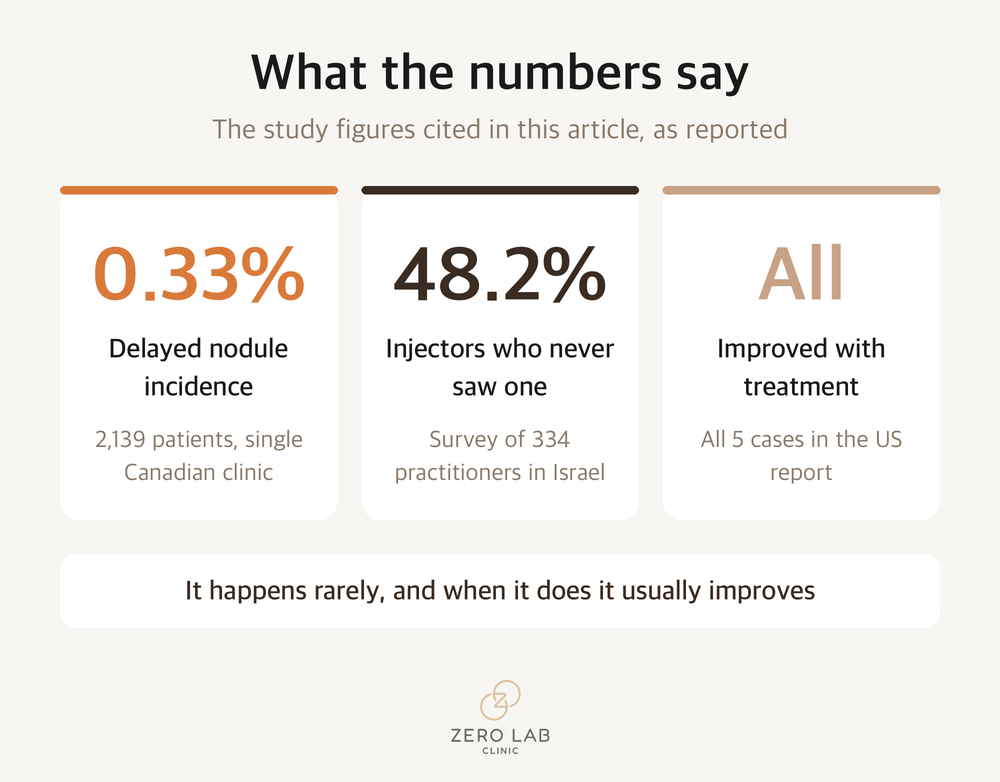
Start with how rare it is. In the 2,139-patient study above, the incidence was 0.33%, about one in 300. The authors noted that this figure was lower than earlier studies had estimated[1]. In data on 1,029 patients from another center in the United States, it appeared in 5 people with only one of three products, and there was not a single case with the other two[2]. When 334 medical practitioners who inject fillers in Israel were asked, 48.2% answered that they had never encountered it[3].
There is one more thing to note. In the same study, the occurrence of delayed nodules was not associated with the injection technique or the amount used[1]. The clumping I described earlier turns on technique, and this does not. Other axes, such as immune status or product characteristics, are involved.
The course is generally good. In the Canadian study, using a steroid together with the enzyme was the most effective, and 2 people improved on their own without any particular treatment[1]. In the American study, every nodule resolved with treatment[2].
Why a delayed inflammatory nodule occurs, what triggers it, and which periods are better avoided is a big enough subject to organize on its own. I will cover it in a separate article.
What we do
First, we keep a broad range of materials and products. For hyaluronic acid we mainly use Juvederm and also keep Restylane and Belotero, and among domestic products we use Neuramis and REJUVIEL. To that we add Radiesse in the calcium line and Juvelook in the PDLLA line. Even within hyaluronic acid, cohesivity and physical properties differ from line to line[4][5], and when the crosslinking technology differs the pattern of reaction differs as well[2]. To choose by area and by purpose, you have to have that much on hand.


Second, we keep records. Writing down which product went into which area and how much lets us narrow the cause quickly if anything ever needs checking later. If you were injected at another clinic, coming in with at least the product name helps.
Third, we do not fix on one instrument. We divide needle and cannula by area and plane, and we treat everything from the smoothing right after the injection to the check a few days later as one package.
Fourth, if you tell us you can feel something, we do not dissolve it right away. We first sort out whether it is clumping or inflammation. Get the order right and it is mostly a simple matter, so it is better not to rush.

A lot of people ask whether it has to be dissolved right away once they can feel it. What I say first is to give it a little time and wait. Some people take that as simply stalling. But what you feel after filler is mostly clumping that has not settled yet, and it is often sorted out on the spot. A granuloma, where the body reacts to it as a foreign body, is rare, about one person in data of more than 2,000. So there is no need to reach for a drug for a problem that mostly resolves without any particular measure. In most cases it is more than the situation calls for.
Filler is not a procedure you take on by accepting risk. Hyaluronic acid is the material that became the default because of its range of use and its safety, and if adjustment is needed it can be reversed. That does not mean the other materials are lesser. Different areas and purposes have their own suitable material, and choosing it is the injector's job.
Lifting and skin boosters go into different planes and respond differently, so we covered each separately.
Treatments covered in this article
Prices and booking
References
[1] Rivers JK. Incidence and treatment of delayed-onset nodules after VYC filler injections to 2139 patients at a single Canadian clinic. J Cosmet Dermatol. 2022;21(6):2379-2386. DOI: https://doi.org/10.1111/jocd.15013
[2] Sadeghpour M, Quatrano NA, Bonati LM, Arndt KA, Dover JS, Kaminer MS. Delayed-Onset Nodules to Differentially Crosslinked Hyaluronic Acids: Comparative Incidence and Risk Assessment. Dermatol Surg. 2019;45(8):1085-1094. DOI: https://doi.org/10.1097/DSS.0000000000001814
[3] Shalmon D, Cohen JL, Landau M, Verner I, Sprecher E, Artzi O. Management Patterns of Delayed Inflammatory Reactions to Hyaluronic Acid Dermal Fillers: An Online Survey in Israel. Clin Cosmet Investig Dermatol. 2020;13:345-349. DOI: https://doi.org/10.2147/CCID.S247315
[4] Sundaram H, Rohrich RJ, Liew S, et al. Cohesivity of hyaluronic acid fillers: development and clinical implications of a novel assay, pilot validation with a five-point grading scale, and evaluation of six U.S. Food and Drug Administration-approved fillers. Plast Reconstr Surg. 2015;136(4):678-686. DOI: https://doi.org/10.1097/PRS.0000000000001638
[5] Heitmiller K, Ring C, Saedi N. Rheologic properties of soft tissue fillers and implications for clinical use. J Cosmet Dermatol. 2021;20(1):28-34. DOI: https://doi.org/10.1111/jocd.13487
[6] Borzabadi-Farahani A, Mosahebi A, Zargaran D. A Scoping Review of Hyaluronidase Use in Managing the Complications of Aesthetic Interventions. Aesthetic Plast Surg. 2024;48(6):1193-1209. DOI: https://doi.org/10.1007/s00266-022-03207-9
[7] Kroumpouzos G, Treacy P. Hyaluronidase for Dermal Filler Complications: Review of Applications and Dosage Recommendations. JMIR Dermatol. 2024;7:e50403. DOI: https://doi.org/10.2196/50403
[8] Murray G, Convery C, Walker L, Davies E. Guideline for the Safe Use of Hyaluronidase in Aesthetic Medicine, Including Modified High-dose Protocol. J Clin Aesthet Dermatol. 2021;14(8):E69-E75. PMID: 34840662
[9] Sánchez-Carpintero I, Candelas D, Ruiz-Rodríguez R. Dermal fillers: types, indications, and complications. Actas Dermosifiliogr. 2010;101(5):381-393. DOI: https://doi.org/10.1016/s1578-2190(10)70660-0
[10] Bachmann F, Erdmann R, Hartmann V, Wiest L, Rzany B. The spectrum of adverse reactions after treatment with injectable fillers in the glabellar region: results from the Injectable Filler Safety Study. Dermatol Surg. 2009;35(Suppl 2):1629-1634. DOI: https://doi.org/10.1111/j.1524-4725.2009.01341.x
The 10 papers above are indexed in PubMed. This article provides general medical information; decisions about an individual's condition are made through consultation.
This article was written directly by Zero Lab Clinic to provide medical information. Results of any procedure vary with individual skin condition, and side effects are possible. Please decide on a procedure only after an in-person consultation with a doctor.