

Zero Lab Treatment Information
A nodule a year after filler — should it be dissolved?
Hello, I am Dr. Dong Won Kim, Medical Director of Zero Lab Clinic, one minute from Hongdae (Hongik Univ.) Station Exit 1.
This is rare in the clinic, but I do meet it now and then. I mean symptoms that come on suddenly — redness, swelling, tenderness — a long while after a filler, nearly a year later, when much of the filler has already gone and the patient has been doing fine. Symptoms like these are called delayed inflammatory reactions, or delayed-onset inflammatory nodules.
Most people who come in with this arrive with a good deal of worry on their face. These days they have gathered all sorts of information online beforehand, and much of what they have read is alarming — that it stays for life, that it does not treat easily, that it drags on. I usually put them a little at ease first, and then we begin.
Many now already know the name when they come. They tell me first, “the place where I had filler a while back has swollen up.” Only a few years ago people could not connect it to the filler at all and I had to work backwards and ask when the injection had been, so that part has changed.
Most of what you can feel after a filler is clumpingis something I wrote up separately. At the end of that piece I noted that delayed-onset inflammatory nodules were too big a subject and would have to wait for another time — this is that piece. Why they happen, what pulls the trigger, and what has to be checked before dissolving anything.
First, how uncommon this is
Let me start with the numbers.
In a set of prospective studies pooled and calculated in the United Kingdom, delayed inflammatory reactions came to 1.1% per year, and the portion that could genuinely be counted as delayed-type hypersensitivity was 0.06% per year. Most retrospective studies put it under 1% over follow-up ranging from one year to 5.5 years [1].
There is also a study in which two hospitals in Canada and the United States went back through nine years of charts. 4,500 patients received 9,324 treatments, and there were 44 delayed adverse events. 0.98% per patient, 0.47% per treatment[2]. In the earlier 68-month data from the same investigators, 23 patients out of 4,702 treatments — 0.5%[3].
Country and product differ, but it generally sits inside 1%.
It is uncommon. That said, uncommon does not mean it cannot happen to you, so you should know what is done if it does.
A nodule and a granuloma are not the same thing
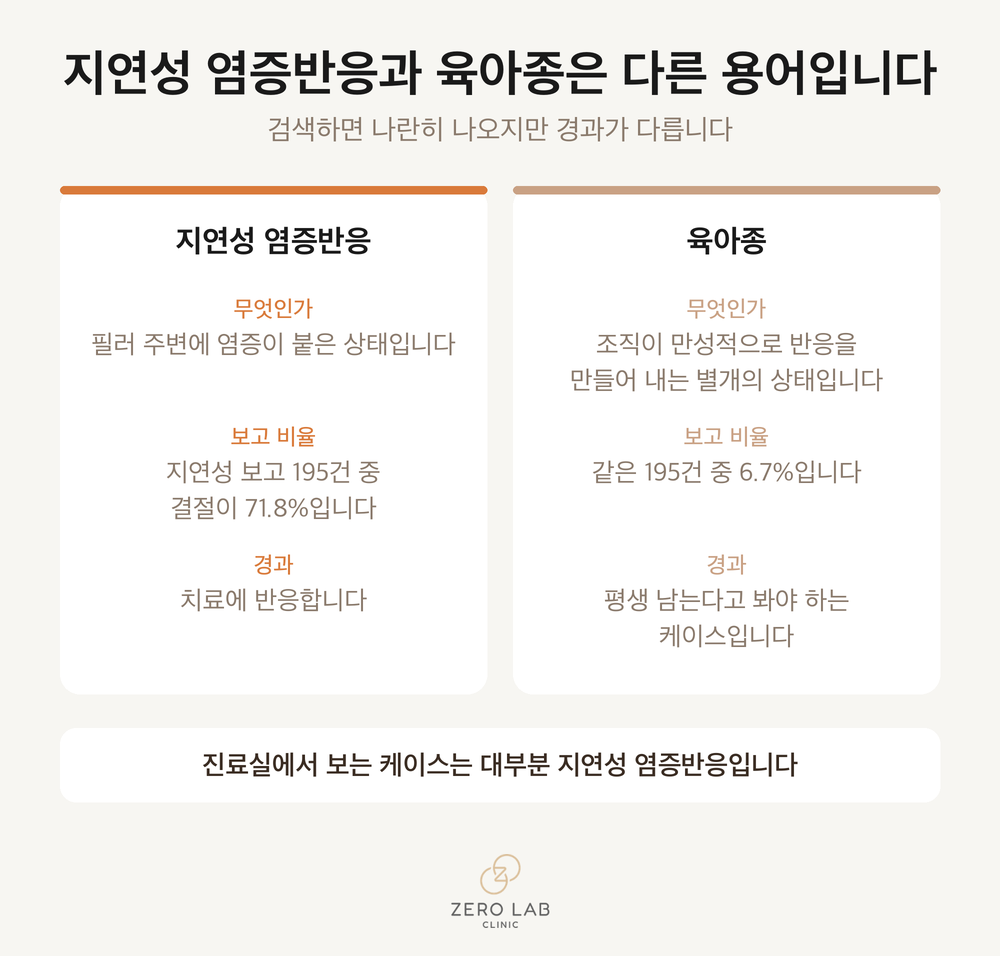
There is something to settle first. When people hear the word nodule, most of them picture a foreign body granuloma, the kind of case you have to assume will stay for life. But the two are clearly different terms.
There is a paper that classified 195 delayed reports for the recently approved hyaluronic acid fillers in the US FDA’s post-market adverse event database.
| Category | Share |
|---|---|
| Nodule | 71.8% (inflammatory 42.1%, non-inflammatory 29.7%) |
| Hypersensitivity reaction | 21.5% |
| Foreign body granuloma | 6.7% |
Granulomas are only a part even among delayed reports[4].
A delayed inflammatory reaction is a state in which inflammation has attached itself around the filler, and it responds to treatment. A foreign body granuloma is a separate condition in which the tissue chronically keeps producing a reaction, so its course is different. Search for them and the two words come up side by side, which makes them read as one and the same — but the cases we see in the clinic are, for the most part, delayed inflammatory reactions.
So in consultation I begin by defining this distinction. We first work out what it is that you are feeling now, and the treatment and the course both change according to that answer.
When does it appear
This is the evidence that shows the character of a delayed inflammatory reaction most clearly.
| Source | Time of onset |
|---|---|
| 4,500 patients, Canada/US [2] | median 4 months |
| 68-month data, same hospitals [3] | median 4 months |
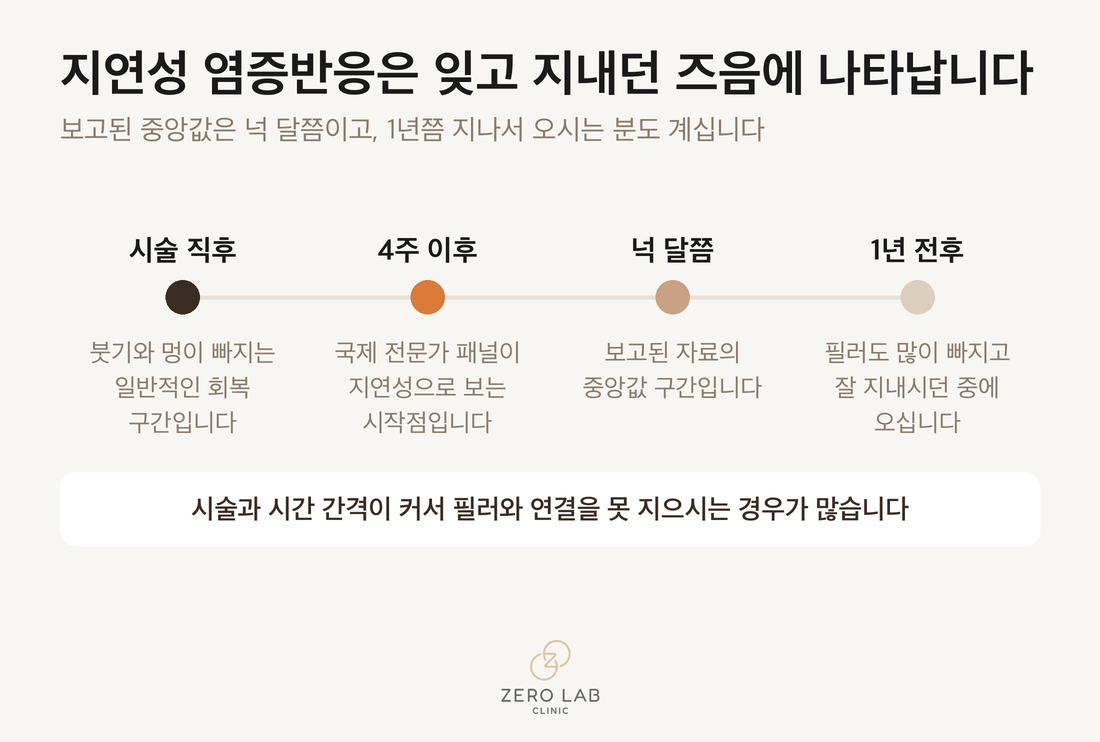
The median in the reported data is about four months. But a median means there are cases on both sides of it, earlier and later. What we see in the clinic is not clustered at four months either — some people come in about a year afterwards. That is why I often hear, “but that was a long time ago.”
An international expert panel defines a delayed adverse reaction as one that appears more than four weeks after the treatment[5]. Four months or six months, both fall inside that.
There is one more thing. In the 4,500-patient data, the frequency rose between October and January[2]. The authors themselves did not state why. But if you think about what goes around in that season, it leads into the next part.
Why it happens has not yet been settled on one answer
I think I have to give you a slightly candid answer here.
It used to be explained as an allergic immune reaction. That explanation is now unsteady.
A Dutch research team took tissue with an 18G needle from 13 people who had had a delayed inflammatory reaction and 16 who had not, and examined the bacteria in detail. Gram-positive bacteria came back at high levels on the inflamed side. The bacterial makeup collected with a swab from the skin surface and the makeup that came out of the tissue were clearly different, so this was not contamination picked up during sampling [6].
The same team gathered 211 people and looked at genes as well. HLA-B*08 and DRB1*03 carried together was found in 16.3% of the inflammation group and 4.9% of the control group, with an odds ratio of 3.79 [7]. That said, the lower bound of the confidence interval was 1.25, close to 1, and this was not a study that checked whether it can be used to screen people in advance.
To sum up, bacteria, immunity and product characteristics are all involved, and it is hard to pin it down to any one of them. So in consultation I do not state the cause as settled. That does not mean the cause is entirely unknown — it means this is how far the current evidence in the literature has been demonstrated.
What pulls the trigger
This side is relatively consistent.
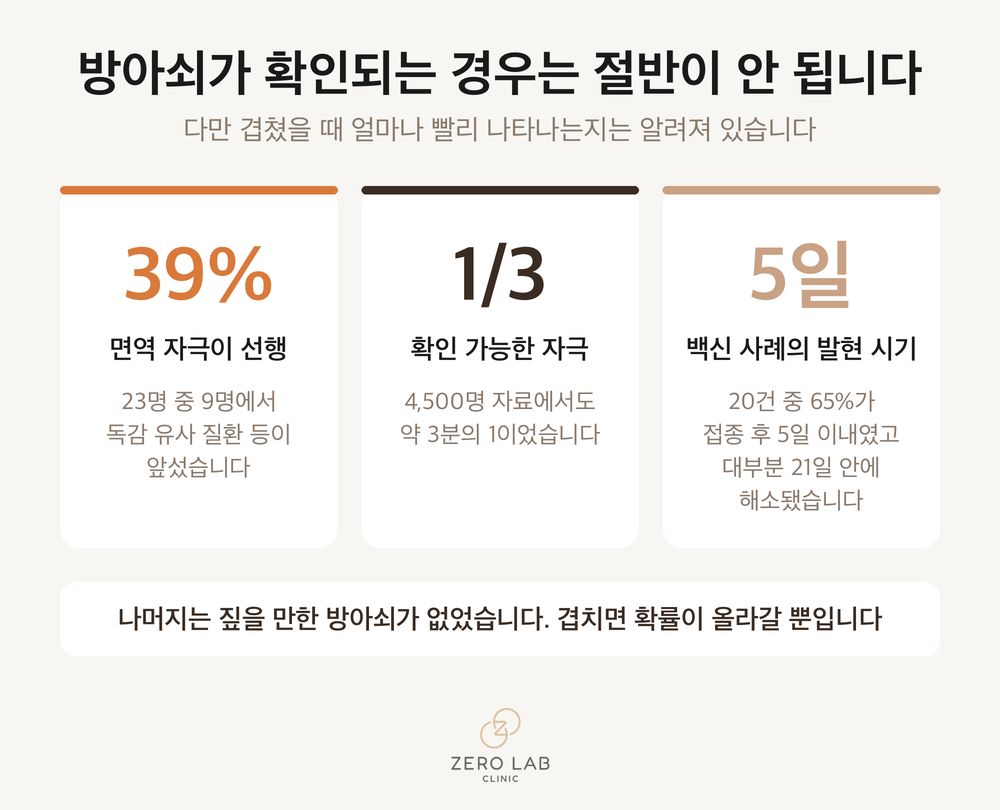
In the 68-month data, of the 23 patients, 9 (39%)had an immune stimulus such as an influenza-like illness before the nodule appeared [3]. In the 4,500-patient data as well, about one thirdhad an identifiable immunological stimulus beforehand [2].
Vaccines have been reported as well. In 20 cases collected by asking injectors in Israel, 65% appeared within five days of the shot, and most resolved within 21 days. The greater the volume of filler injected, the more severe the symptoms tended to be [8].
Two things have to be read together here.
First, it is less than half. 39%, one third. In the rest there was no trigger worth pointing to. It is hard for me to tell you that catching a cold brings this on.
Second, even so, when they overlap the odds go up. So we ask about your condition before we treat. If you have the beginnings of a cold, or dental work coming up, we simply do not do it that day. That said, no study has yet given a specific number of days to leave clear. What the international consensus statement recommends goes as far as five things: patient selection, choice of injection site and product, aseptic technique, injection technique, and aftercare [5].
Volume injected and type of product also matter
Two factors come up repeatedly across the data.
One is the volume injected. In the data on 4,500 patients, those who developed an adverse event had a slightly higher cumulative injected volume than those who did not [2]. In the 20 vaccine-related cases as well, the tendency for symptoms to be more severe the larger the volume injectedwas confirmed statistically (p = 0.016) [8]. This is the evidence for why putting in a large amount at one time is a burden.
The other is the product. **The other is the product.** A study that followed 400 patients in whom a particular product was used only under the eyes and on the lips reported 4.25%, a far higher rate than what is generally reported[10].
Which means fillers are not all the same. Depending on the cross-linking method and the viscosity, the way it breaks down inside the tissue differs, and that is reflected in the incidence. So we use different products for different areas. A product used somewhere like under the eye, where the skin is thin and there is a lot of movement, cannot be the same as a product used to hold volume.
Treatment policy is still divided
This is the most important part of this piece.
There is a survey that gave 334 filler injectors a case of a delayed reaction and asked what they would do. The most common answer was a short course of oral steroids (35.3%), and intralesional hyaluronidase was 31.4%. And only 34% of the injectors kept the enzyme in their own clinic. The concluding sentence of that paper runs as follows.
That approaches to the management of delayed reactions vary this widely shows that the literature itself is ambivalent about the management and treatment of this problem [9]
This is an area the textbooks do not tidy up into one answer for us. I think it is better to say that as it is than to write around it.
Let me look at the numbers. Among the 20 vaccine-related cases, medical intervention was carried out in 12 (60%). The remaining 8 resolved with nothing done at all [8]. The 68-month data reported that oral steroids, intralesional steroids and the enzyme were all effective [3].
That said, there are certainly cases that do not end with medication alone. I will come back to that later.
How we see it
Since the literature is divided, let me give you our own standards.
First, we do not rush to dissolve. We do not put the enzyme in straight away simply because something can be felt. We first sort out whether it is clumping or inflammation. Dissolving while the inflammation is easing and dissolving while the inflammation is in full swing give different results.
Second, if infection is suspected, antibiotics come first. Studies finding bacteria in the tissue are accumulating [6], and the treatment recommendation in the international consensus statement also puts oral antibiotics first [5].
Third, steroids are used briefly. The international consensus statement does put oral steroids on its list of recommendations, but used over a long period they create other problems.
Fourth, if it keeps coming back, we dissolve. **Fourth, when it recurs, we dissolve it.** This is the representative case. In the 400-patient study mentioned above, 17 patients developed a delayed inflammatory reaction, it recurred an average of 3.17 times and ran as long as 11 months. What was effective in those cases was broad-spectrum antibiotics and repeated high-dose enzyme injection[10]. If it settles once and then comes up again, at that point we move towards taking the causative material out.
I am honest about how long it takes
I am not going to shorten the timeline in order to reassure you.
In the 68-month data, the median time to resolution was 6 weeks[3]. The vaccine-related cases mostly cleared within 21 days [8]. By contrast, the 17 patients in the 400-patient study above ran as long as 11 months [10].
A few weeks to a few months. This is not something that ends in a day or two. That said, the concluding sentence of the 4,500-patient data runs like this — the delayed adverse events were transient and resolved without problems[2]. A course that takes a long time and a lesion that stays behind are clearly two different matters.

What we check in consultation
- When it was done — when you had what, and where. At four months out the memory is often hazy, so we look at the records together
- Your recent condition — colds, influenza, gastroenteritis, dental work, vaccinations. We ask about the two weeks just before the nodule came up
- Redness and warmth — this is the criterion that separates something you can simply feel from something that is inflamed
- Whether it is the first time at that site — if it is the first time, medication first; if it is recurrent, the order changes
- Allergy history — we also look at whether you have had allergies unrelated to filler

In closing
A lot of people ask me, “this isn’t going to last for life, is it?” My answer is always the same. Most of it clears up. But it does not happen overnight, and if the order is set wrong it takes longer.
And to add one thing: delayed inflammatory reactions occur at a frequency inside 1%, but once a case has actually happened, explaining probability is meaningless. It is certainly an uncommon case, but in my own practice I explain first what kind of lesion the present symptom is, and then the direction and the order of treatment. It is not a very easy situation, but I do want to get across the message that it is resolved with appropriate treatment.
References
[1] Chung KL, Convery C, Ejikeme I, Ghanem AM. A Systematic Review of the Literature of Delayed Inflammatory Reactions After Hyaluronic Acid Filler Injection to Estimate the Incidence of Delayed Type Hypersensitivity Reaction. Aesthet Surg J. 2020;40(5):NP286-NP300. DOI: https://doi.org/10.1093/asj/sjz222
[2] Humphrey S, Jones DH, Carruthers JD, et al. Retrospective review of delayed adverse events secondary to treatment with a smooth, cohesive 20-mg/mL hyaluronic acid filler in 4500 patients. J Am Acad Dermatol. 2020;83(1):86-95. DOI: https://doi.org/10.1016/j.jaad.2020.01.066
[3] Beleznay K, Carruthers JDA, Carruthers A, Mummert ME, Humphrey S. Delayed-onset nodules secondary to a smooth cohesive 20 mg/mL hyaluronic acid filler: cause and management. Dermatol Surg. 2015;41(8):929-939. DOI: https://doi.org/10.1097/DSS.0000000000000418
[4] Cohen JL, Hicks J, Nogueira A, Lane V, Andriopoulos B. Postmarket Safety Surveillance of Delayed Complications for Recent FDA-Approved Hyaluronic Acid Dermal Fillers. Dermatol Surg. 2022;48(2):220-224. DOI: https://doi.org/10.1097/DSS.0000000000003350
[5] Philipp-Dormston WG, Goodman GJ, De Boulle K, et al. Global Approaches to the Prevention and Management of Delayed-onset Adverse Reactions with Hyaluronic Acid-based Fillers. Plast Reconstr Surg Glob Open. 2020;8(4):e2730. DOI: https://doi.org/10.1097/GOX.0000000000002730
[6] Decates TS, Budding AE, Velthuis PJ, et al. Bacterial Contamination Is Involved in the Etiology of Soft-Tissue Filler, Late-Onset, Inflammatory Adverse Events. Plast Reconstr Surg. 2023;151(5):971-978. DOI: https://doi.org/10.1097/PRS.0000000000010074
[7] Decates TS, Velthuis PJ, Schelke LW, et al. Increased risk of late-onset, immune-mediated, adverse reactions related to dermal fillers in patients bearing HLA-B*08 and DRB1*03 haplotypes. Dermatol Ther. 2020;34(1):e14644. DOI: https://doi.org/10.1111/dth.14644
[8] Safir A, Samuelov L, Sprecher E, Daniely D, Artzi O. Association between BNT162b2 vaccination and the development of delayed inflammatory reactions to hyaluronic acid-based dermal fillers - A nationwide survey. J Cosmet Dermatol. 2022;21(10):4107-4113. DOI: https://doi.org/10.1111/jocd.15260
[9] Shalmon D, Cohen JL, Landau M, Verner I, Sprecher E, Artzi O. Management Patterns of Delayed Inflammatory Reactions to Hyaluronic Acid Dermal Fillers: An Online Survey in Israel. Clin Cosmet Investig Dermatol. 2020;13:345-349. DOI: https://doi.org/10.2147/CCID.S247315
[10] Artzi O, Loizides C, Verner I, Landau M. Resistant and Recurrent Late Reaction to Hyaluronic Acid-Based Gel. Dermatol Surg. 2016;42(1):31-37. DOI: https://doi.org/10.1097/DSS.0000000000000562
The 10 papers above are indexed in PubMed. This article is general medical information; decisions about an individual's condition are made through consultation.
This article was written directly by Zero Lab Clinic to provide medical information. Results of any procedure vary with individual skin condition, and side effects are possible. Please decide on a procedure only after an in-person consultation with a doctor.