
Zero Lab Treatment Information
Ultherapy or Thermage First?
Hello, I am Dr. Dong Won Kim, Medical Director of Zero Lab Clinic, one minute from Hongdae (Hongik Univ.) Station Exit 1.
Let me start with the question we hear most often in the consultation room: "which of the two should I have first?" The answer: the basis for deciding the order is not which procedure is better, but which layer of your face is giving way. The two devices differ in the very depth their energy reaches, and that is why the skin types they suit diverge. Today I want to go through how the working layers of Ultherapy and Thermage differ, how to choose by type, and why on the ultrasound side we look at the number of lines before the intensity, with the research behind it.
Ultherapy and Thermage: same lifting, different layers
Radiofrequency generates heat as current passes through tissue resistance, so the heat spreads broadly. Ultrasound does the opposite: it concentrates energy at a single point, creating coagulation points smaller than 1 mm³ at set depths within the skin. These points reach as deep as 5 mm, targeting the deep reticular dermis and the fascial layer beneath it (SMAS), while passing through the epidermis and papillary dermis in between without affecting them[1]. A closer, layer-by-layer look at how the two devices generate heat and which layers they reach is in Thermage and Ultherapy: comparing how they work, which we wrote separately.
That stays abstract in words alone, so let me bring in a study that compared them directly by histology. It treated skin with monopolar radiofrequency and with ultrasound, then divided the dermis by layer and measured how much new collagen had formed[2]. The results were fairly clear.
| Category | How heat is delivered | Where new collagen was found |
|---|---|---|
| Radiofrequency | Diffused across a broad area | All layers, from papillary to deep reticular dermis |
| Ultrasound | Focused on a narrow point | Mid and deep reticular dermis (most marked in the deep layer) |

The Ultherapy PRIME sign and the Thermage tip display outside our treatment room
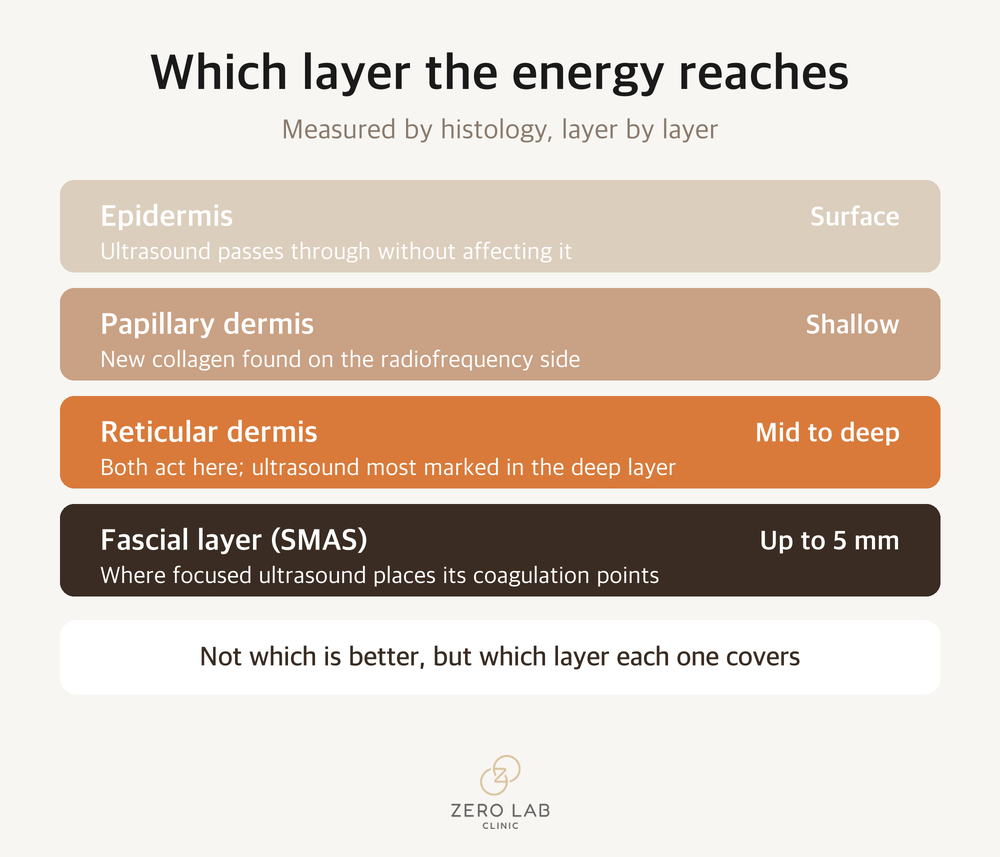
In short, radiofrequency works evenly from the shallow layers to the deep, while ultrasound works intensively on one deep layer. On the radiofrequency side, dermal collagen was found to have increased from immediately after the procedure through to 6 months later, and an increase in the thickness of the epidermis and dermis themselves was reported alongside it[3]. It is not a question of which is the better procedure; it is more accurate to see them as covering different layers.
If you are thin-faced with thin skin
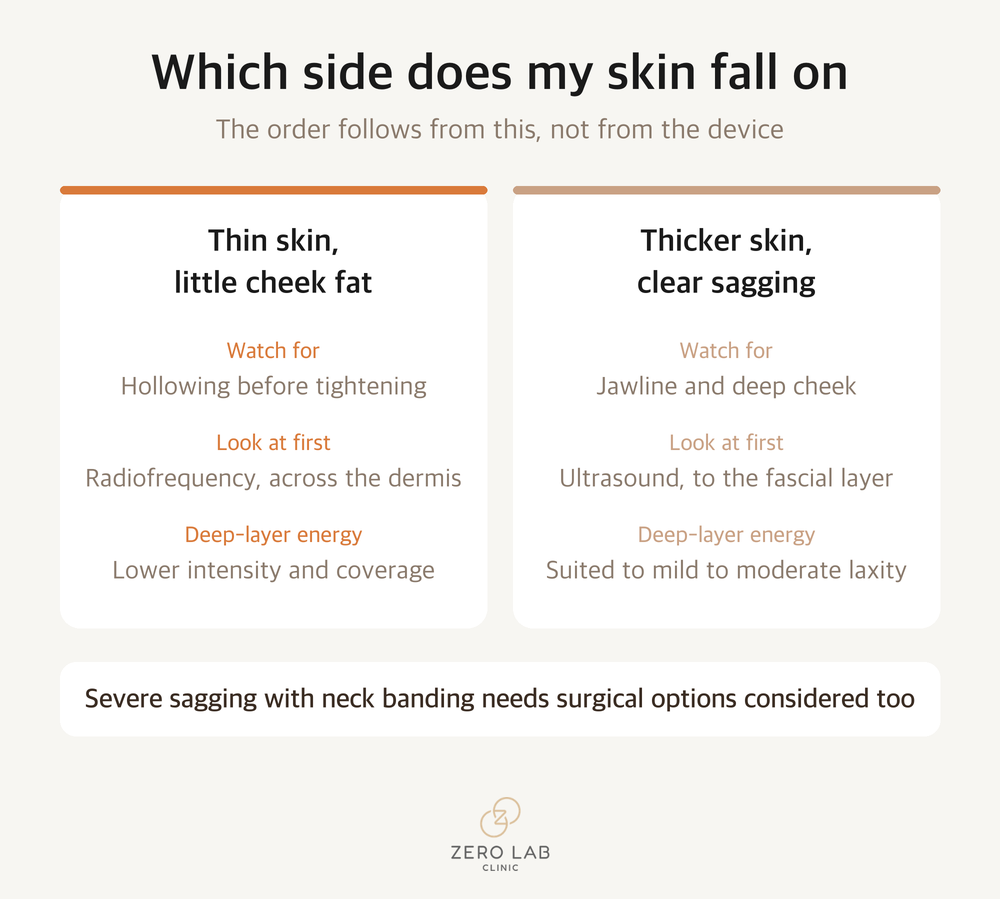
This is the part that matters. What has to be checked is not which procedure is better, but your own condition. People with little cheek fat and thin skin need a little more caution when using energy aimed at the deep layers. As ultrasound sends heat into the deep layers it can affect the subcutaneous fat and cause fat atrophy, and the point that this limits its use in thin faces appears directly in the research[4]. In data collecting actual complications, problems were reported in 23% of 39 people, including pseudo fat atrophy making the face look hollow, and temporary paralysis of the lip and eyebrow[5].
It is not common. But if you are already concerned about hollowing at the cheeks and strong energy goes into the deep layer, the hollowing may register before the tightening does. So in these cases we tend to suggest looking at radiofrequency first, which treats the dermis evenly throughout.
Conversely, people with thicker skin and clear sagging at the jawline or the deep cheek are often better served by ultrasound reaching the fascial layer first. There is a condition on this side too. Ultrasound aimed at the fascial layer is documented as suited to mild to moderate laxity, and where sagging is severe and neck muscle banding is prominent, surgical options should be considered alongside[1]. There is a clear limit to what non-surgical procedures can carry.
On the ultrasound side, lines come before intensity
Many people open an Ultherapy or Thermage consultation by asking about shot count. As people have built up more experience lately, I think more of them already have a grasp of what shot count means.
An expert consensus document on ultrasound treatment states that good outcomes are associated with higher-density treatment[7]. The density it refers to is how many lines are placed at which depth — that is, the shot count. The same document sets out, as basic procedure, using ultrasound imaging to look into the tissue, selecting transducer and depth, and planning the number of lines for each depth. This is where the DeepSee technology of Ultherapy PRIME stands out.
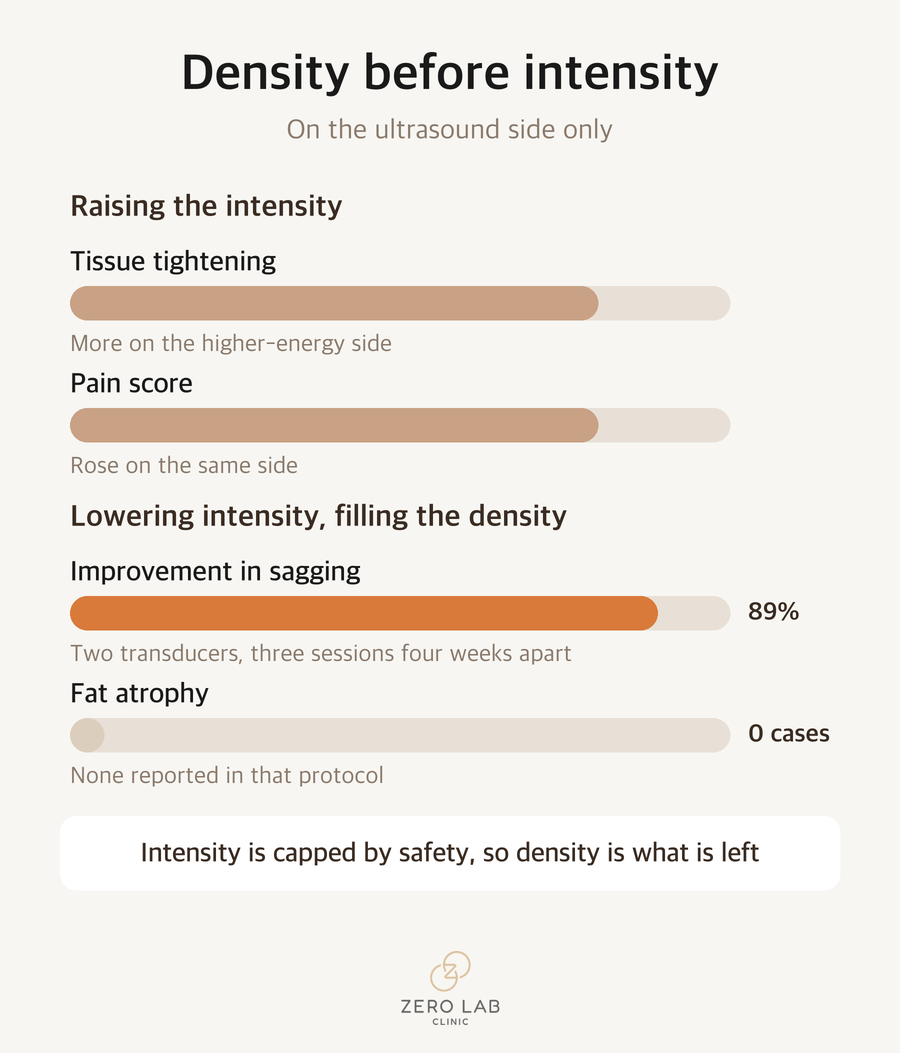
You might then think it would be enough to raise the energy. In a study comparing the left and right sides of the face, the side treated at higher energy and with more treatment levels did show more actual tissue tightening. But on that same side, pain scores rose as well[8]. This does not mean intensity is meaningless; it means raising it comes at a cost.
And the problem from the previous section overlaps here. Strong heat into the deep layer can cause fat atrophy[4], and complication data reported pseudo fat atrophy and temporary paralysis[5]. In the end, intensity is not a value you can raise at will — it is capped by a safety margin. It means the pain and the risk rise relative to the gain, so this is a matter that calls for a considered choice.
Which leaves density as the answer. A study that deliberately lowered the intensity shows this well[4]. It combined two transducers of different depths and, instead of doing everything at once, split the treatment into three sessions four weeks apart. Improvement in sagging was confirmed in 89%, with not a single case of fat atrophy. Filling in adequately at a safe intensity, rather than going hard in one go, was the side that gave the better result while keeping safety intact.
This is an ultrasound story, though. Radiofrequency spreads heat broadly, so line count is not counted on the same basis. What it decides instead is where to lay more passes, and that is what is called a vector. A study treating facial and neck laxity with monopolar radiofrequency reported laying 4-5 passes over the areas where the improvement would be greatest, setting this out as the multipass vector (mpave) technique[6], and another study uses an algorithm that takes two non-overlapping passes as the baseline and adds vector passes only where they are needed[9].
Let me flag a point that is easy to misread here. The vector in radiofrequency is not a direction of pull, the way a thread lifts tissue by hooking it and drawing it one way. Because the heat spreads broadly, there is no way to generate a pull in one direction in the first place. Vector here is less "where we will pull" than "where, and how many times, we will pass over".
The same holds for radiofrequency: it must not be stacked into one spot. Monopolar radiofrequency works by cooling the surface to protect it while heating the dermis beneath[11], so layering energy onto the same spot can go beyond what that protection covers. In a retrospective analysis of more than 600 monopolar radiofrequency treatments, adverse events came to 2.7% and none were permanent, but among them was surface crusting caused by the early tips[10].
The same data sets out that the way the procedure is performed changed over four years. Going over the area several times at a lower intensity, rather than once at a strong one,gave better results and better satisfaction alike[10]. That said, going over the area several times brings a problem of its own. Passing repeatedly over the same surface makes it hard even for the operator to know exactly where they have been and how many times, and then heat builds up in particular squares. The algorithm cited earlier takes non-overlapping passesas its baseline for the same reason[9].
So with Thermage we draw a grid on the skin before we begin. Making the places where the tip will land visible means that even when passes are layered several times, no one square is overlapped excessively. The vector described above — deciding which areas to fill in more — is also worked out on this grid. This is what we are explaining when we mark out the treatment area in consultation.
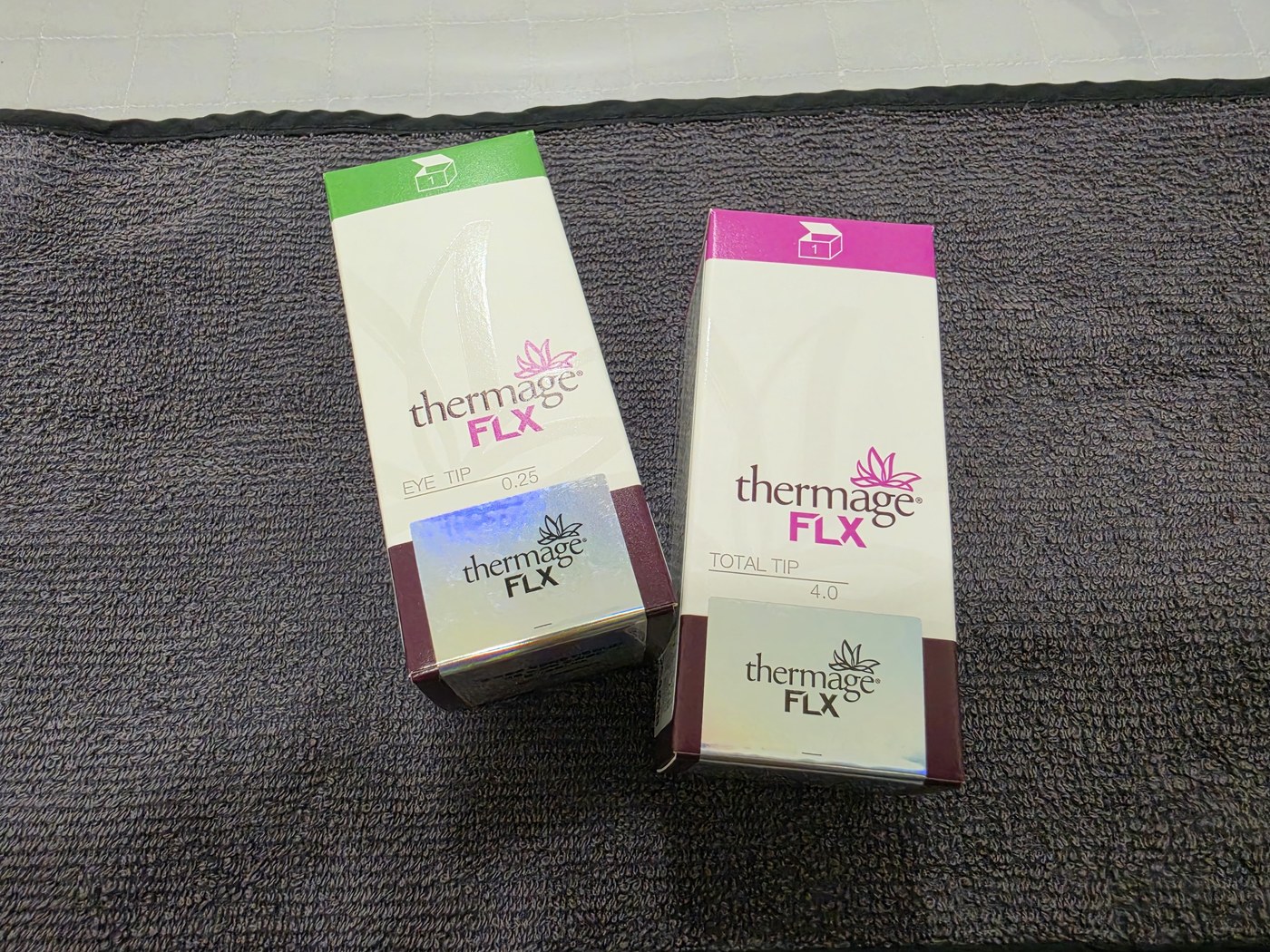
Thermage FLX tips used by area — one for the eye area, one for the full face
So this is how we set the order between Ultherapy and Thermage
- If what strikes you first is that firmness and texture across the whole face have given way, we look at radiofrequency first
- If sagging in a specific area such as the jawline or deep cheek is distinct, we look at ultrasound first
- If hollowing at the cheeks is already a concern, we set deep-layer energy at lower intensity and coverage, or move it later in the order
- Even if you plan to have both, we do not do them together on the same day; we leave an interval

Attending the Ultherapy PRIME Train The Trainer 2nd Module
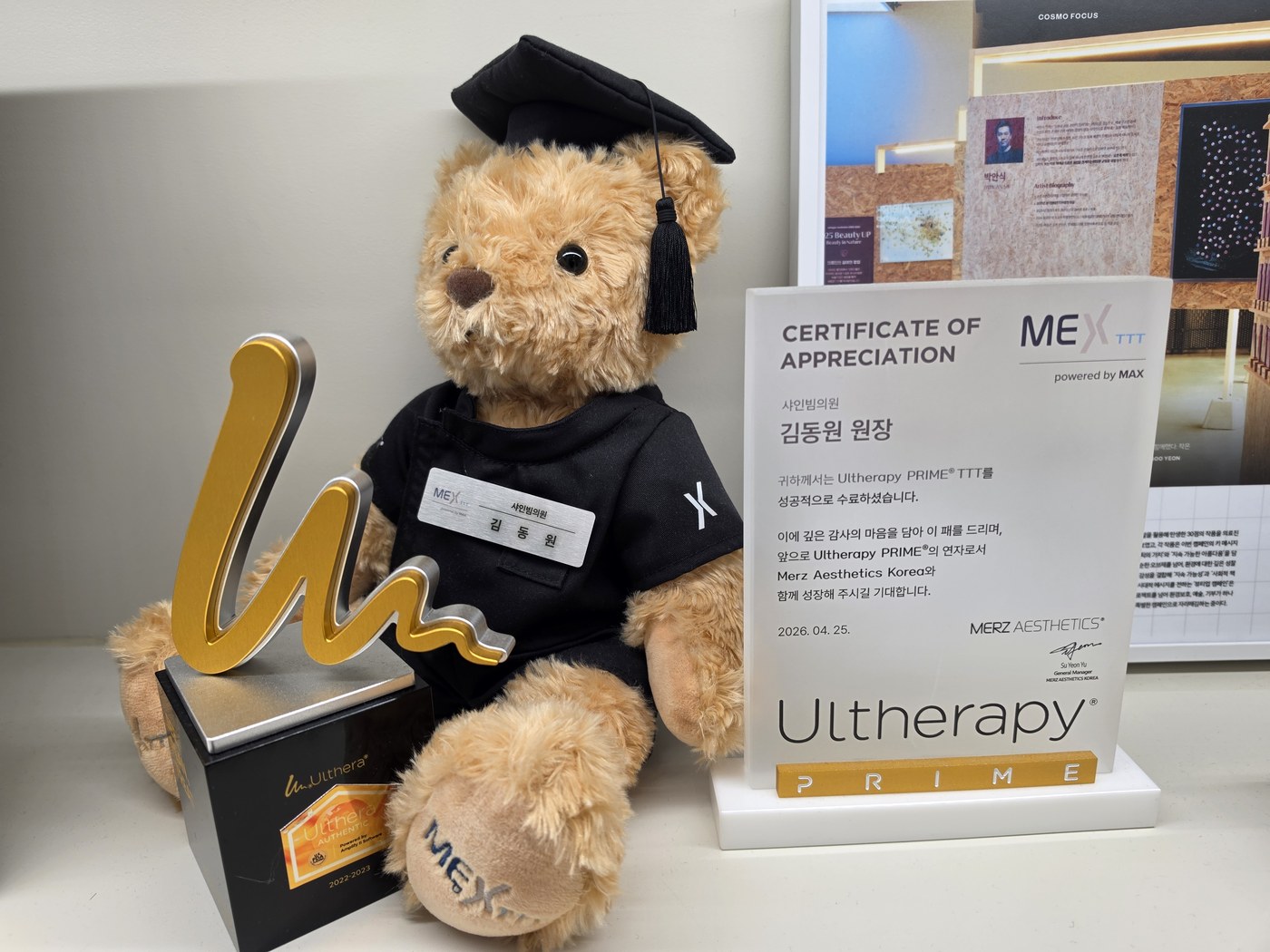
Ultherapy PRIME Train The Trainer certificate of completion
What we check in an Ultherapy or Thermage consultation
- We look at skin thickness and cheek fat volume first. If thin and hollowed, we plan the deep layer conservatively
- We separate whether the sagging comes from an overall loss of firmness or from one area having dropped
- We confirm the type and timing of any lifting procedures you have had before
- We settle whether the change you want is on the texture and tone side or the contour side before starting
- Rather than putting everything in at once, we put the option of splitting it into sessions on the table and discuss it
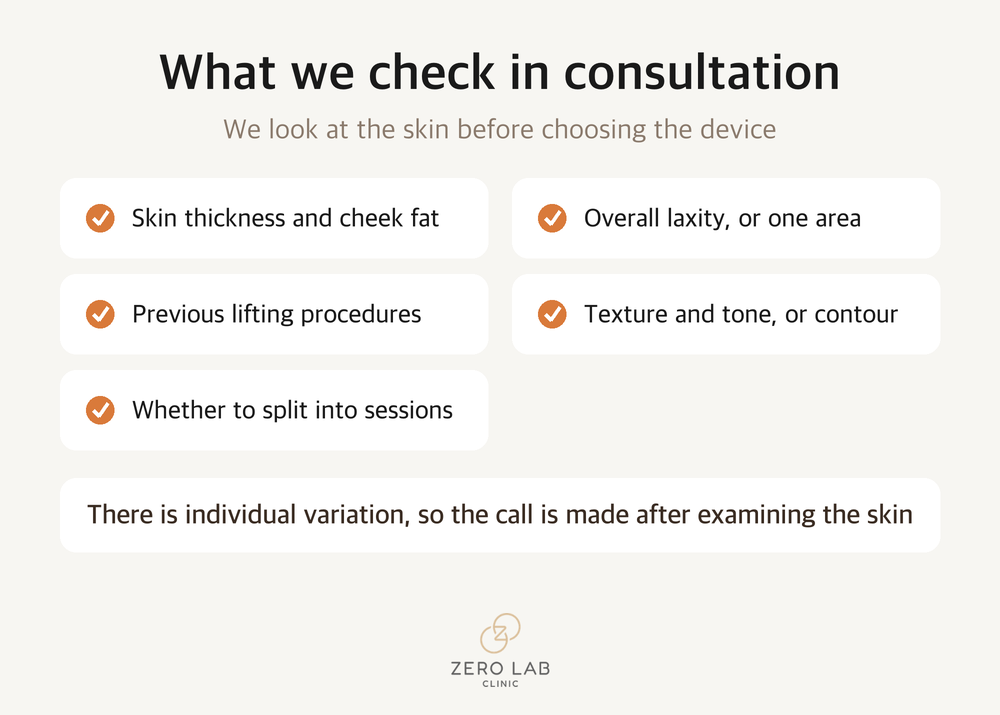
Our clinic, Zero Lab Clinic, is a Merz Expert Member, certified to handle Ultherapy-related procedures, and in our seventh year since opening we have seen more than 200,000 people. The principle that has settled over that time is simple: do not choose the device first, look at the skin first. Of course there is individual variation even within the same type, so the actual judgment is made after examining the skin directly.
Setting the order mostly answers itself once we look at skin thickness and at where the sagging is. The time spent wondering which of the two to do first matters less than the time spent checking where, and in what way, the face has given way.
We have written separately on the basic mechanisms of the two devices and how they differ in pain and recovery.
Treatments covered in this article
Prices and booking
References
[1] Fabi SG. Noninvasive skin tightening: focus on new ultrasound techniques. Clin Cosmet Investig Dermatol. 2015;8:47-52. DOI: https://doi.org/10.2147/CCID.S69118
[2] Suh DH, Choi JH, Lee SJ, et al. Comparative histometric analysis of the effects of high-intensity focused ultrasound and radiofrequency on skin. J Cosmet Laser Ther. 2015;17(5):230-236. DOI: https://doi.org/10.3109/14764172.2015.1022189
[3] Goldman MP, Kilmer SL, Biesman B, et al. Monopolar radiofrequency-induced fibroblast stimulation for the prevention and improvement of skin laxity. Dermatol Surg. 2025;51(9S):S38-S43. DOI: https://doi.org/10.1097/DSS.0000000000004714
[4] Suh DH, Kim DH, Lim HK, et al. Intense focused ultrasound (IFUS) with a modified parameter on facial tightening: a study on its safety and efficacy. J Cosmet Laser Ther. 2016;18(8):448-451. DOI: https://doi.org/10.1080/14764172.2016.1225961
[5] Sabet-Peyman EJ, Woodward JA. Complications using intense ultrasound therapy to treat deep dermal facial skin and subcutaneous tissues. Dermatol Surg. 2014;40(10):1108-1112. DOI: https://doi.org/10.1097/DSS.0000000000000124
[6] Finzi E, Spangler A. Multipass vector (mpave) technique with nonablative radiofrequency to treat facial and neck laxity. Dermatol Surg. 2005;31(8 Pt 1):916-922. DOI: https://doi.org/10.1097/00042728-200508000-00005
[7] Fabi SG, Joseph J, Sevi J, et al. Optimizing patient outcomes by customizing treatment with microfocused ultrasound with visualization: gold standard consensus guidelines from an expert panel. J Drugs Dermatol. 2019;18(5):426-432. PMID: 31141851
[8] Sasaki GH, Abelev N, Papadopoulos L. A split face study to determine the significance of adding increased energy and treatment levels at the marionette folds. Aesthet Surg J. 2017;37(8):947-960. DOI: https://doi.org/10.1093/asj/sjx055
[9] Sasaki G, Tucker B, Gaston M. Clinical parameters for predicting efficacy and safety with nonablative monopolar radiofrequency treatments to the forehead, face, and neck. Aesthet Surg J. 2007;27(4):376-387. DOI: https://doi.org/10.1016/j.asj.2007.05.007
[10] Weiss RA, Weiss MA, Munavalli G, Beasley KL. Monopolar radiofrequency facial tightening: a retrospective analysis of efficacy and safety in over 600 treatments. J Drugs Dermatol. 2006;5(8):707-712. PMID: 16989184
[11] Abraham MT, Mashkevich G. Monopolar radiofrequency skin tightening. Facial Plast Surg Clin North Am. 2007;15(2):169-177. DOI: https://doi.org/10.1016/j.fsc.2007.01.005
The references above are papers indexed in PubMed. This article provides general medical information; decisions about an individual's condition are made through consultation.
This article was written directly by Zero Lab Clinic to provide medical information. Results of any procedure vary with individual skin condition, and side effects are possible. Please decide on a procedure only after an in-person consultation with a doctor.