
Zero Lab Treatment Information
Thermage vs Ultherapy
Hello, I am Dr. Dong Won Kim, Medical Director of Zero Lab Clinic, one minute from Hongdae (Hongik Univ.) Station Exit 1.
New lifting devices arrive every year. Among them Thermage and Ultherapy are famous enough that everyone knows the names, yet what actually separates them is something people find hard to follow even after we explain it. They work on different principles, so the recovery period and the pain feel different as well, and choosing without knowing that can leave you thrown by an experience you did not expect. Today I want to lay out Thermage and Ultherapy by mechanism, pain, and recovery. If you read to the end, you should have a sense of which one fits your own skin concern better. As for how to decide which one to have first, see Ultherapy or Thermage First? — I wrote that up separately.
Thermage and Ultherapy differ from the mechanism up
Our clinic, Zero Lab Clinic, is a Merz Expert Member and has been certified to handle Ultherapy-related procedures. Drawing on that experience, let me start with how the mechanisms of Thermage and Ultherapy differ.
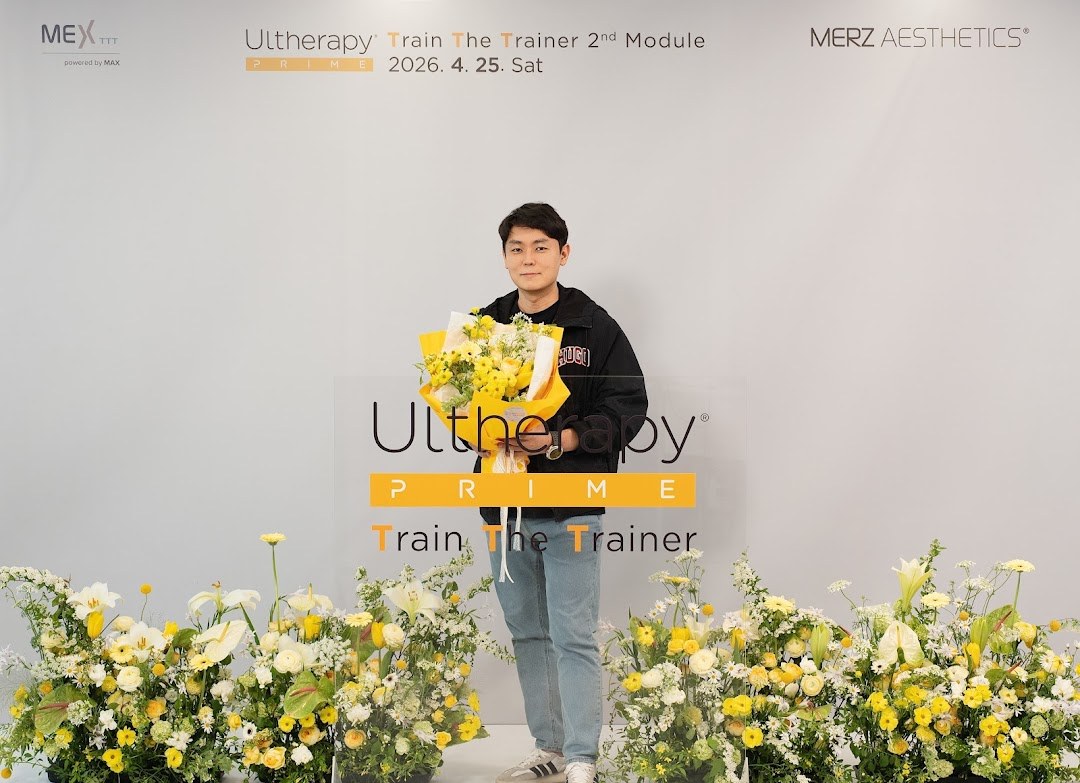
Attending the 2026 Ultherapy PRIME Train The Trainer 2nd Module
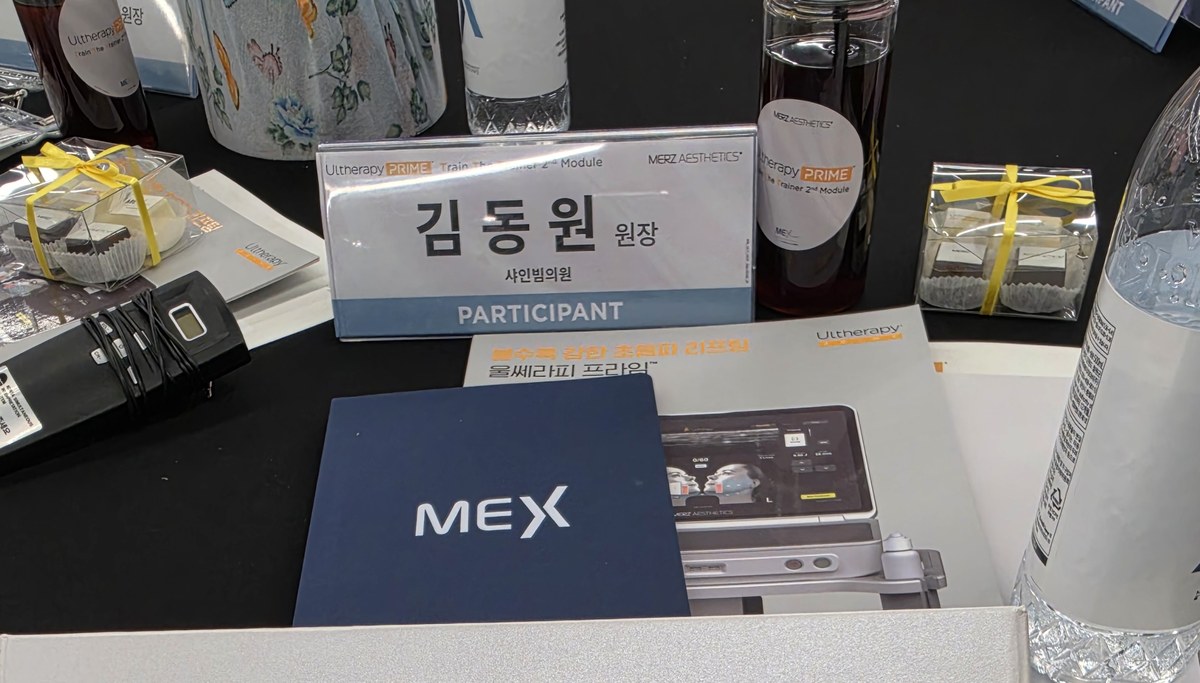
On site — Ultherapy PRIME Train The Trainer 2nd Module
| Category | How it works | Mainly aimed at |
|---|---|---|
| Thermage | Delivers radiofrequency (RF) heat uniformly across the skin | Skin tone and texture, overall firmness |
| Ultherapy | Focuses high-intensity focused ultrasound (HIFU) into the deep reticular dermis and the fascial layer beneath it (SMAS) | Areas of sagging, jawline and contour |
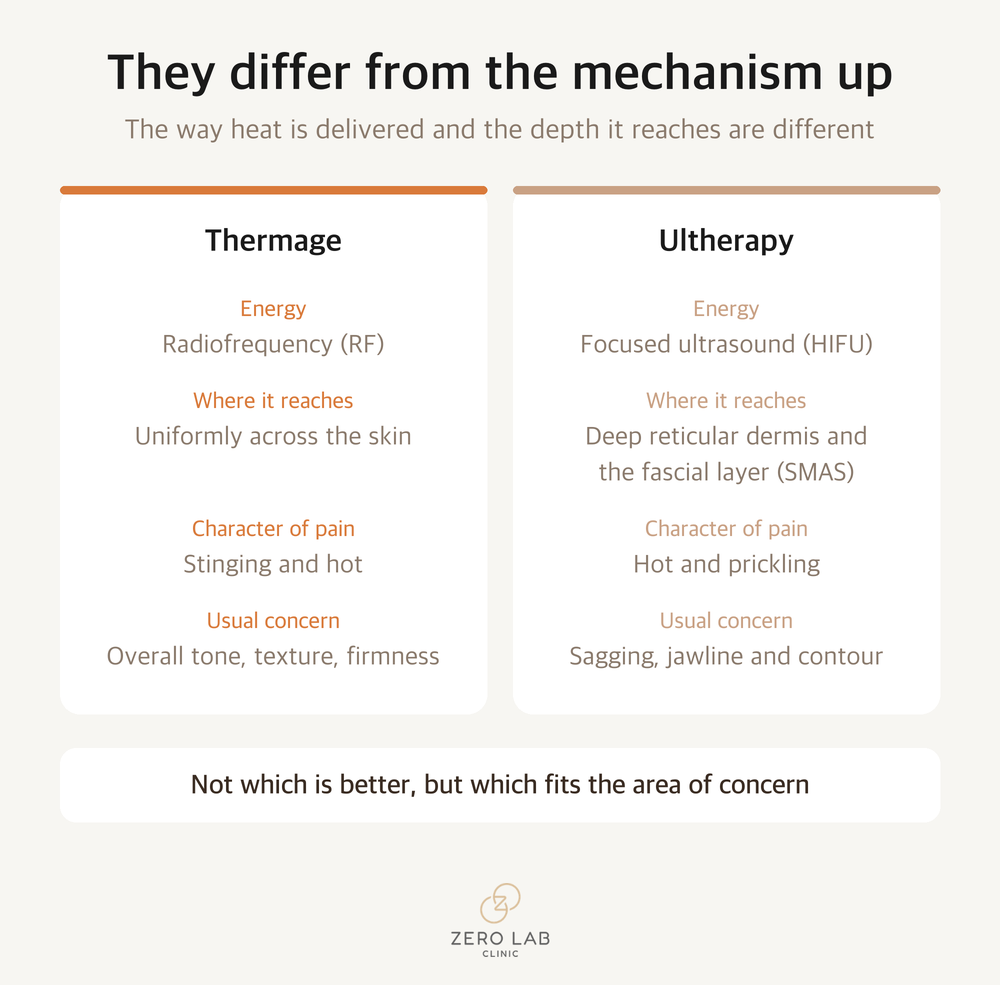
Both procedures point in a similar direction in that they induce skin regeneration, but they differ in how the heat is delivered and how deep it reaches. Radiofrequency delivers heat to the dermis to induce collagen regeneration, while focused ultrasound gathers heat at set depths down to the deep reticular dermis and the fascial layer beneath it (SMAS)[1]. The monopolar radiofrequency used in Thermage is a modality with a relatively large accumulated body of clinical research on wrinkles and firmness[2], and the focused ultrasound used in Ultherapy also has clinical results reported for improvement of facial and neck laxity[3]. So depending on whether the concern is overall tone and texture or sagging in a specific area, we guide people differently. Rather than declaring one flatly superior, we think it is right to choose according to the area of concern and the change you want.
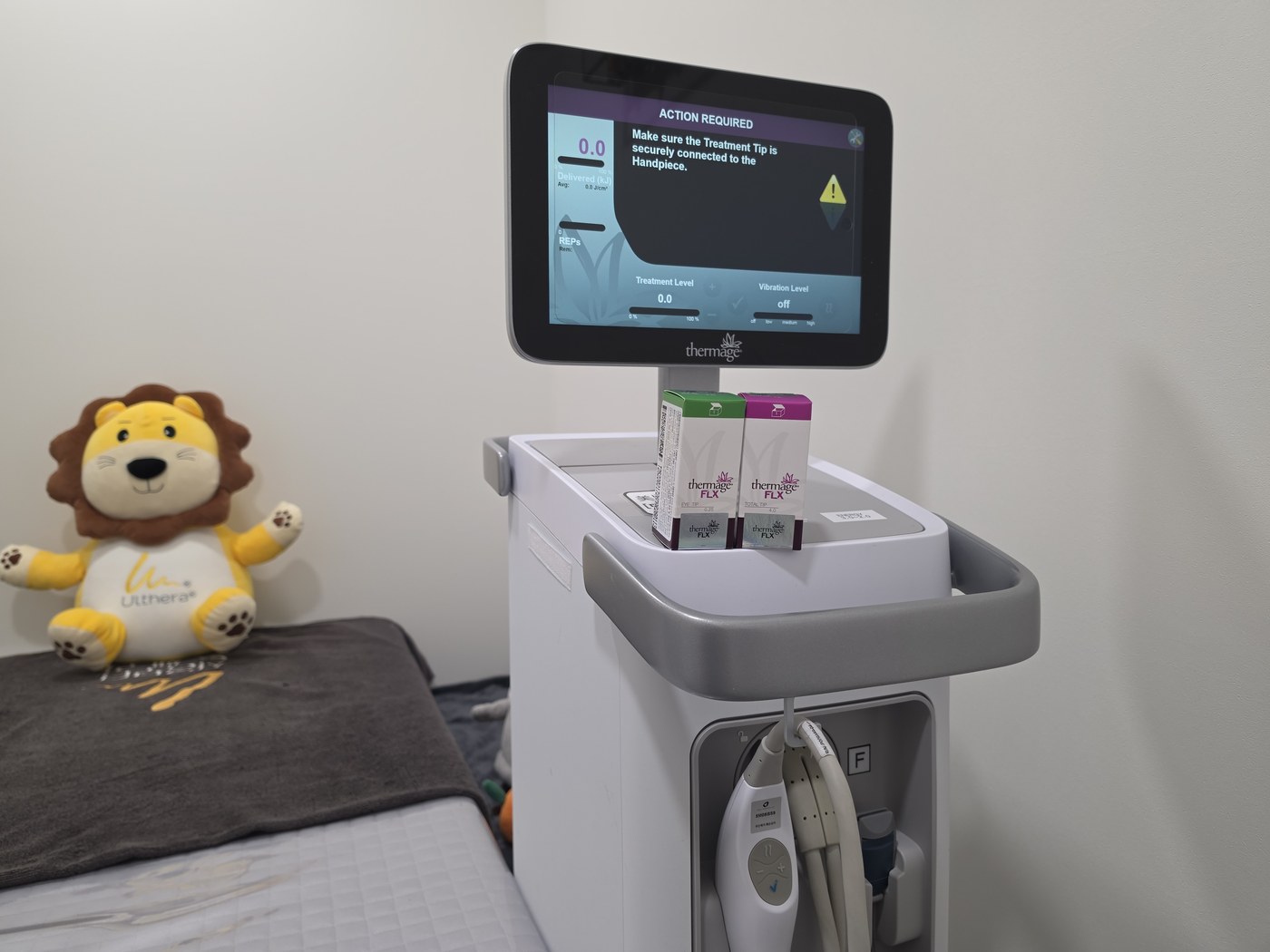
The Thermage FLX system and its treatment tips in our treatment room
The pain has a different character
Because the methods differ, the pain you feel and the way you recover differ as well.
- Thermage comes with a stinging sensation and a stronger sense of heat. That said, the tip structure changed in the middle of last year and the cooling improved, and since then many people tell us the pain has dropped considerably
- Ultherapy brings heat together with a prickling pain. Some people mention a sensation like sensitive teeth when the jawline area is treated
- There is individual variation by pain sensitivity and treatment area, so the same energy is felt differently from person to person
There are also ways that help reduce the pain.
- We apply topical anesthetic cream for a sufficient length of time before the procedure
- We adjust the intensity (energy level) in stages to match the condition
- Where needed, we add an anesthetic injection to lower the pain you feel
Some people ask about sedation, so let me give you our position on it. Procedures on the order of Thermage or Ultherapy can be received perfectly well without sedation. Sedation is a procedure for which accidents are reported, rarely but genuinely, so relative to the difficulty of the procedure we consider the risk too large to take on. We therefore suggest managing it with anesthetic cream and an anesthetic injection first, and we judge carefully whether sedation is genuinely necessary.
Especially if it is the first procedure you are having, we explain the anesthesia method and the expected level of pain in advance at the consultation stage.
How to care for your skin afterwards
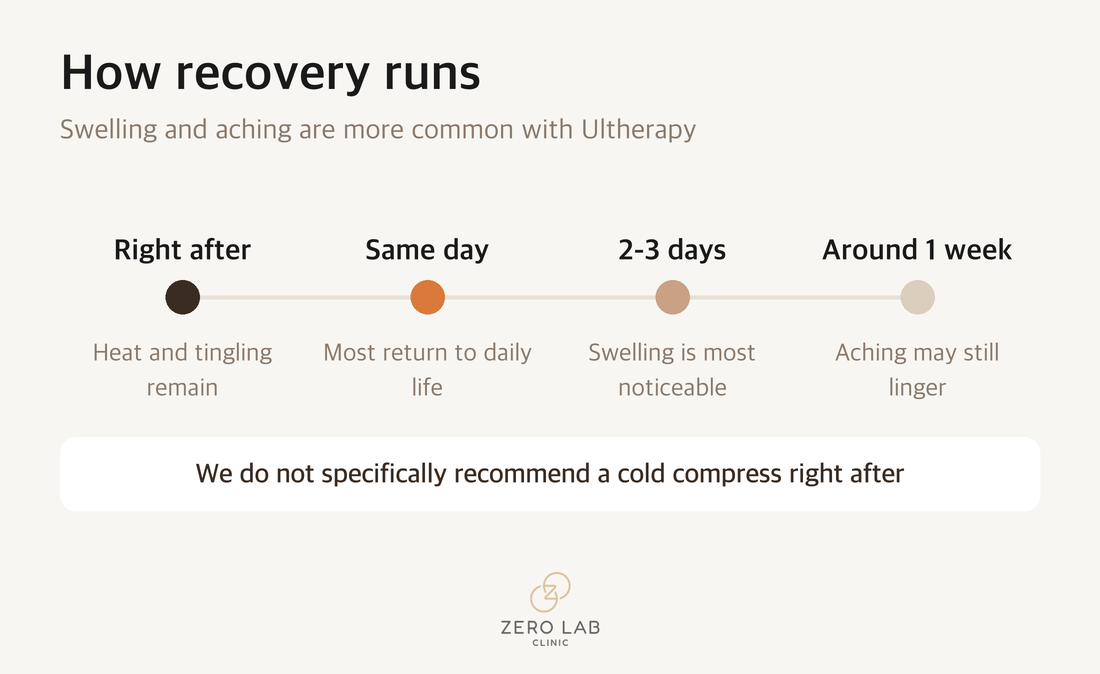
The few days after the procedure affect the result a fair amount, more than the procedure itself. The treated area is temporarily more sensitive, so being thorough with sun protection helps more than usual. Activities that raise body heat, such as saunas or intense exercise, are best avoided for a few days right after. For cosmetics, stick to the gentle products you normally use, and give harsh exfoliating products a rest for a while. Recovery runs a little differently between the two. With Thermage, redness or a feeling of warmth usually passes within a day or two. Ultherapy tends to bring noticeable swelling, and an aching feeling can continue for about a week. Knowing this in advance keeps it from being alarming, so we always mention it in consultation.
One more thing: we do not specifically recommend a cold compress right after the procedure. If the heat is uncomfortable, cool air is enough, and if swelling or pain lasts longer than expected, contacting us is better than treating it yourself.
Many people tell us that keeping to just this much makes recovery considerably easier.
So which one is right for me
When choosing between Thermage and Ultherapy, we suggest thinking along these lines.
- If your concern is overall tone, texture, and firmness across the face, many people look at Thermage first
- If your concern is the jawline or sagging in a particular area, many people consider Ultherapy alongside it
- Some people combine the two, so working out the combination through consultation is the accurate route
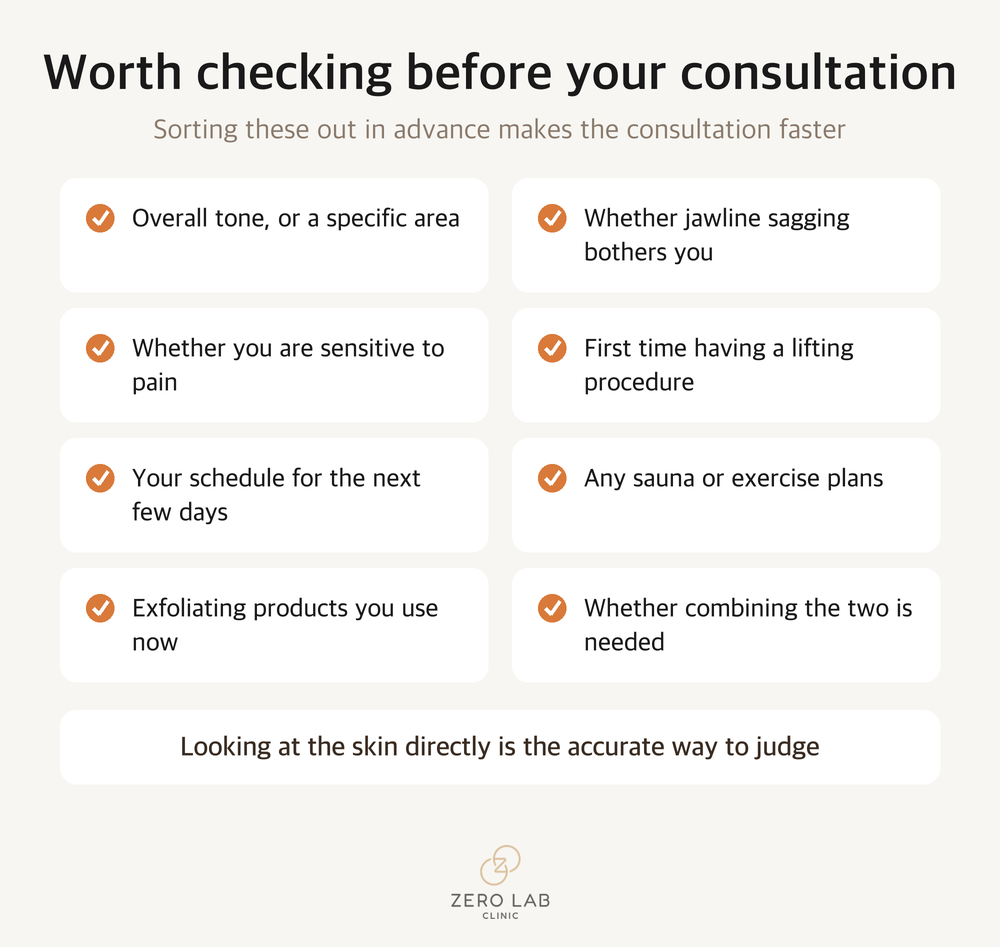
Many people ask me which one is better. My answer is always the same. It is not that one device is better — what comes first is which layer your face needs right now. Looking at the skin directly is the most accurate way to judge, but simply knowing that the two devices reach different layers settles which explanation you need to hear.
Skin boosters and scar care are a different kind of question, so we covered each separately.
Procedures covered in this article
Prices and booking
References
[1] MacGregor JL, Tanzi EL. Microfocused ultrasound for skin tightening. Semin Cutan Med Surg. 2013;32(1):18-25. PMID: 24049925. https://pubmed.ncbi.nlm.nih.gov/24049925/
[2] Polder KD, Bruce S. Radiofrequency: Thermage. Facial Plast Surg Clin North Am. 2011;19(2):347-59. DOI: https://doi.org/10.1016/j.fsc.2011.04.006
[3] Baumann L, Zelickson B. Evaluation of micro-focused ultrasound for lifting and tightening neck laxity. J Drugs Dermatol. 2016;15(5):607-14. PMID: 27168269. https://pubmed.ncbi.nlm.nih.gov/27168269/
The three papers above are indexed in PubMed. The descriptions of pain and recovery in this article reflect general tendencies from clinical experience rather than study results, and decisions about an individual's skin condition are made through consultation.
Some images in this article were generated with AI.
This article was written directly by Zero Lab Clinic to provide medical information. Results of any procedure vary with individual skin condition, and side effects are possible. Please decide on a procedure only after an in-person consultation with a doctor.