

Zero Lab Skin Lecture
Retinol: Push Through, or Stop?
Hello, I am Dr. Dong Won Kim, Medical Director of Zero Lab Clinic, one minute from Hongdae (Hongik Univ.) Station Exit 1.
Some patients come to see us after starting retinol and finding that their skin has broken out. The question is almost always the same one. "Can I keep using this?" This is a question I answer only after asking a good many of my own.
Search online and the answer has already been decided for you: what was sitting underneath is coming to the surface, it is a normal process, endure it for 2 to 4 weeks. The word "purging," carried over from English-language skincare writing, is attached to it, and you will find it on cosmetic brand pages and information sites.
Today I want to begin with whether that instruction to endure has any evidence behind it.If you are deciding whether to push through or stop, that has to come first.
Is there evidence for "just endure it"?
There is a paper that takes this question head-on. Its title is literally "Do topical retinoids cause acne to 'flare'?"
The authors searched for data that would support or refute this received wisdom, reviewing results from clinical trials. Their conclusion was this. No primary clinical trial data supporting the idea that starting a topical retinoid makes acne worse could be identified. If anything, the available data pointed toward acne improving even in the first 1 to 2 weeksof treatment[1].
Then what is happening to the people who genuinely do get worse? The authors suggest that while some patients may see worsening in the first 1 to 2 weeks, this may simply be the natural fluctuation of acne as a disease[1].
This matters because it undercuts the premise of "what you are seeing now means the medication is working, so hold on." The promise that enduring leads to improvement does not rest on as firm a foundation as it appears to.
Two things should be stated precisely, though. This review looked at topical retinoids used to treat acne, and there is even less data on retinol used as a cosmetic. And it was published in 2009. As far as we can find, no clinical trial has taken up this question directly since.
So what is actually common
It has a name of its own: retinoid dermatitis.Dryness, flaking, redness, and stinging belong here. This side does have both a name in the literature and numbers attached to it.
In a study that followed 250 patients prescribed topical treatment for acne, 45.6% discontinued treatment. The reasons given were lack of efficacy in 62.3% and side effects in 37.7%[2].
Close to half do not make it to the end. If you started and gave up, you are not unusual.
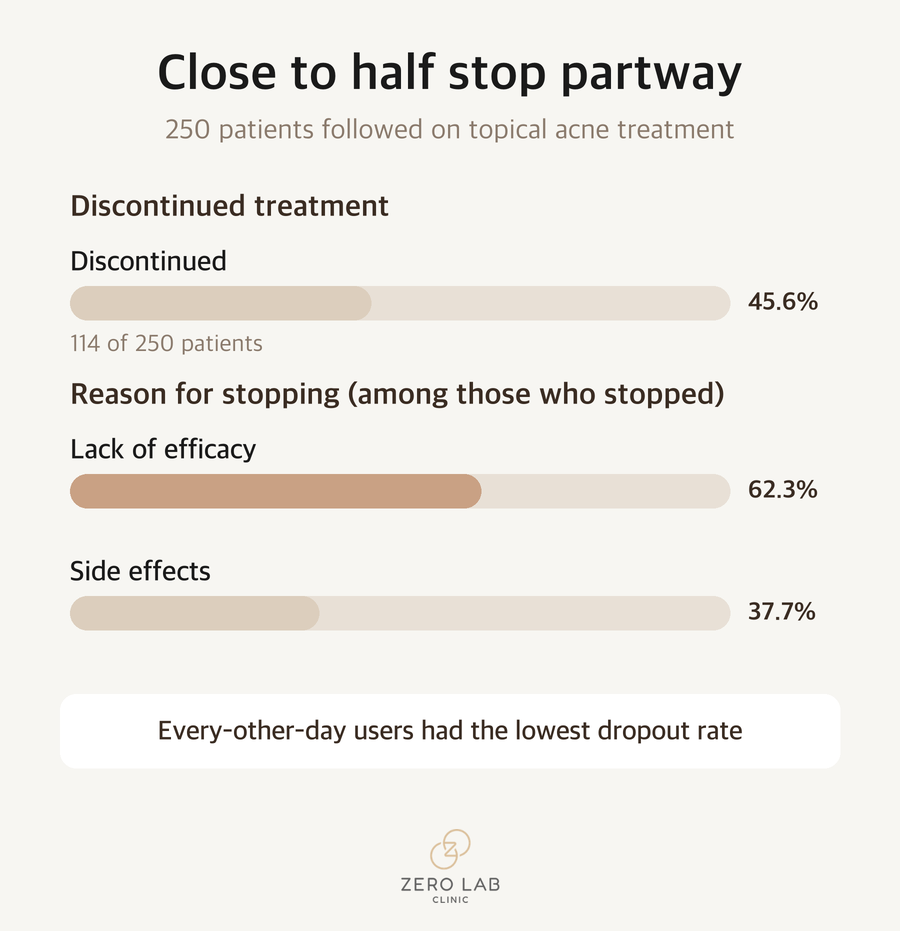
There is one more finding worth noting in the same study. Side effects and discontinuation were lowest among those who applied it every other day rather than daily[2]. Applying more often is not always the better choice.
On the other side, there are reports that reactions such as redness, dryness, and sensitivity — and the discontinuation that follows from them — can be reduced with supportive care. One survey found that patients who used a routine combining gentle cleansing, moisturizing, and sun protection had less retinoid dermatitis and fewer treatment interruptions because of it[3]. That said, it was a questionnaire of 28 patients, so it does not carry much evidentiary weight. How to handle sun protection while using retinol is covered in Sunscreen: reapplying matters more than the number.
Our standard is a single one
It comes down to this.
If it interferes with daily life, we consider stopping.
If your skin feels a little tight after washing and some flaking appears, you can adjust the frequency and carry on. But if the flaking is heavy enough that makeup will not sit on your skin, if the burning keeps you awake, or if there is swelling and oozing, that is a different matter. That is not something to write off as part of adjusting.
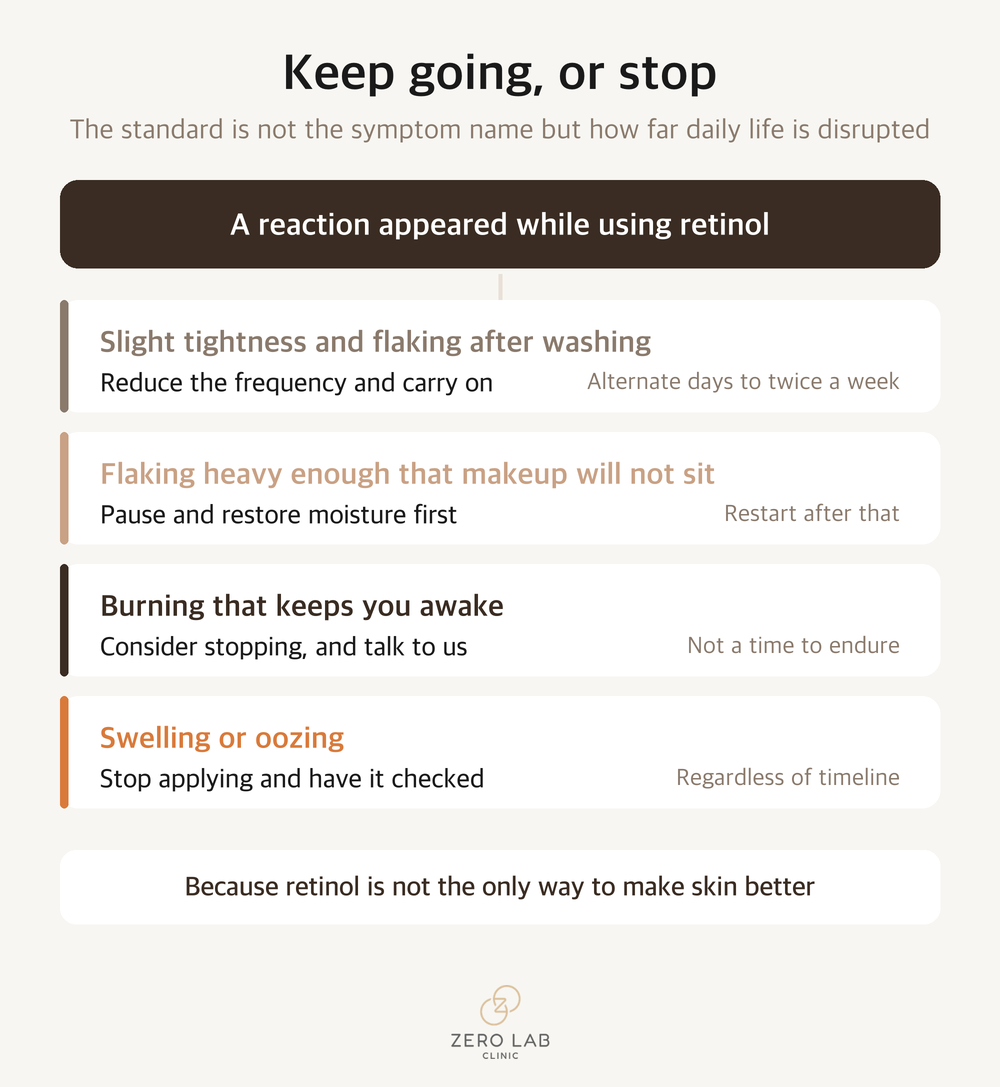
There is a reason we set the bar there. Retinol is not the only way to make skin better.
As we saw above, the promise that enduring leads to improvement is not clearly supported, and there is no reason to bear the discomfort on that basis. If there were no reasonable alternatives, accepting some degree of it might be a defensible call. That is not the situation here.
6 to 8 weeks is not a period of endurance
These two often get mixed up.
Guidance on managing acne recommends that when starting topical treatment, patients be advised in advance on how to avoid irritation, and be told that it takes 6 to 8 weeks for an effect to appear[4].
So 6 to 8 weeks means "you need at least this long to judge whether it is working", not "endure this long even if it hurts".
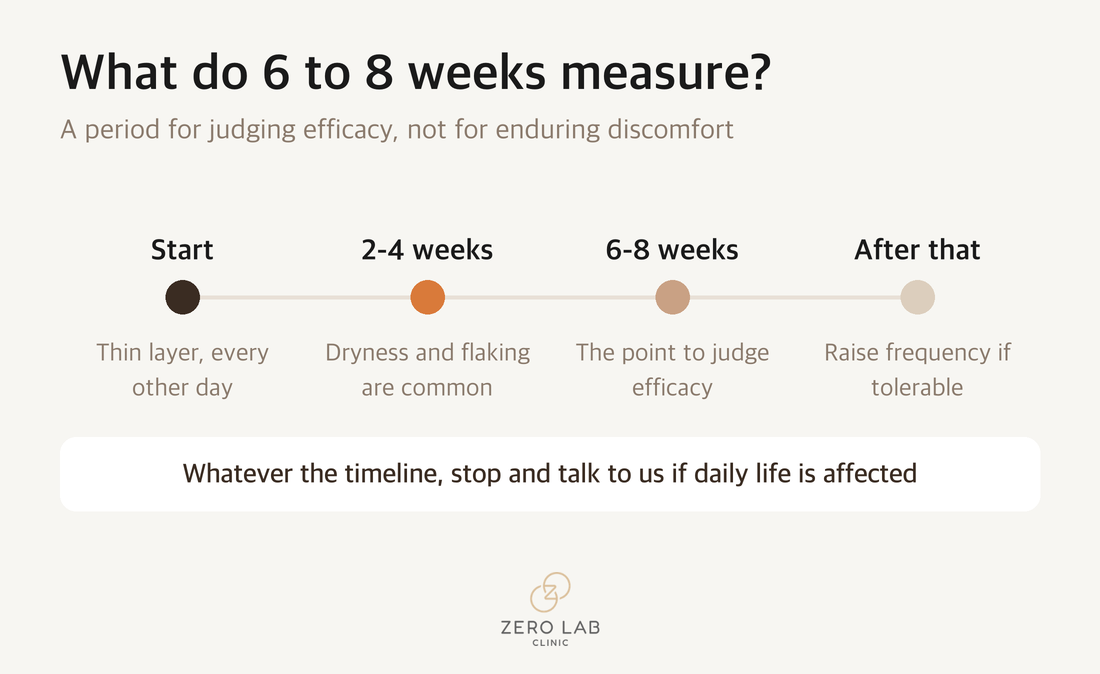
Keep the two separate. Using it for two weeks and concluding "this is not working" is premature. Conversely, being sore and burning for 6 straight weeks while thinking "I have to hold out until week 8" has no basis behind it. The timeframe applies only to the efficacy side.
If acne is the reason, retinol is not essential
I want to be clear about this part.
There are several distinct approaches to acne. There is the medication side, which includes topical treatment and antibiotic therapy; there is the device side; and there is care aimed at rebuilding the skin barrier. Retinoids are one of these, not a gate that everyone has to pass through.
Let me look at the device side. In one study, 20 patients with inflammatory acne received 3 sessions of 1450-nm diode laser treatment and were assessed by imaging analysis. Porphyrin and red-area scores improved across successive sessions, and the physician-rated global improvement scale improved significantly as well. However, there was no meaningful change in sebum production itself[5].
A systematic review pooling 23 studies of energy-based devices reported that photodynamic therapy and radiofrequency reduced sebum levels by roughly 30 to 40%, that lasers produced smaller reductions, and that light-therapy studies varied widely and carried a high risk of bias[6].
I am not citing these numbers to argue that devices are better. The opposite. By weight of evidence, this side is thinner than retinoids. The studies are small, the designs differ from one another, and the outcome measures are not standardized.
What does hold is that this is not a situation with only one option, and so there is no reason to cling painfully to a single one. Which approach to take is decided by looking at the type of acne and the current state of the skin. It is not a question that starts with "let us endure the retinol first and see."
The barrier side follows the same logic. In a randomized, double-blind patch test comparing irritation-reducing ingredients, a physiologic lipid mixture of ceramides and cholesterolclearly reduced the erythema and inflammation caused by retinol. Yet in the same study, 3% niacinamide did not reduce retinol irritation[7]. The idea that using the two together makes things less stinging is widespread, but at least in this trial it was not confirmed. This does not mean niacinamide is a poor ingredient. It means the evidence for this particular purpose is weak.
If you have decided to use it anyway
Many people use retinol for aging-related care, so let me lay this out.
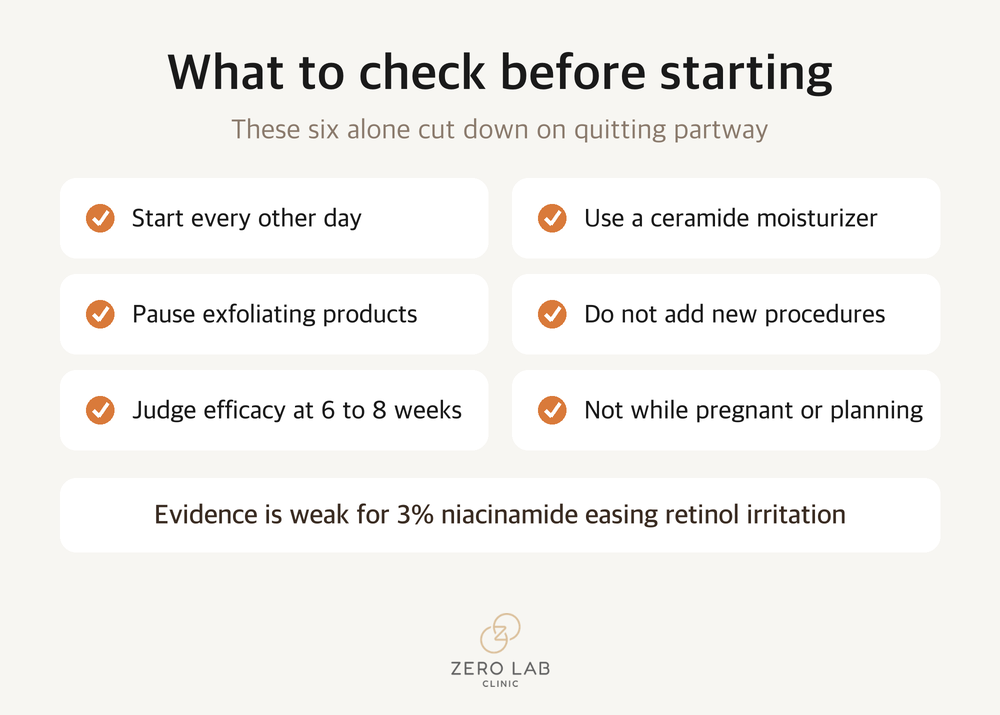
First, start every other day. There is data showing lower side effects and discontinuation than with daily application[2], and you can raise the frequency once it becomes tolerable. That is better than applying it daily from the start and quitting within a week.
Second, use a moisturizer alongside it. A product containing ceramides is an evidence-based choice[7]. Applying a thin layer of moisturizer before the retinol is another way we use to reduce irritation.
Third, do not stack other irritants. If you begin exfoliating products or a new procedure during the adjustment period, you will not be able to tell what caused a problem when one appears.
Fourth, judge efficacy at 6 to 8 weeks[4], but before that, if it is interfering with daily life, stop and talk to us.
Fifth, do not start if you are pregnant or planning to be. This is something we ask about first in consultation.
There is more than one member of the family
Retinol, retinaldehyde, and tretinoin look like entirely different ingredients, but they sit on a single line. The form that ultimately acts in the skin is retinoic acid, and retinol and retinaldehyde are the steps before it. Retinol converts to retinaldehyde, and retinaldehyde converts to retinoic acid.
Put another way, the fewer the conversion steps, the faster the effect and the greater the irritation.
| Ingredient | Steps to retinoic acid | Category | Irritation tendency |
|---|---|---|---|
| Retinol | Two steps | Cosmetic | Relatively low |
| Retinaldehyde | One step | Cosmetic | Intermediate |
| Tretinoin | Acts directly, no conversion | Prescription required | Greatest |
A systematic review comparing treatments for photoaging notes that while tretinoin is established as the reference agent in this field, its use is often limited by poor tolerability.In a substantial share of the 25 studies compared, the comparator agent caused less irritation and was better tolerated[8].
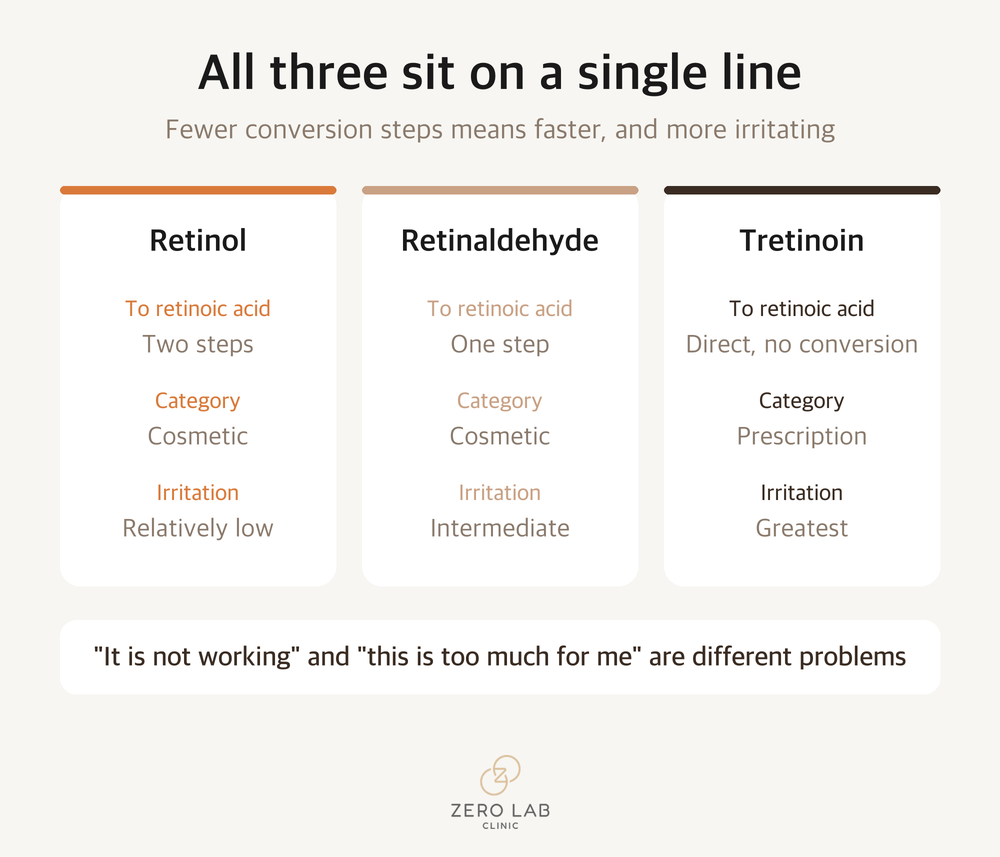
So "it is not working" and "this is too much for me" are entirely different problems. For the first, consider moving up a step. For the second, reduce the frequency before anything else. Jumping straight to something stronger because the irritation was hard to take has the order backwards.
There are also options outside the family. In a 12-week trial comparing bakuchiol with retinol, there was no statistically significant difference in the improvement of wrinkles and pigmentation, while retinol users reported more scaling and stinging[9].
It is worth addressing whether the wait is worth it at all. In a 24-week randomized controlled trial in 36 elderly participants with a mean age of 87, the arm treated with 0.4% retinol lotion showed significant improvement in fine wrinkle scores (-1.64 versus -0.08), and biopsies showed increases in both glycosaminoglycan and procollagen I[10]. In a study where 23 Korean participants applied retinaldehyde to one side of the face and retinol to the other for 8 weeks, wrinkle depth improved significantly on both sides and no adverse events were reported[11].
This is not to say the ingredient does not work. It is to say that you only reach that effect if you use it within a range you can tolerate.That is where the 45.6% who stop partway come from.
In summary
- The claim that "it is purging, so endure it" is not supported by clinical trial data[1]
- What is common is retinoid dermatitis, and close to half discontinue partway[2]
- 6 to 8 weeks is the period for judging efficacy, not for enduring discomfort[4]
- If it is interfering with daily life, you are better off stopping and discussing it
- If acne is the goal, retinoids are not a path everyone has to take
Many people ask whether they should keep pushing through. I rarely tell anyone to endure it. Enduring is not the point of retinol. If you write down the concentration of the product you are using now and how often you apply it, whether to continue or change direction is something we can sort out on the spot.
If the barrier has already weakened, reworking how you wash your face is the faster place to start. We have covered that separately.
Treatments covered in this article
Prices and booking
References
[1] Yentzer BA, McClain RW, Feldman SR. Do topical retinoids cause acne to "flare"? J Drugs Dermatol. 2009;8(9):799-801. PubMed: https://pubmed.ncbi.nlm.nih.gov/19746671/
[2] Sevimli Dikicier B. Topical treatment of acne vulgaris: efficiency, side effects, and adherence rate. J Int Med Res. 2019;47(7):2987-2992. DOI: https://doi.org/10.1177/0300060519847367
[3] Belmontesi M. Integrating Dermocosmetic Therapy for Acne: Addressing Severity Levels in Real-Life Experiences. J Drugs Dermatol. 2025;24(1):88-94. DOI: https://doi.org/10.36849/JDD.8877
[4] Santer M, Burden-Teh E, Ravenscroft J. Managing acne vulgaris: an update. Drug Ther Bull. 2024;62(1):6-10. DOI: https://doi.org/10.1136/dtb.2023.000051
[5] Chu GY, Huang CC, Shih NH, Hsu CH, Wu CY. The 1450-nm Diode Laser Reduces Redness and Porphyrin Density: An Image-Based, Patient-Oriented Appraisal. J Clin Med. 2023;12(13):4500. DOI: https://doi.org/10.3390/jcm12134500
[6] Jaalouk D, Pulumati A, Algarin YA, Humeda J, Goldberg DJ. The impact of energy-based devices on sebum in acne vulgaris: A systematic review. J Cosmet Dermatol. 2024;23(10):3066-3077. DOI: https://doi.org/10.1111/jocd.16466
[7] Fang Y, Ying Y, Xiaolan W, et al. Mitigation of retinol-induced skin irritation by physiologic lipids: Evidence from patch testing. J Cosmet Dermatol. 2024;23(8):2743-2749. DOI: https://doi.org/10.1111/jocd.16330
[8] Siddiqui Z, Zufall A, Nash M, Rao D, Hirani R, Russo M. Comparing Tretinoin to Other Topical Therapies in the Treatment of Skin Photoaging: A Systematic Review. Am J Clin Dermatol. 2024;25(6):873-890. DOI: https://doi.org/10.1007/s40257-024-00893-w
[9] Dhaliwal S, Rybak I, Ellis SR, et al. Prospective, randomized, double-blind assessment of topical bakuchiol and retinol for facial photoageing. Br J Dermatol. 2019;180(2):289-296. DOI: https://doi.org/10.1111/bjd.16918
[10] Kafi R, Kwak HSR, Schumacher WE, et al. Improvement of naturally aged skin with vitamin A (retinol). Arch Dermatol. 2007;143(5):606-612. DOI: https://doi.org/10.1001/archderm.143.5.606
[11] Kim J, Kim J, Jongudomsombat T, et al. The efficacy and safety of multilamellar vesicle containing retinaldehyde: A double-blinded, randomized, split-face controlled study. J Cosmet Dermatol. 2021;20(9):2874-2879. DOI: https://doi.org/10.1111/jocd.13993
The references above are papers indexed in PubMed. This article provides general medical information; decisions about an individual's condition are made through consultation.
This article was written directly by Zero Lab Clinic to provide medical information. Results of any procedure vary with individual skin condition, and side effects are possible. Please decide on a procedure only after an in-person consultation with a doctor.