
Zero Lab Treatment Information
Pores: Why One Laser Isn't Enough
Hello, I am Dr. Dong Won Kim, Medical Director of Zero Lab Clinic, one minute from Hongdae (Hongik Univ.) Station Exit 1.
The question that comes up most often in pore consultations is, "How many laser sessions will make them go away?" Not being able to give a clean answer to that is something I always regret. To be honest, pores are less something you remove than something you make less visible. What is fairly clearly established, though, is why that is and what actually changes things. Today I will go through the three reasons pores look large, how to tell which one your own pores are closer to, what pushes pores to get larger, and why this does not end with a single session, along with the research behind each point.
There are three main reasons pores look large
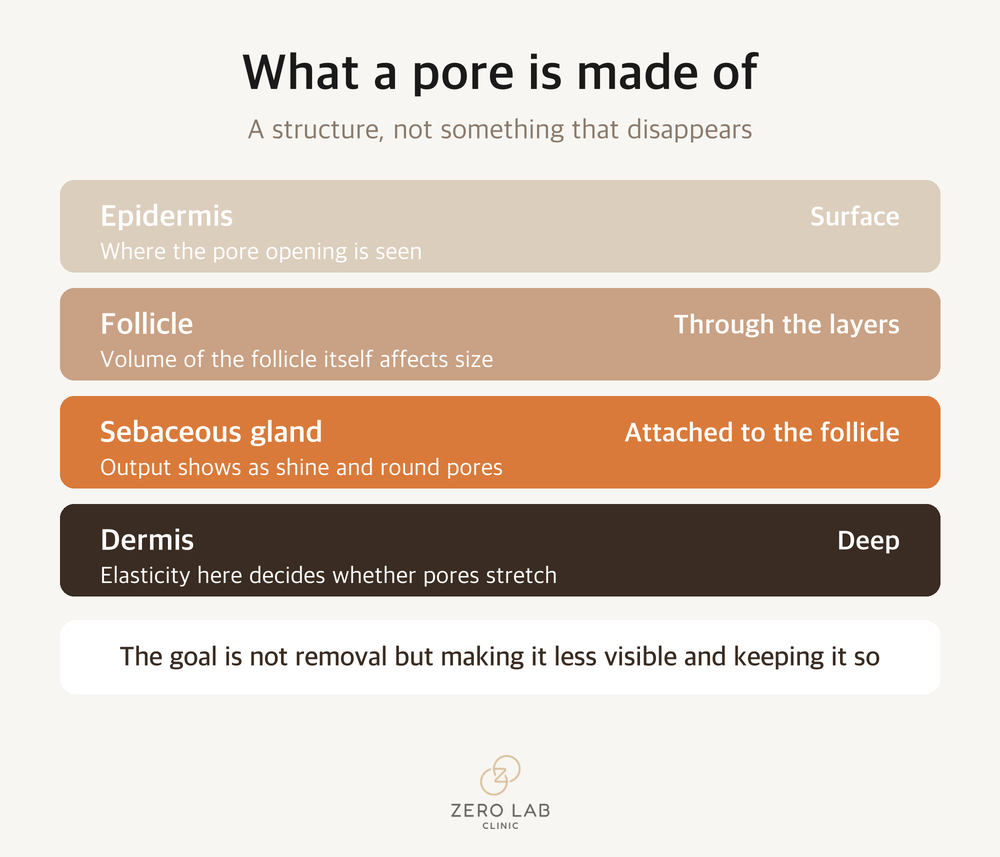
A review article on facial pores sorts the main causes of visible pore enlargement into three: high sebum secretion, loss of elasticity around the pore, and an increase in the volume of the follicle itself [1]. On top of these, recurring acne, sex hormones, and everyday skincare habits are also considered to affect pore size.
These three do not act separately; they are usually mixed together. Even with the same complaint of "large pores," the pores that show up along with shine on oily skin in someone in their 20s and the pores that look elongated as the lower cheek sags in someone in their 40s have different causes. That is why the same paper states firmly that, since the causes run in several directions, treatment has to be individualized for each patient [1].
Pore reduction: which type are my pores closer to?
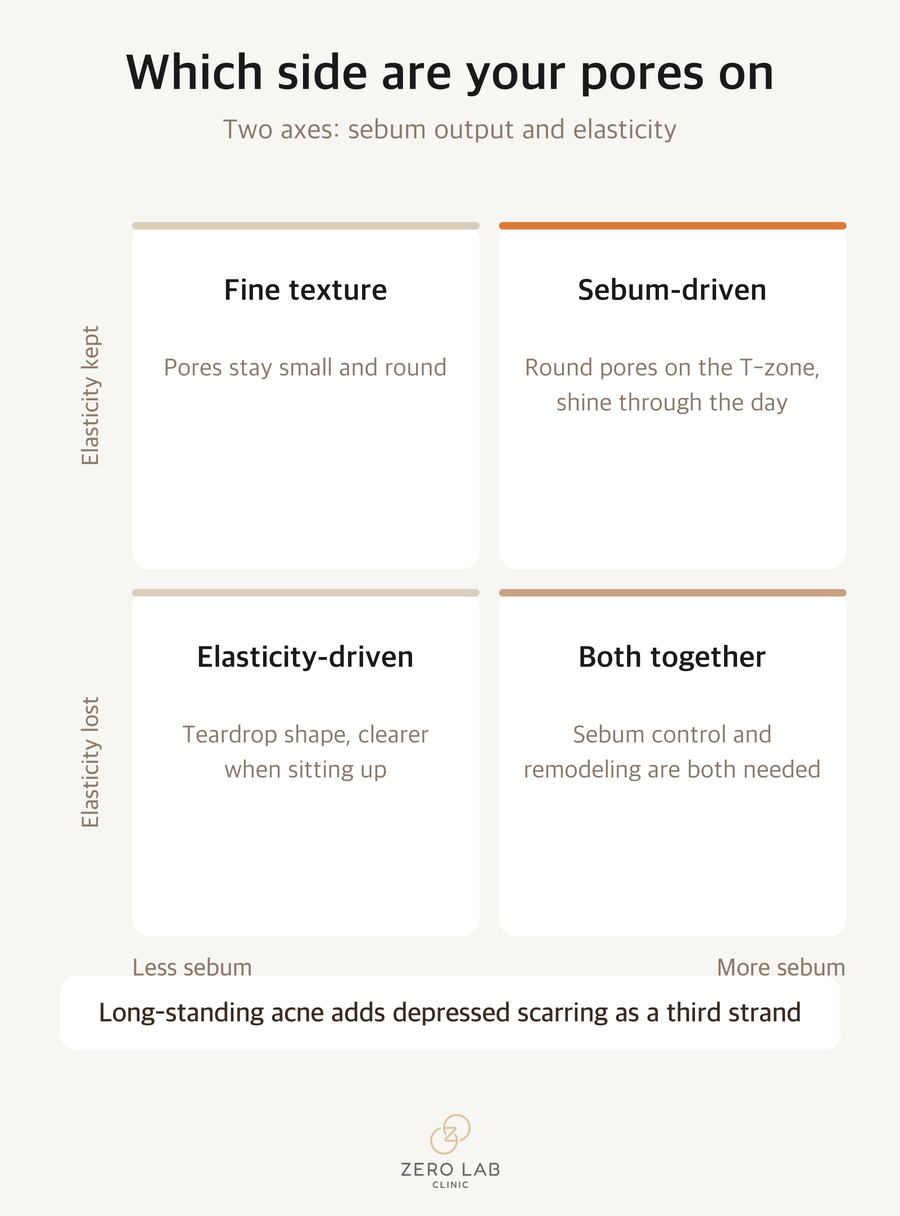
There are two axes that separate the causes: whether there is a lot of sebum, and whether elasticity has dropped.
When sebum is the main factor, round pores stand out on the T-zone and the inner cheek, and shine through the day comes with it. When elasticity is the main factor, pores look less round and more like teardrops pulled downward, and they are less visible lying down but stand out when sitting up. In people who have had acne for a long time, indented scarring is layered on top of this, which becomes a third branch. If pitted scars left behind by acne are part of your concern as well, Acne Scars: There Is an Orderis worth reading alongside this.
This distinction matters because the approaches are the opposite of each other. A review that organized pore treatments concludes that in younger patients the focus should be on controlling sebum secretion, while in older patients the focus should be on regeneration in addition to sebum control [2].
Things that push pores toward getting larger
The three causes are, for the most part, something you are born with. On top of that, though, what you do every day is layered. The pore treatment review cited above lists, in its very first sentence, age, sex, genetics, UV exposure, ethnicity, and sebum secretion together as factors affecting pore size [2]. Of these, the items I can actually change are, in practice, UV and sebum.
Let me start with acne. There is a study that assessed the faces of 2,895 women aged 10 to 70 from photographs and directly measured sebum output and pore size. Acne appeared together with large pores (p=0.001) and sebum output (p=0.002), and smokers had more acne than non-smokers, mostly comedonal [7]. A comedo is a pore in a blocked state. When blocking and stretching repeat, the pore stays that way. That said, this study was a cross-sectional survey capturing a single point in time, so it cannot conclude that smoking is the cause.
There are numbers on diet and body weight as well. In a study that divided 540 women aged 18 to 35 into an oily-skin group and a non-oily group for comparison, the risk of oily skin was 3.3 times higher with a first-degree family history and 1.7 times higher when body mass index exceeded 24. Drinking milk more than three times a week carried 1.6 times the risk, and eating sweets more than three times a week 2.0 times. In the same study, smoking and drinking were not associated with oily skin [8]. The smoking result differs from the earlier study, but one looked at acne and the other at oily skin, so they cannot simply be laid over each other.
What about heat and sweat? Over the short term, heat pushes out more sebum. A study looking at seasonal changes in sebum confirmed that ambient temperature affects the rate of sebum excretion, while noting that what increases is the amount of sebum reaching the surface, not the number of active sebaceous glands [11]. In a study that measured 100 Korean men in summer and again in winter, sebum was higher in summer and the pore count was also significantly higher[12].
Over the long term, it is elasticity that is at stake. A study organizing the effects of infrared radiation and heat on human skin explains that heat exposure induces matrix metalloproteinases in the dermis and breaks down the extracellular matrix [13]. A review of rosacea listing temperature changeamong its triggering and aggravating factors points in the same direction [14].
So work that keeps you standing in front of a flame, as in a kitchen, or an environment where being covered leaves you hot and humid all day long, may be unfavorable for both pores and facial redness. That said, there is no study surveying these occupational groups specifically, so up to this point it is an inference drawn from the condition of heat.
Skincare habits are on the list too. A review organizing the definition and causes of pores lists everyday skincare practicesalongside recurring acne and sex hormones as factors affecting pore size [1]. Squeezing pores empty, frequently stripping away dead skin, and skipping sun protection fall under this.
These items are not things a procedure reverses. What they decide instead is how long the result a procedure creates is held on to. As I will explain later, pores are not an area with a generous set of treatment options. That is why not losing ground here actually leaves more behind.
How far lasers go in pore reduction
This is not at all to say that lasers do not work. But when you know what a given device acts on, your expectations become accurate.
Fractional picosecond-laser devices are described as creating optical breakdown in the epidermis and cavitation in the dermis, thereby inducing skin regeneration and dermal remodeling. Positive effects have indeed been reported in photoaging, pores, pigmentation, wrinkles, and atrophic scars. The same review, however, attaches the caveat that further study is still needed [3].
On the fractional CO2 laser side, the numbers are more specific. In a study of 9 Asian patients, the assessed items including pores improved significantly, but the authors wrote that with a single session the degree of improvement was only mild to moderate. At one month after treatment, hyperpigmentation appeared in 55.6%. By six months it had fallen to 11.1%, but in Asian skin this is not something that can be left out of the conversation [4].
| Category | What it mainly acts on | Limitation |
|---|---|---|
| Fractional lasers | Dermal remodeling, scars and texture | Does not change sebum output itself |
| Sebum control approaches | Output, shine | Do not reverse elasticity that has already been lost |
| Regenerative and injectable treatments | Elasticity around the pore | Cannot resolve sebum or scarring on their own |
To sum up, lasers take care of the dermis and scarring; they do not change how much oil the sebaceous glands put out. With three causes in play, using only one tool means touching only one axis and stopping there.
So we combine them
The conclusion of a review that pooled 19 clinical trials on pore treatment, covering 591 participants, says exactly this. When several modalities were combined, the effect on reducing the number and area of pores was greater, and it does not end in one go: multiple sessions are needed [2]. As for side effects, mild and self-resolving burning and erythema were reported as common.
The flow in actual practice is similar. In a survey of 407 aesthetic physicians in Korea, those who said they use polynucleotide (PN) injections for pores most often answered that they use them together with device treatments such as RF microneedling [5]. That said, I will make clear that this was a survey asking physicians about their usage patterns and impressions, not a trial verifying efficacy.
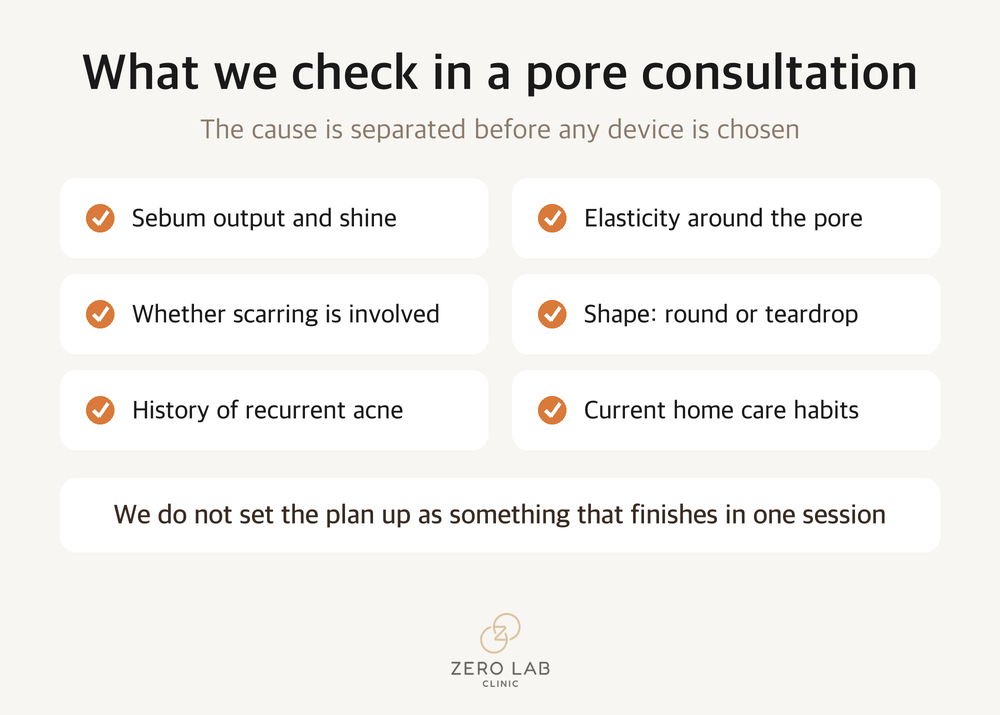
The broad framework we work with in pore reduction consultations has three branches. If sebum is the main axis, we start with controlling secretion; if elasticity is the main axis, we start with dermal remodeling; and if scarring is layered on top, we count scar treatment separately. Either way, we do not set the plan up as something to be finished in one session.
It does not end in one session, and it comes back
If you have read this far, you will have guessed it. Pores are not on the easy side to treat. A review on pores takes as its premise that pore enlargement is a layered process and therefore difficult to treat, explaining that the approach ends up being to address associated factors such as sebum secretion and skin aging [6]. A study that used salicylic acid followed by a laser also opens with a sentence saying that the treatment of acne and pore enlargement remains difficult [9]. This means there is not yet a treatment that removes the cause directly.
A decline in effect is observed as well. In a study where 40 people whose pores had been enlarged by acne were injected with botulinum toxin and non-cross-linked hyaluronic acid together, pores and skin texture improved clearly at one month. But by the fourth month the effect had diminished. It was still better than at the start, but it was not the state it had been in at one month [10].
So we split the plan into several sessions rather than one strong one. The study just mentioned applied 30% salicylic acid four times at two-week intervals over 20 weeks, then followed it with a non-ablative fractional laser three times at four-week intervals. The laser maintained the improvement the salicylic acid had made, and sebum secretion dropped one step further [9]. This was not a result produced by packing everything into a single visit.
The sebaceous glands and the follicles are still there after treatment ends. Since the cause remains, going back toward where it started once care stops is the natural course. That is why, in the first consultation, before how many sessions to do, we talk first about at what intervals to continue. The lifestyle side I described earlier comes up again here. It is what carries you between one session and the next.
Why we set expectations first
A pore is a structure. The sebaceous gland and the follicle do not disappear, so the goal of treatment is less "removal" and more "making it less visible and keeping it that way." What the review pooling clinical trials reported was also not that pores disappeared, but that the number and area were reduced[2]. The figure showing that a single session of fractional CO2 laser gave only mild to moderate improvement points the same way [4].
Turned around, this is also hopeful. With pore reduction, if the direction is right, what you feel follows. If the cause is identified accurately and a combination matched to it is put together, at least the direction to go in becomes clear. Conversely, if the device is chosen before the cause is identified, there are cases where cost and time are spent without any felt change.
Identifying the cause itself does not take long. Sebum output, elasticity, and whether scarring is present as well: checking these three first and then choosing the device is the order that works.
When people ask which device is best, I always say the same thing. The cause has to be identified before the device. Pores are difficult to treat because the causes are layered, the effect diminishes with time, and the options are not generous. So rather than a plan that tries to finish with one strong session, identifying the cause and then continuing at intervals while addressing the lifestyle side alongside itgives better results. This is not to say you should lower your expectations, but to put expectations in the right place.
Acne scarring and the skin barrier often overlap with pores, so I have covered each of them separately.
Treatments covered in this article
Check prices and book
References
[1] Lee SJ, Seok J, Jeong SY, et al. Facial pores: definition, causes, and treatment options. Dermatol Surg. 2016;42(3):277-285. DOI: https://doi.org/10.1097/DSS.0000000000000657
[2] Parvar SY, Amani M, Shafiei M, et al. The efficacy and adverse effects of treatment options for facial pores: a review article. J Cosmet Dermatol. 2023;22(3):763-775. DOI: https://doi.org/10.1111/jocd.15502
[3] Zhou Y, Hamblin MR, Wen X. An update on fractional picosecond laser treatment: histology and clinical applications. Lasers Med Sci. 2023;38(1):45. DOI: https://doi.org/10.1007/s10103-022-03704-y
[4] Chan NPY, Ho SGY, Yeung CK, et al. Fractional ablative carbon dioxide laser resurfacing for skin rejuvenation and acne scars in Asians. Lasers Surg Med. 2010;42(9):615-623. DOI: https://doi.org/10.1002/lsm.20974
[5] Lee D, Choi H, Yoo K, et al. Assessment of current practices and perceived effectiveness of injectable polynucleotide for enlarged facial pores among cosmetic physicians: a survey-based evaluation. Skin Res Technol. 2024;30(9):e13738. DOI: https://doi.org/10.1111/srt.13738
[6] Dong J, Lanoue J, Goldenberg G. Enlarged facial pores: an update on treatments. Cutis. 2016;98(1):33-36. PMID: 27529707
[7] Perkins AC, Maglione J, Hillebrand GG, et al. Acne vulgaris in women: prevalence across the life span. J Womens Health (Larchmt). 2012;21(2):223-230. DOI: https://doi.org/10.1089/jwh.2010.2722
[8] Yang Z, Yang X, Chen X, Wang Y. Influence of family history, body mass index, selected dietary factors, personal habits, and menstrual history on oily skin in young women. J Cosmet Dermatol. 2021;20(11):3661-3665. DOI: https://doi.org/10.1111/jocd.14029
[9] Han Q, Zeng J, Liu Y, et al. Evaluation of 30% supramolecular salicylic acid followed by 1565-nm non-ablative fractional laser on facial acne and subsequent enlarged pores. Lasers Med Sci. 2023;38(1):91. DOI: https://doi.org/10.1007/s10103-023-03751-z
[10] Yang R, Bai Y, Liu C, et al. Combination of botulinum toxin A and hyaluronic acid improved facial pore enlargement caused by acne. J Cosmet Dermatol. 2025;24(4):e70198. DOI: https://doi.org/10.1111/jocd.70198
[11] Piérard-Franchimont C, Piérard GE, Kligman A. Seasonal modulation of sebum excretion. Dermatologica. 1990;181(1):21-22. DOI: https://doi.org/10.1159/000247853
[12] Song EJ, Lee JA, Park JJ, et al. A study on seasonal variation of skin parameters in Korean males. Int J Cosmet Sci. 2015;37(1):92-97. DOI: https://doi.org/10.1111/ics.12174
[13] Cho S, Shin MH, Kim YK, et al. Effects of infrared radiation and heat on human skin aging in vivo. J Investig Dermatol Symp Proc. 2009;14(1):15-19. DOI: https://doi.org/10.1038/jidsymp.2009.7
[14] Nobeyama Y. Rosacea in East Asian populations: clinical manifestations and pathophysiological perspectives for accurate diagnosis. J Dermatol. 2024;51(9):1143-1156. DOI: https://doi.org/10.1111/1346-8138.17411
The 14 papers above are indexed in PubMed. This article is general medical information; judgments about an individual's condition are made through consultation.
This article was written directly by Zero Lab Clinic to provide medical information. Results of any procedure vary with individual skin condition, and side effects are possible. Please decide on a procedure only after an in-person consultation with a doctor.