

Zero Lab Skin Lecture
Acne Scars: There Is an Order
Hello, I am Dr. Dong Won Kim, Medical Director of Zero Lab Clinic, one minute from Hongdae (Hongik Univ.) Station Exit 1.
Many people come in because the acne itself has passed but the scars are still there. For me, too, a scar consultation is always harder than getting the acne under control. Patients tell me makeup does not quite cover them, and that they are on their mind every time a photo is taken. Search online and everyone says something different, which makes it hard to know what to believe.
But in the consultation room, a good number of the people who come in about scars are still breaking out. In that case, going straight at the scars is not the right order. Today I want to go over how the types are told apart, and what to look at first when acne and scarring are mixed together.
Acne scars are not all the same scar
Zero Lab Clinic is in its seventh year, and we have seen more than 200,000 people to date. What that experience has taught us is that caring for acne scars starts with correctly telling the scar types apart.
Depressed scars in particular can look alike at a glance, but the shape of the hollow differs from one to the next. Words alone do not convey that well, so we drew the cross-sections at the same scale.
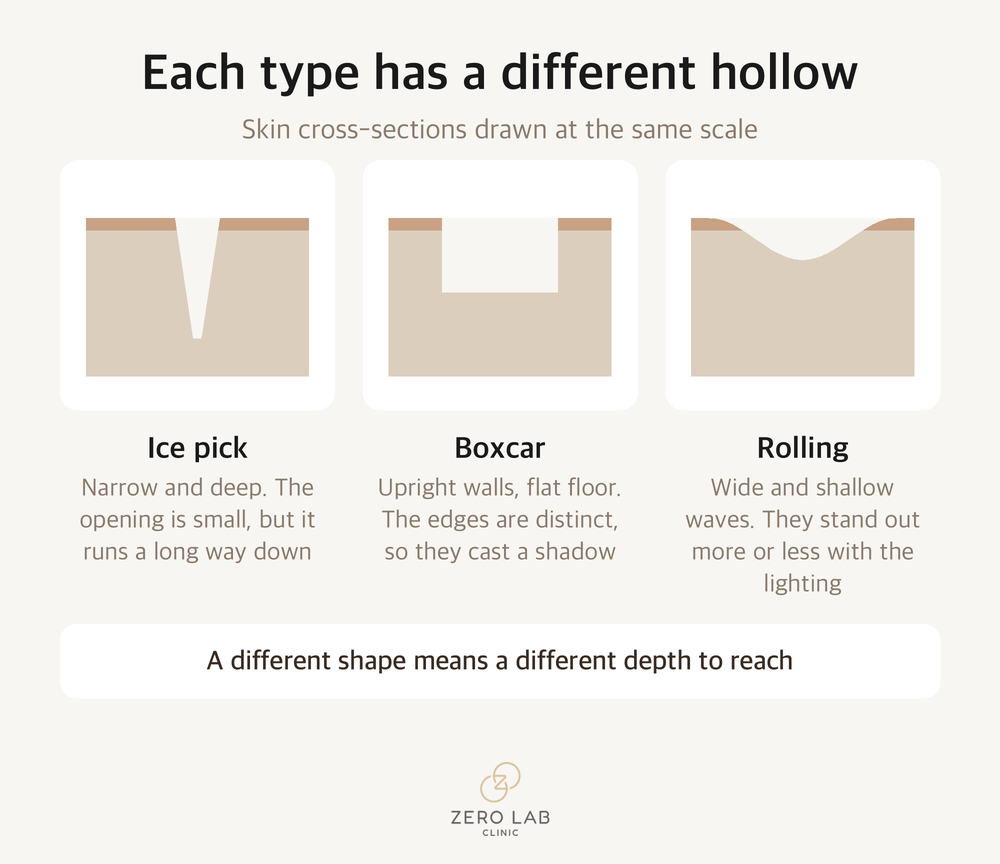
- Ice pick scars are narrow and deep. The opening at the surface is small, but it runs a long way down
- Boxcar scars have upright walls and a flat floor. The edges are distinct, so they cast a shadow
- Rolling scars wave across the skin, wide and shallow. They stand out more or less depending on the lighting
This difference matters because the depth and the way you have to reach it change with the shape. A systematic review covering 30 papers on fractional lasers also concludes that for the ice pick type, combination treatment should be considered rather than a single modality[1]. Because the structure is narrow and deep, an approach that only works on the surface does not reach the floor of the scar. Along with the scars, the pores often look wider as well, and we covered that side separately in Pores: Why One Laser Isn't Enough.
Here is how we divide up the types overall.
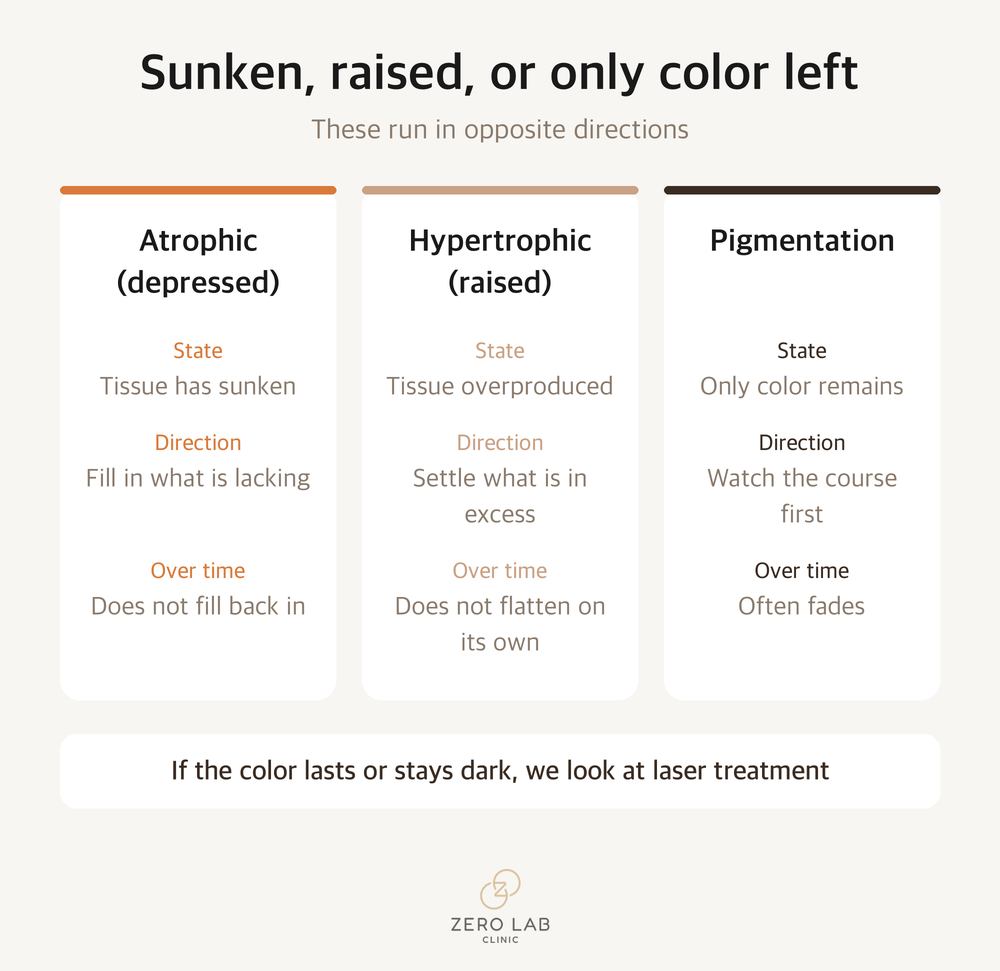
| Scar type | Characteristics | Direction of care |
|---|---|---|
| Atrophic (depressed) scars | Sunken inward. Divided into ice pick, boxcar and rolling | Approaches that support collagen regeneration, combined depending on the type |
| Hypertrophic (raised) scars | Thickened and raised above the skin | Approaches that settle the overgrown tissue |
| Pigmentation | Red or brown marks left behind. Easily mistaken for scars | Often fades, so we watch the course first |
For raised scars the direction is the opposite
Talk only about depressed scars and scar care starts to sound as though it were all about “filling in,” but it is not.
A hypertrophic scar is tissue that has been overproduced and has risen up thick. If the depressed side is a matter of filling in what is lacking, this side is a matter of settling down what is in excess. The approach runs in the opposite direction, so carrying over the methods used for depressed scars does not fit.
They form more readily where the skin is pulled taut, such as along the jawline, the chest and the shoulders, and some people are simply more prone to making them. Review papers on acne scarring also separate atrophic from hypertrophic from the outset[6][7].
So in consultation, saying “I have scars” is not on its own enough to set the direction. We start by looking at whether it is sunken or raised.
Why some acne leaves scars
Even with the same acne, some cases leave scars and some do not. What the literature consistently points to is how deep the inflammation went and how long it lasted[7].
A lesion that comes up briefly at the surface and settles usually passes without leaving a mark. Where inflammation sits deep and lingers, the surrounding tissue is damaged along with it, and the area sinks or rises as it heals. In a cohort study analyzing 417 acne patients, the finding that papular acne came out as a factor raising the risk of complications can be read in the same light[2].
Two things follow from this.
One is that time is a variable. The longer it drags on, the more room there is for something to be left behind. Putting off acne treatment because you are worried about scars runs in the wrong direction.
The other is that squeezing and picking have a direct effect. They push the inflammation deeper and make it last longer, which grows scarring and pigmentation at the same time.
Mixed cases are more common than scarring alone
This is the part I most want to get across today.
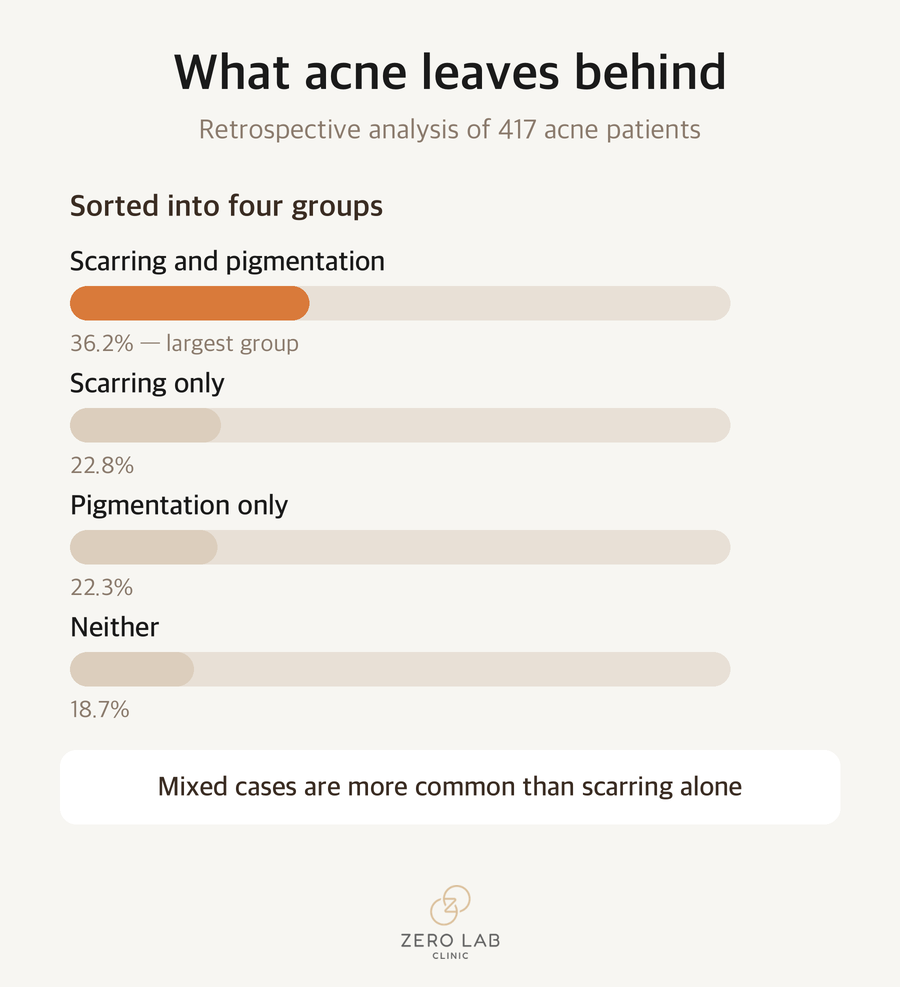
That study sorted the outcomes into four groups. The distribution came out like this[2].
- Scarring only: 22.8%
- Pigmentation only: 22.3%
- Scarring and pigmentation together: 36.2%
- Neither: 18.7%
The largest group is the one where the two are mixed. It outnumbers scarring on its own. That matches what we see in the clinic. People tell us they came because of scars, but when we actually look, pigmentation is there too, and often acne is still coming up.
If acne is still coming up, that side comes first
Going straight into scar treatment while active acne is still present runs into two problems.
First, new scars keep forming. A protocol paper for developing a core outcome set for clinical trials states that some degree of facial scarring occurs in 95% of patients with active acne[3]. It means that as long as inflammation is running, the process that makes scars keeps running as well. If new hollows are being carved at the front while you are filling in at the back, nothing is left to show for it.
Second, more pigmentation is left behind. A review of the pigment changes acne causes explains that the inflammatory process itself stimulates pigment production. It also points out that this change in pigment is often more distressing to patients than the active lesions[4]. Add the stimulus of a procedure while inflammation is running, and that risk goes up.
So this is the order we work in.
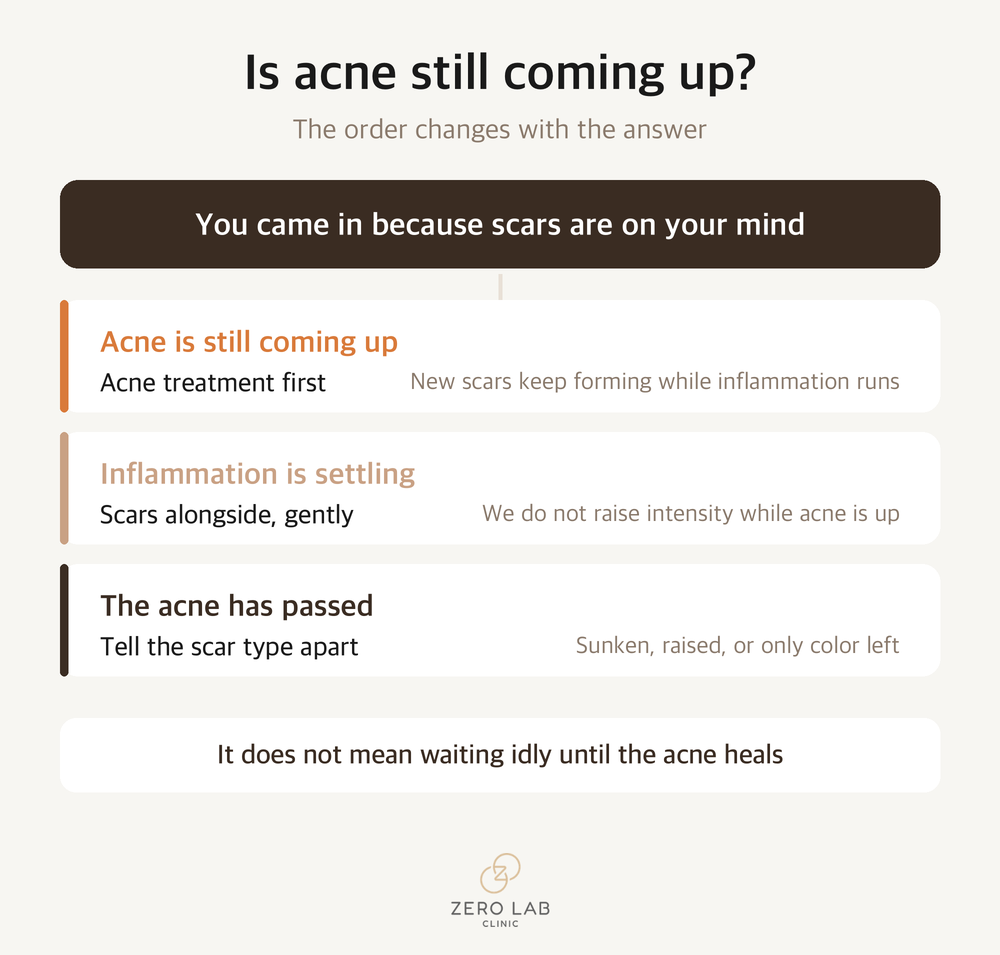
1) When there is active acne, acne treatment comes first.
2) While watching the inflammation come under control, we start on the scars within a range that does not aggravate the acne
3) Once the acne is stable, we raise the intensity of the scar treatment and shorten the intervals
What matters is that this does not mean “leave the scars entirely alone until the acne has fully healed”. If you sit on your hands while acne treatment drags on, the scars settle in during that time. It means carrying the scar side along within a range that does not provoke the acne, while keeping the priority on the acne.
Pigmentation follows a different course from scarring
Let me say a little more about why pigmentation is the one row in the table with a different direction of care.
A depressed scar is tissue that has actually sunken, so it does not fill back in with time. Pigment left after inflammation, on the other hand, often fades. So for marks that look like pigment, we tend to suggest watching the course first. Over a few months, a good deal of it resolves.
There are two exceptions, though.
The color can last a long time, or stay dark. In that case we do not simply wait; we look at treatment including pigment lasers. Telling the type of pigment apart comes first, so I would suggest reading the separate article we have written on that alongside this one.
Exposure to UV darkens it again. Scarred areas especially so. Keeping up with sun protection day to day makes a difference on its own, and for spots where color remains, a tinted formulation containing inorganic pigments such as iron oxides may help[5]. With sunscreen, the amount you apply comes before the number on the bottle, so we have written that up separately as well.
And if you have a habit of squeezing or picking at spots, inflammation and pigmentation keep repeating together. That is a part to sort out before any procedure.
How we approach acne scar care
Zero Lab Clinic was selected as a Rejuran Diamond Member in 2025 and 2026, and in the process we have kept studying regeneration-related procedures and building up cases. The principle we settled on along the way is simple.
Decide the type and the order first; the procedure comes after.
When you come in for a consultation, we proceed in this order.
1) We first check whether there is active acne
2) We look at the scar type and the state of the pigmentation separately
3) We decide which of acne, scarring and pigmentation to put first
4) We go over the expected duration and the care interval together
Caring for acne scars is less a matter of finishing in a single procedure than a process of setting an order and keeping at it. The systematic review of fractional lasers cited above also concludes that the number of sessions, the intervals and the settings have to be matched to each patient[1]. That is why we take our time at the consultation stage.
It is better to set expectations at the start as well. Scars do not go back to never having been there; it is closer to moving toward being less noticeable. The same review also concludes that skin care before and after the procedure helps the outcome[1], which again means this is a process running on both sides of a procedure rather than a single session.
The way it runs is similar to pigment treatment. Early on we repeat at shorter intervals, and once the condition is stable we widen the intervals and move toward maintenance. Rather than burning through a set number of sessions at a fixed pace, adjusting the interval while watching the response is what matters.
When acne is present alongside in particular, we do not raise the intensity during a period when acne is coming up. For that stretch we lengthen the intervals, and once the inflammation settles we shorten them again.
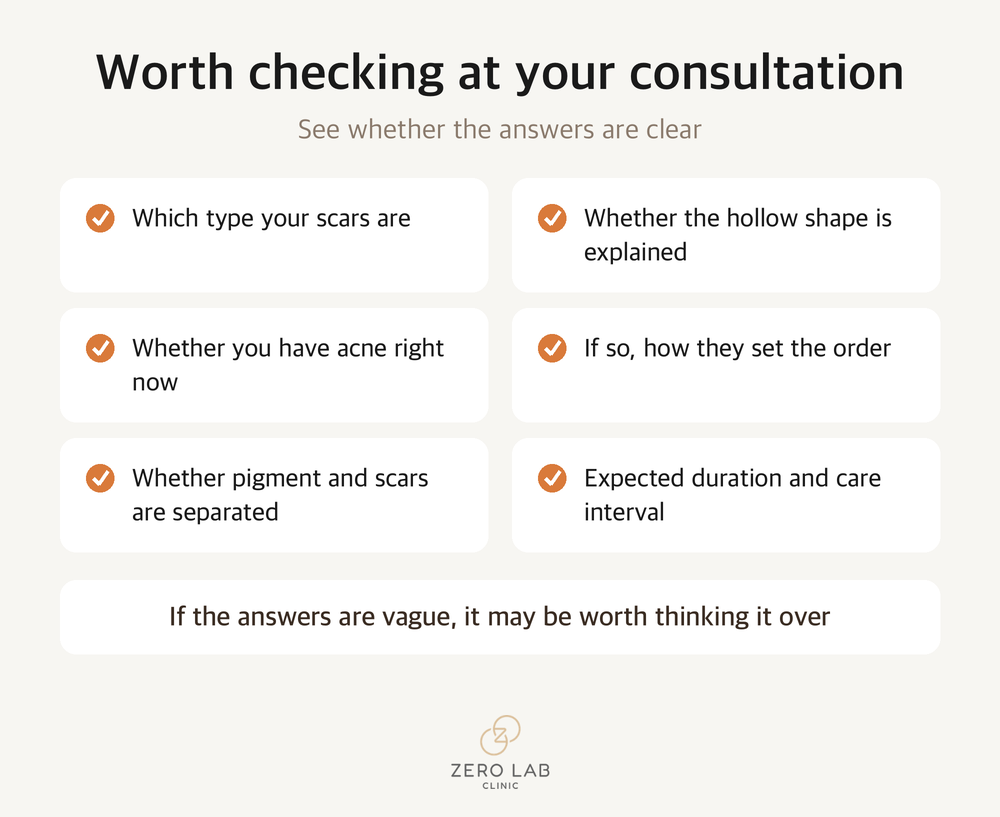
What to check when you come in for a consultation
When choosing a clinic, we suggest asking the following.
- Do they explain which type your scars are, down to the shape of the hollow
- Do they tell you whether you have acne right now, and if so how they would set the order
- Do they explain pigmentation and scarring separately
- Do they tell you roughly how many sessions and over what period to expect
If a clinic answers these four vaguely, it may be worth thinking it over a little more carefully.
People often ask which laser they should go for. I always start with the order instead. Scars are not something you finish in one go; they are something you work through in order. Whether active acne is still there, and whether what remains is a depression or only a change in colour — sorting out just those two usually settles what comes next.
Pigmentation is what most often remains alongside them, so telling pigmentation apart is covered separately.
Treatments covered in this article
Prices and booking
References
[1] Xu Y, Deng Y. Ablative Fractional CO2 Laser for Facial Atrophic Acne Scars. Facial Plast Surg. 2018;34(2):205-219. DOI: https://doi.org/10.1055/s-0037-1606096
[2] Alamri A, Alzahrani D, Alharbi G, et al. The Predictive Factors of Acne Scarring and Post-Inflammatory Hyperpigmentation: A Retrospective Cohort Study. Clin Cosmet Investig Dermatol. 2025;18:143-150. DOI: https://doi.org/10.2147/CCID.S504281
[3] Haq M, Koza E, Ma MS, et al. Acne scarring: protocol for development of a core outcome set for clinical trials. BMJ Open. 2025;15(4):e088049. DOI: https://doi.org/10.1136/bmjopen-2024-088049
[4] Elbuluk N, Grimes P, Chien A, et al. The Pathogenesis and Management of Acne-Induced Post-inflammatory Hyperpigmentation. Am J Clin Dermatol. 2021;22(6):829-836. DOI: https://doi.org/10.1007/s40257-021-00633-4
[5] Doan V, Rustad AM, Akuamoah J, et al. Iron oxides in tinted sunscreen for hyperpigmentation: a product analysis and literature review. J Drugs Dermatol. 2026;25(5):440-443. DOI: https://doi.org/10.36849/JDD.9919
[6] Levy LL, Zeichner JA. Management of acne scarring, part II: a comparative review of non-laser-based, minimally invasive approaches. Am J Clin Dermatol. 2012;13(5):331-340. DOI: https://doi.org/10.2165/11631410-000000000-00000
[7] Goodman G. Post acne scarring: a review. J Cosmet Laser Ther. 2003;5(2):77-95. DOI: https://doi.org/10.1080/14764170310001258
The seven papers above are indexed in PubMed. This article provides general medical information; decisions about an individual's condition are made through consultation.
This article was written directly by Zero Lab Clinic to provide medical information. Results of any procedure vary with individual skin condition, and side effects are possible. Please decide on a procedure only after an in-person consultation with a doctor.