

Zero Lab Treatment Information
How many laser hair removal sessions until it is done?
Hello, I am Dr. Dong Won Kim, Medical Director of Zero Lab Clinic, one minute from Hongdae (Hongik Univ.) Station Exit 1.
It has been several years now since laser hair removal came into its heyday. By now more people have had it than have not. And yet the question I get in consultations has not changed in years. "How many sessions until it's finished?"
That question is hard to give a clean answer to, because this is not a treatment that has a finish line. Today I would like to lay that out: why there is no end point, how the intervals should then be set, and why we recommend maintenance treatment.
Let us start by being precise about the phrase "permanent hair removal"
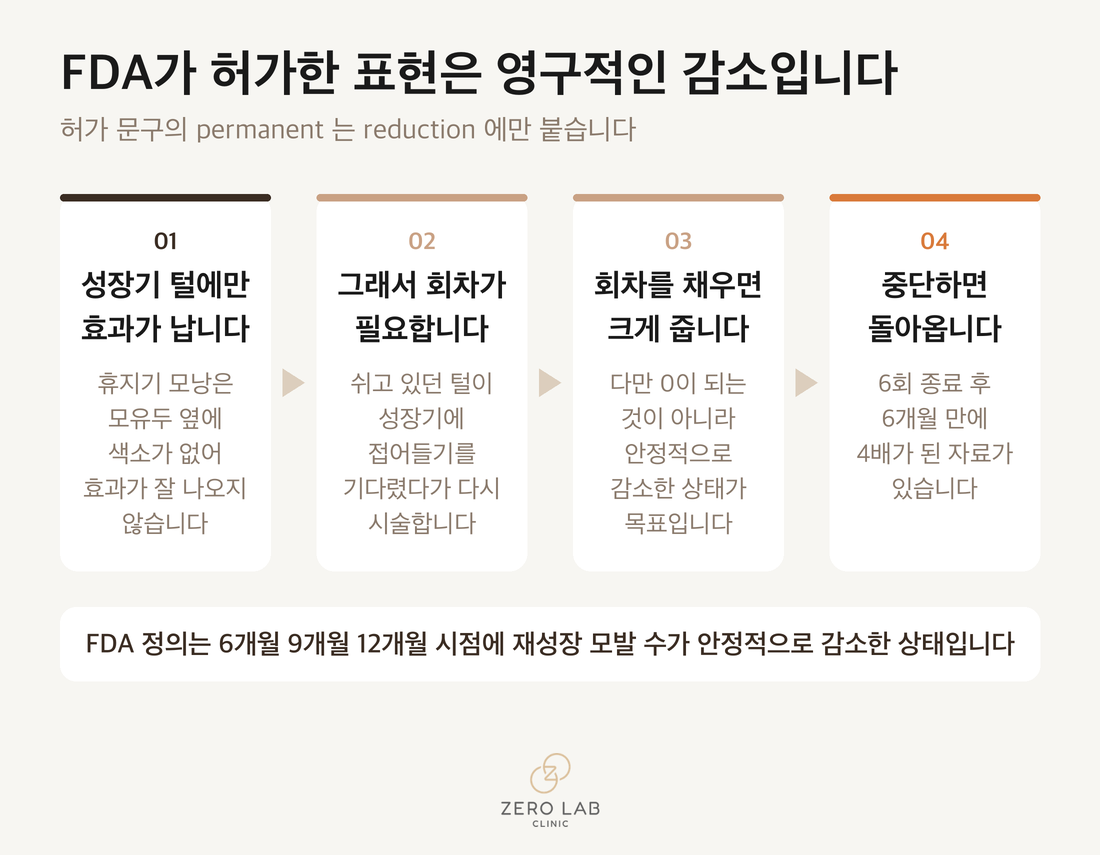
There is one thing to settle first. The phrase "permanent hair removal" is not accurate.
The wording the US FDA has cleared for hair removal lasers is `permanent hair reduction`. Not removal, but reduction. And the document also states how that permanence is judged. The indications section of the clearance document for a diode hair removal laser (510(k) K180353) reads as follows.
Permanent hair reduction, after the completion of a treatment regime, means a long-term, stable reduction in the number of hairs re-growing, measured at 6, 9 and 12 months.
It is not zero. The criterion is a stably reduced state. That is as far as we can go in using the word permanent.
The literature points the same way. A Harvard team treated 13 people once with a ruby laser and followed them for two years. Hair was reduced in all 13 immediately after treatment, but only 4 still had a clear reduction in hair two years later[1]. The concluding sentence of a comparative study that treated the underarms three times and looked at six months is more blunt still — partial regrowth within six months is typical, and further treatment is therefore needed[2].
In data following 29 people for one year after treatment on the legs, the areas that received five sessions still held more than 50% reduction in 40% of cases a year later, while the areas that received only one session were at 0%[3].
Which is to say that it takes several sessions for the result to stay.
Why it cannot be done in one session
Hair alternates between periods of growth and periods of rest. The laser only works on hair that is in its growth period.
A Taiwanese team confirmed this directly. When mouse hair was irradiated with an alexandrite laser during the anagen (growth) phase, the hair grew back finer in the next cycle, and it was confirmed that not only the pigment-bearing cells but also the adjacent dermal papilla cells were reduced by 24%. When the laser was fired during the telogen (resting) phase, however, no thermal damage, no loss of cells and no thinning of the hair was observed[4]. A telogen follicle has no pigment next to the dermal papilla, so there is no path for the heat to travel.
Human tissue shows a similar picture. In a study that treated the underarms and the bikini line one to three times and took tissue samples at 3 months, 4 1/2 months and 6 months, the treated skin had a significantly higher proportion of telogen follicles, and a higher proportion of thinned hairs as well. The authors summarised the mechanism of this change as induction of telogen followed by miniaturisation[5].

This is where the answer lies. In any one session, only the hairs that have entered the anagen phase respond. The rest are in telogen, resting, so the effect does not come through well. Having to wait for those remaining hairs to enter the anagen phase and then treat again is why several sessions are needed.
And that cycle differs from area to area. Here is what measurements of the thighs and upper arms of 20 men and women in their twenties and thirties show[6].
| Area | Anagen phase | Full cycle |
|---|---|---|
| Thigh (F) | 22 days | 84 days |
| Thigh (M) | 54 days | 151 days |
| Upper arm (F) | 22 days | 106 days |
| Upper arm (M) | 28 days | 108 days |
Different area, different sex, different cycle. Which means one fixed interval cannot be applied to every area alike.
How many sessions are we talking about
Let me show you the numbers as they are.
In data from 29 people treated on the legs with an Nd:YAG laser, 44.9% of the areas were reduced by more than 50% one month after a single session. Up to that point it means that even one session brings a visible reduction. But raise it to five sessions and it becomes 71.5%. The issue is what comes after. The proportion that still held more than 50% reduction a year later was 40% in the five-session group and 0% in the single-session group[3].
One session does reduce hair. It is only that the effect does not last long.
In data where 38 people were treated an average of 2.7 times with an 800nm diode laser and assessed from photographs an average of 8.7 months later, 59% showed only sparse regrowth , and the authors wrote that the higher the power and the more sessions, the better the long-term result[10].
In a comparative study treating the underarms three times at monthly intervals, the best response was one month after the second session, and after that, changing the device or the power made no difference to the six-month result[2]. Meaning that the big reduction comes in the first few sessions and it flattens out after that.
The interval changes the result
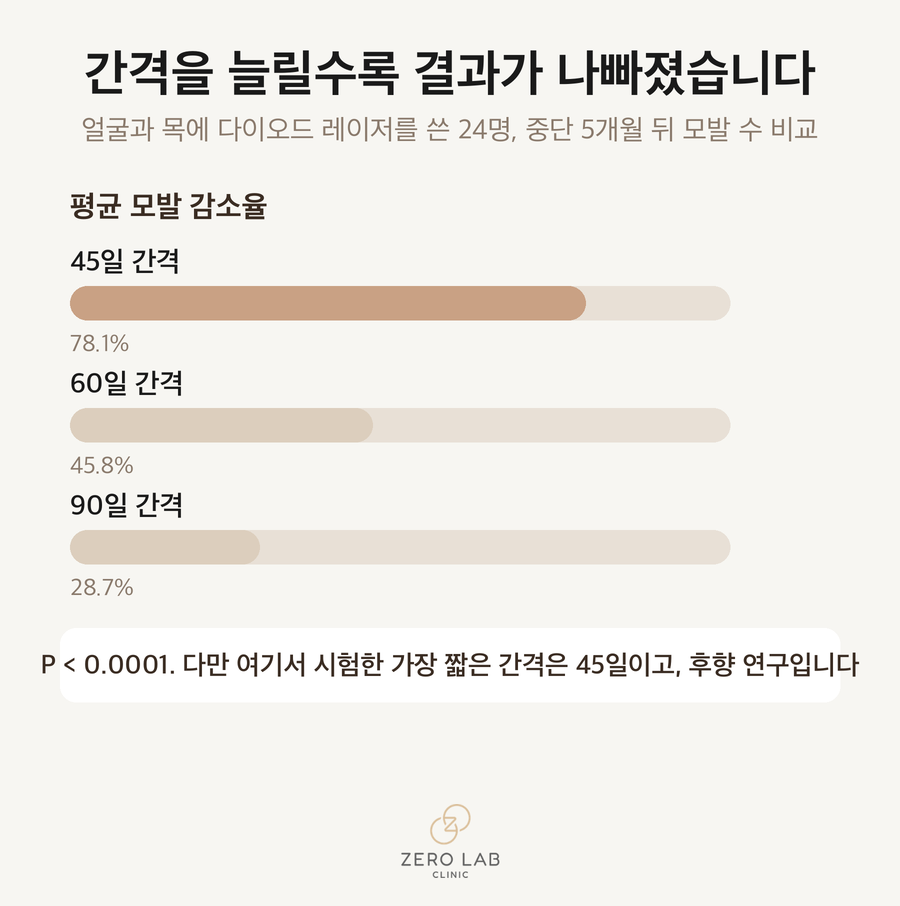
There is a study that compares this directly. In Iran, people receiving diode laser hair removal on the face and neck were divided by interval, and the hairs were counted and compared five months after treatment was stopped.
| Treatment interval | Mean hair reduction |
|---|---|
| 45 days | 78.1% |
| 60 days | 45.8% |
| 90 days | 28.7% |
P < 0.0001[7].
The wider the interval, the worse the result. The 90-day interval is not even half of the 45-day interval. This is why, if you come for hair removal only now and then, the sessions pile up and the result does not stay.
This study does have its limits, though. It is a retrospective study of 24 people, and the intervals were not randomly assigned — the patients chose them themselves. And the shortest interval tested was 45 days.
The intervals we set
What the study above lets us say goes as far as "shorter is better". A study confirming that 2–3 weeks is better still does not exist yet. So what follows is not from the literature but from our own standards.
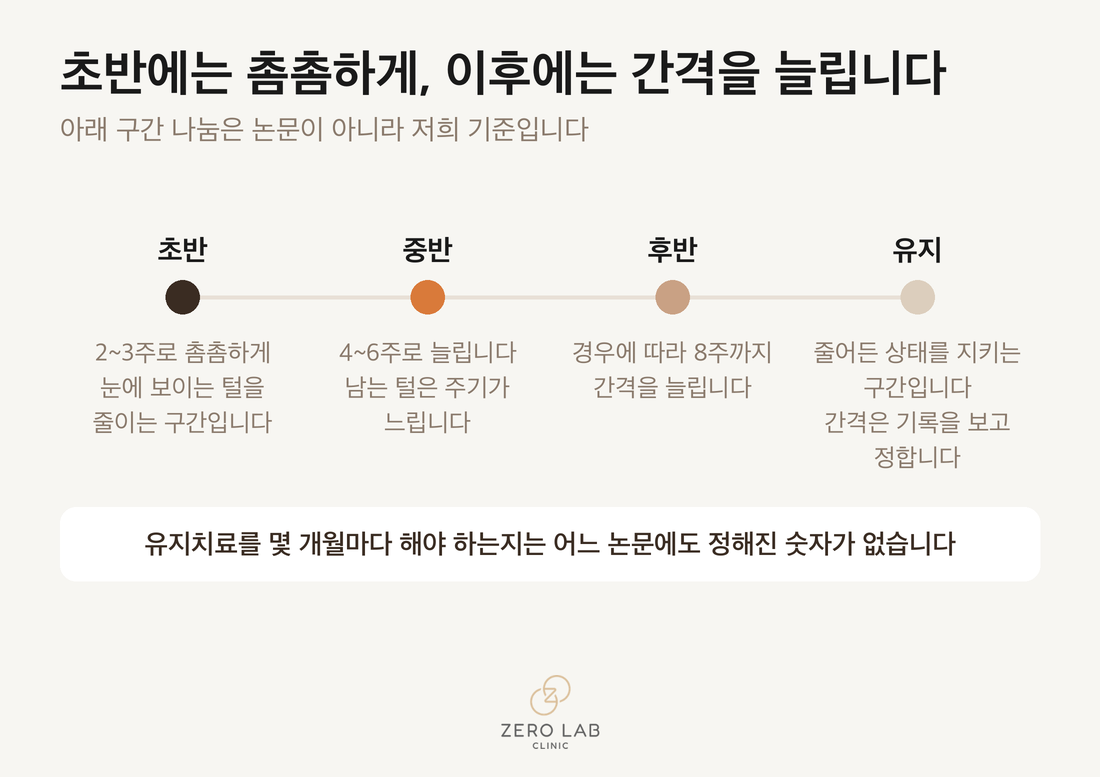
Early on we go close together, at 2–3 weeks. The first few sessions are the stretch where the visible hair comes down quickly, so we keep the intervals short. We advise this in particular for people coming in ahead of summer.
After that we stretch the interval to 4–6 weeks, and up to 8 weeks in some cases. Once the early stretch is past, the hair that remains is the slower-cycling kind, so firing at close intervals will not catch it in the anagen phase. At that point it is better to lengthen the interval.
We set it differently by area. As the cycle data above shows, the thigh and the upper arm differ, and the face differs again.
There is one thing you can be reassured about. There is a meta-analysis that looked at whether the treatment interval affects the incidence of paradoxical hypertrichosis, and neither the interval nor the device affected the incidence[8]. There is no evidence that shortening the interval increases side effects.
Stop, and it comes back
This number will make it quick to understand.
There is a study in which 129 women with hirsutism were treated with an alexandrite laser six times, once a month , and the hairs within a 5×5cm area of the chin were counted.
| Time point | Number of hairs |
|---|---|
| Just before the 6th session | 2.80 ± 1.16 |
| 6 months after the last session | 11.27 ± 9.30 |
Six sessions were completed, treatment was ended, and within six months it was four times as many[9].
Not because anything went wrong with the treatment. Because hair keeps growing. So we do not tell you that it is over once a set number of sessions is done. There is a stretch of filling out the sessions, and after that there is a stretch of maintaining.
That said, for maintenance treatment, there is no set number for how many months apart it has to be done. It is in none of the papers. It varies with how much hair is left, with the area, and with hormonal status, so we decide it by looking at the treatment record.
A few more things to mention
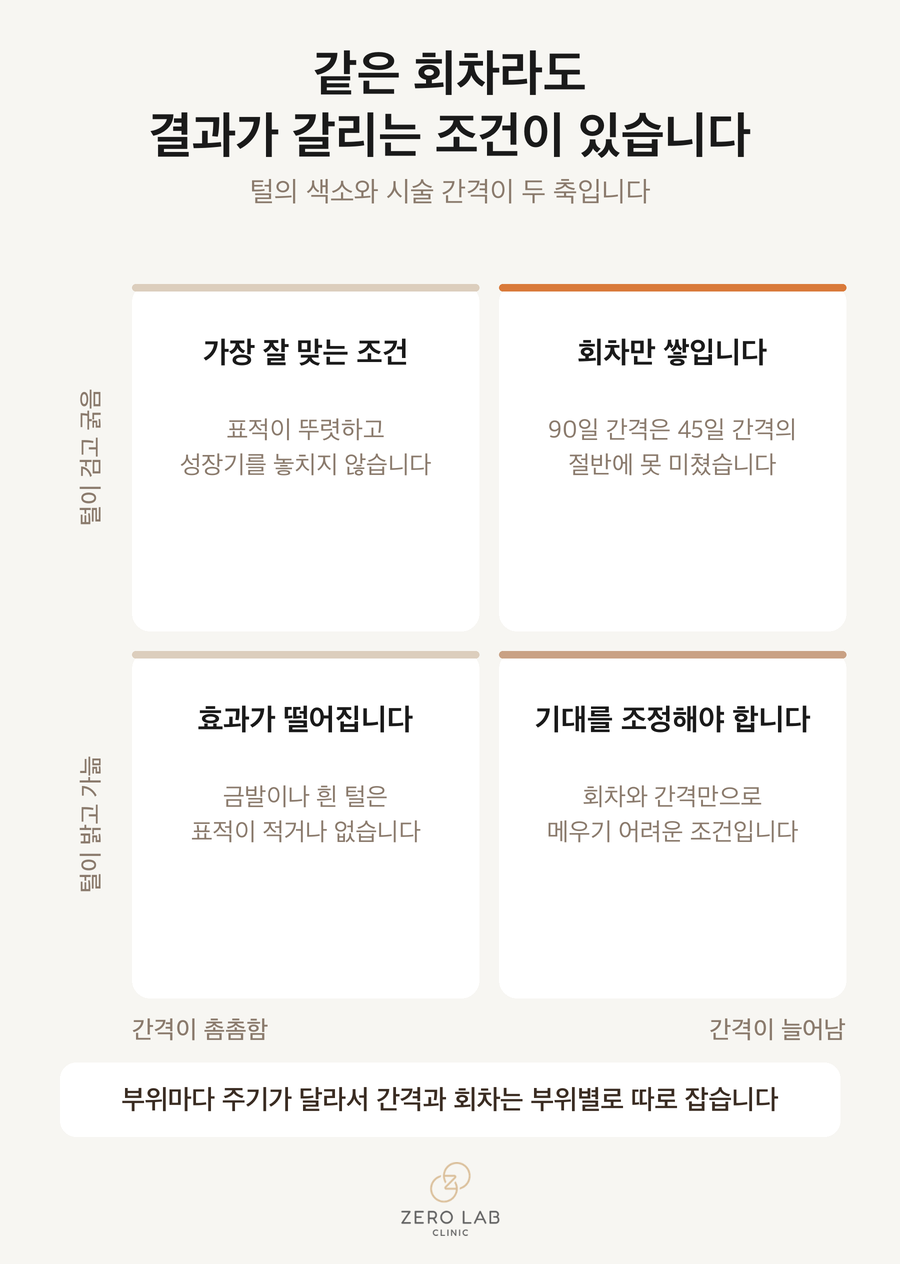
Light-coloured hair responds less. What the laser aims at is the pigment inside the hair, so blond or white hair offers little or no target. The hair removal effect therefore comes out weaker.
Darker skin shows pigment changes more often. In data from 38 people treated with an 800nm diode laser, temporary pigment changes appeared in 29%, and were more common in skin types IV to VI (P = 0.047)[10]. They were temporary, but this is why we often adjust the power according to skin colour. Of course, within the range of Asian skin it is rarely a factor of great importance.
On the face and neck we look once more for paradoxical hypertrichosis. In a meta-analysis gathering 9,733 people the pooled prevalence was 3%, and it was concentrated on the face and neck. In other areas it appeared in only 0.08%[8]. It is rare, but it is better to know about it when you are having hair removal on the face. And even in these cases, it improved in many instances when treatment was continued.
What we check at the consultation
- Which area it is — the cycle differs, so the interval and the number of sessions are decided here. We do not put the face on the same schedule as the legs
- The colour and thickness of the hair — we look at whether there is pigment for the laser to catch. Light, fine hair gives a different result
- Skin tone, and whether you have tanned recently — if there is a lot of pigment in the skin, the power has to be set lower[10]
- How many sessions you have had so far, and at what intervals — even if you had them elsewhere, bringing the record makes it easier to set the next interval
- By when you would like it sorted out — whether to shorten the early intervals is decided here
- For women, whether you have ever had a hormone-related diagnosis — there are cases where more sessions are needed
Closing
Many people ask, "so doesn't that mean coming in for the rest of my life?" My answer is this.
It is not that you have to come at the same frequency for life. There is a stretch early on of filling out the sessions, and once that stretch is past, what is left is only keeping the hair reduced to the point where it does not show. As in the data above, the hair that remains becomes finer and lighter, so even if it is still there when counted, to look at it is close to not being there.
It is hard for me to tell you how many sessions make finishing possible. What I can tell you is that doing a few sessions and then stopping is the biggest loss. The data in which the hair of people who ended after six sessions was four times as much six months later supports this.
References
[1] Dierickx CC, Grossman MC, Farinelli WA, Anderson RR. Permanent hair removal by normal-mode ruby laser. Arch Dermatol. 1998;134(7):837-842. DOI: https://doi.org/10.1001/archderm.134.7.837
[2] Handrick C, Alster TS. Comparison of long-pulsed diode and long-pulsed alexandrite lasers for hair removal: a long-term clinical and histologic study. Dermatol Surg. 2001;27(7):622-626. DOI: https://doi.org/10.1046/j.1524-4725.2001.00338.x
[3] Lorenz S, Brunnberg S, Landthaler M, Hohenleutner U. Hair removal with the long pulsed Nd:YAG laser: a prospective study with one year follow-up. Lasers Surg Med. 2002;30(2):127-134. DOI: https://doi.org/10.1002/lsm.10032
[4] Chiu HY, Wang WH, Kuan CH, et al. Depilatory laser miniaturizes hair by inducing bystander dermal papilla cell necrosis through thermal diffusion. Lasers Surg Med. 2022;54(6):916-927. DOI: https://doi.org/10.1002/lsm.23533
[5] McCoy S, Evans A, James C. Long-pulsed ruby laser for permanent hair reduction: histological analysis after 3, 4 1/2, and 6 months. Lasers Surg Med. 2002;30(5):401-405. DOI: https://doi.org/10.1002/lsm.10047
[6] Seago SV, Ebling FJ. The hair cycle on the human thigh and upper arm. Br J Dermatol. 1985;113(1):9-16. DOI: https://doi.org/10.1111/j.1365-2133.1985.tb02038.x
[7] Bouzari N, Tabatabai H, Abbasi Z, Firooz A, Dowlati Y. Hair removal using an 800-nm diode laser: comparison at different treatment intervals of 45, 60, and 90 days. Int J Dermatol. 2005;44(1):50-53. DOI: https://doi.org/10.1111/j.1365-4632.2004.02423.x
[8] Snast I, Kaftory R, Lapidoth M, Levi A. Paradoxical Hypertrichosis Associated with Laser and Light Therapy for Hair Removal: A Systematic Review and Meta-analysis. Am J Clin Dermatol. 2021;22(5):615-624. DOI: https://doi.org/10.1007/s40257-021-00611-w
[9] Alijanpour R, Aliakbarpour F. A randomized clinical trial on the comparison between hair shaving and snipping prior to laser hair removal sessions in women suffering from hirsutism. J Cosmet Dermatol. 2017;16(1):70-75. DOI: https://doi.org/10.1111/jocd.12280
[10] Campos VB, Dierickx CC, Farinelli WA, Lin TY, Manuskiatti W, Anderson RR. Hair removal with an 800-nm pulsed diode laser. J Am Acad Dermatol. 2000;43(3):442-447. DOI: https://doi.org/10.1067/mjd.2000.107239
The ten papers above are indexed in PubMed. The definition of permanent hair reduction cited in the text is taken from the indications section of US FDA 510(k) clearance document K180353. This text is general medical information; judgements about an individual's condition are made through consultation.
This article was written directly by Zero Lab Clinic to provide medical information. Results of any procedure vary with individual skin condition, and side effects are possible. Please decide on a procedure only after an in-person consultation with a doctor.