

Zero Lab Treatment Information
Thread lifting — once the threads dissolve, is the effect over?
Hello, I am Dr. Dong Won Kim, Medical Director of Zero Lab Clinic, one minute from Hongdae (Hongik Univ.) Station Exit 1.
This is the question I am asked most often in thread lifting consultations. Everyone already knows that the thread is an absorbable material, so they ask whether it all goes back to the way it was the moment the thread dissolves.
The short answer is that it does not. But “so it lasts a lifetime” is not the answer either. Today let me sort out the ground in between: when the thread dissolves, what is left behind once it has, and how long that lasts.
The threads we use
The material used in thread lifting is basically a PDO (polydioxanone) thread. It has long been used as an absorbable surgical suture, so how the body responds to it is relatively well documented.
In the past we often used the barbless mono thread, and spring types as well. These days we mainly use barbed cog threads. The force that actually hooks sagging tissue and lifts it comes from the barbs.
The manufacturing method is also trending from cutting towards molding . Cutting carves the barbs out of the body of the thread; molding forms the barbs in a mould.
On this point, though, I should be straightforward with you. That the manufacturing method changes the physical properties of the thread has been confirmed experimentally. In a study that made PPDO cog threads by three different methods and let them degrade at 37°C over 32 weeks, the injection-molded thread, processed at the highest temperature, degraded fastest, while the cut thread, which is not heated, preserved its molecular chains best and degraded the slowest[1].
In other words, on degradation rate alone, cutting has the advantage. We have not found evidence that molding is better.
The reason we use molded threads all the same lies elsewhere. Because the barbs are not carved away, the cross-section of the thread body stays intact, and the barbs come out uniform in shape. That said, we have not found a study that measured and compared these two points directly. So I am telling you this as our clinical judgement, not as a paper.
When does the thread dissolve?
Let me start by sorting out the premise in the title. The point at which it “dissolves” differs from source to source.
| Source | Timing |
|---|---|
| Absorption in rat skin | About 6 months |
| Absorption and degradation in a rat model | About 24 weeks |
| Ultrasound follow-up in humans | Thread still present at 12 months |
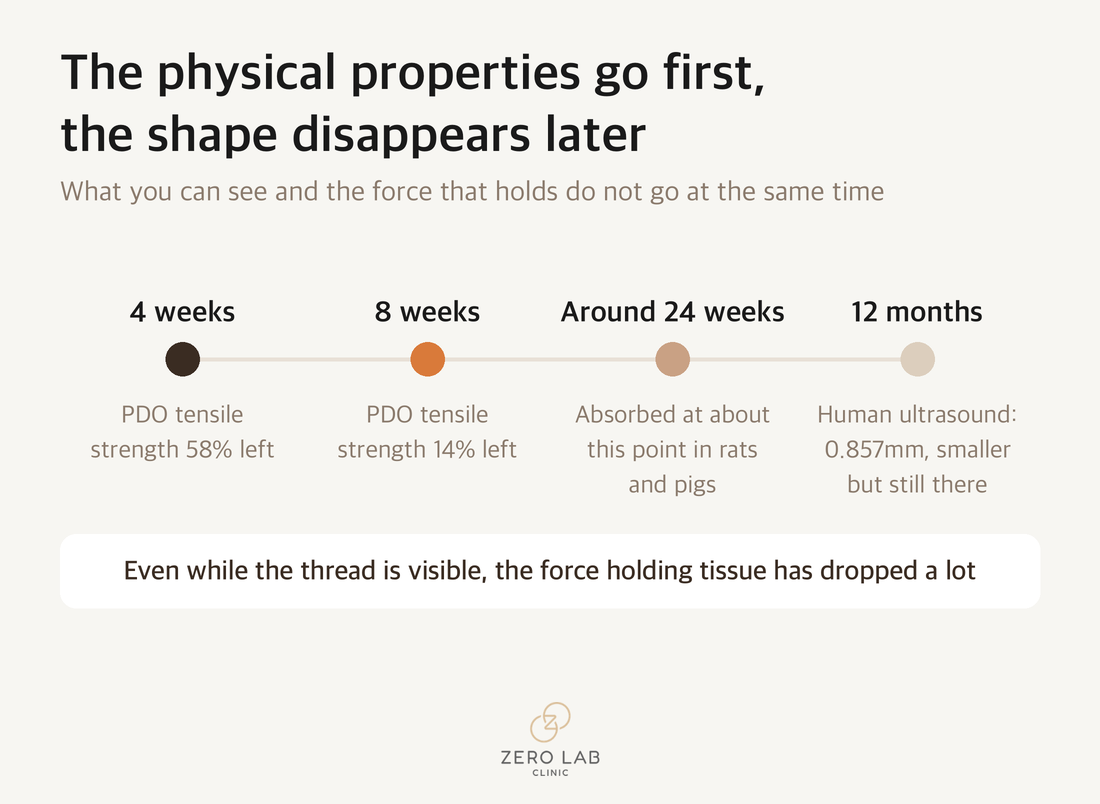
In rat and pig experiments, the thread is absorbed at around 24 weeks[2]. In data that followed threads directly by ultrasound in humans, however, the diameter of PDO threads placed in the nose went from 1.113mm at 1 month to 0.857mm at 12 months — smaller, but still there[3].
The physical properties go first; the shape disappears later. In the original suture development study, PDO retained 58% of its tensile strength at 4 weeks and 14% at 8 weeks[4]. It means that even at a point when the thread is still visible, the force holding tissue up has already dropped considerably.
So the question has to be reframed. Not whether the thread is still there, but what is holding the tissue.
Why it still holds after the barbs go blunt
This is the heart of this article.
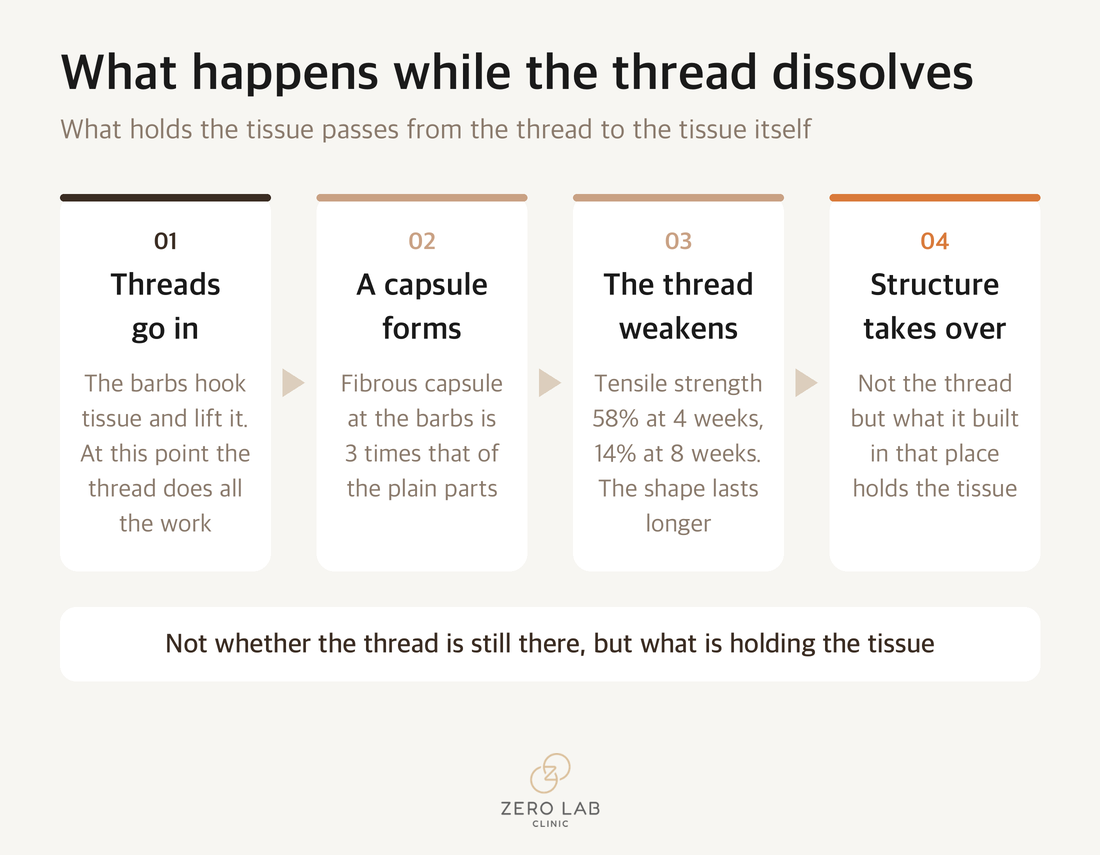
There is a study that implanted PDO cog threads in the dorsal skin of 12 nude mice and examined the tissue. The result is clear. Even within the same thread, the fibrous capsule around the barbed segments was 3 times that around the barbless segments. And when the threads were laid out in a crossed arrangement rather than a fan arrangement, the width and density of the fibrotic area were 5 times greater[5].
The authors write it out themselves in the paper — the duration of thread lifting is disputed, and a shift of perspective is needed, one that adds biochemical factors to physical and mechanical lifting.
In other words, while the thread is holding tissue up, it builds a fibrous structure in that place. By the time the barbs lose their grip, that structure has taken over.
This is not only an animal-experiment story. It is confirmed in humans as well.
- In moderate facial sagging at ages 40 to 50, 10 patientsreceived PDO threads and had the layers measured with 12MHz ultrasound at 30, 60, 90 and 120 days. In that study, collagen formation around the thread was confirmed on imaging in every patient, and the dermal layer increased[6]
- In a randomized double-blind study of 40 patientswho had PDO threads placed in the glabellar lines, ultrasound likewise confirmed dermal thickening[7]
You should look at the evidence on the other side as well. The mechanical holding force of the barbs falls off as time passes. In an experiment that soaked threads in solution and pulled on them at days 0, 7 and 14, the maximum load kept decreasing[8].
The force goes; the structure stays. Each of the two has its own evidence behind it.
The number and arrangement of the barbs change the result too
Even with the same material, the tissue response differs according to the structure of the thread.
In a study that made both PDO and PCL in four forms — mono, 4-strand, 12-strand and cog — implanted them in rats and examined them at 2-week intervals, the larger the surface area where thread met tissue, the greater the tissue response. Inflammatory cells, myofibroblasts and fibroblasts all increased. Multi-strand structures worked in the same direction[2].
The 5-fold figure for the crossed arrangementin the nude-mouse study above is evidence along the same axis. Not only whether there are barbs, but how they are overlapped changes the density of the structure that is built.
There is a similar signal in humans. In a prospective study of 30 patients whose midface was lifted with cut-type 3D bidirectional cog threads, the wrinkle scale improved from 2.33 at 1 month to 1.47 at 6 months (p < 0.001), and on multivariate analysis the significant predictors were time and the number of threads. Age and body mass index had no effect[13].
It should not be read as “the more you put in, the better,” though. The vector study I come to just below is evidence to the contrary.
So how long does it last?
Here too, let me be honest with you.
The period we quote in consultations is around 9 to 10 months. That figure is based on the course we see in the clinic.
But there is no paper that has measured this number. The assessment points in the studies cluster at 1, 3, 6 and 12 months, so no study has measured 9 to 10 months, and the values in the literature do not converge in one direction either.
| Study | Sample | Result |
|---|---|---|
| Italian retrospective study | 160 patients | Improvement up to 1 month, clearly diminished at 6 months, absent at 1 year |
| Korean midface study | 64 patients | Satisfaction 4.7/5.0 at 1 month → 2.8/5.0 at 12 months |
| Korean multilayer technique study | 73 patients | No significant decline through 12 months |
The study with the largest sample is the most negative[9]. In the data covering 160 patients, the effect had already clearly declined at 6 months and was not there at 1 year.
In the 64-patient study, which placed 3 PDO cog threads (18G) in each midface, satisfaction fell from 4.7 to 2.8 at 12 months. Blinded physician assessment moved the same way, from 4.5 to 3.1[10]. It does not fall to 0, but close to half of it is gone.
To sum up, the literature splits between 6 months and 12 months. The 9 to 10 months we quote sits inside that range, but it is not a number that can be pinned down with a paper. It is better to start out knowing that.

Technique decides the result
In thread lifting, more than the material, it is how the threads are placed that largely determines the result. It is a procedure where results diverge even with the same thread. The evidence on this is clear.
There is a study that placed threads by a different method on each side of the face in 5 cadavers and measured the outcome with 3D imaging. One side received a 180mm thread along a 20-degree trajectory, the other a 100mm thread along a 50-degree trajectory.
| Long thread, 20 degrees | Short thread, 50 degrees | |
|---|---|---|
| Vertical lift | 1.42mm | 1.24mm (no difference) |
| Horizontal lift | +3.42mm | −2.02mm |
In the horizontal direction the sign flipped (p = 0.001)[11]. Only the thread length and the insertion angle were changed on the same face, and it means one side was pulled up while the other was actually pushed the other way.
Vector design is the same story. When the same investigators compared a single vector with a double vector, the double vector gave a greater vertical lift (4.45mm versus 2.99mm) , but for horizontal lift and reduction in jawline volume the single vector did better. The authors' conclusion was that the double vector is not superior overall[12].
It means that putting in more does not make it better. Which layer you anchor in, and in which direction, comes first.
Is it better combined with other procedures?
It is hard for me to tell you that combining is always better. The evidence differs by combination.
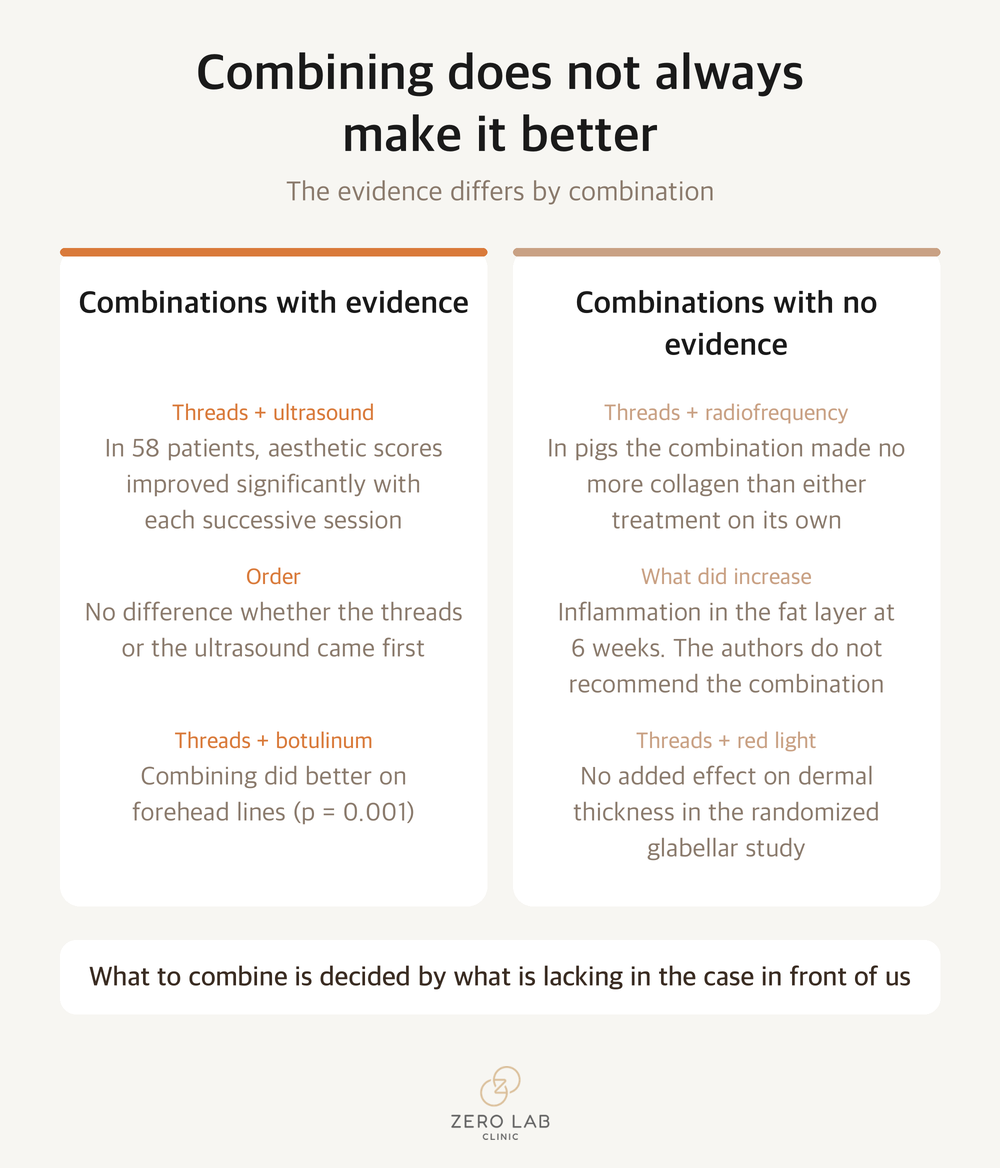
Combinations that helped. In a 58-patient study that used threads together with ultrasound, aesthetic scores improved significantly with each successive session, and there was no difference in outcome whether the threads or the ultrasound came first[14]. For forehead lines, combining botulinum toxin did significantly better (p = 0.001). In the same study, though, the glabella was not significant (p < 0.112)[15].
Combinations that did not help. In a study that placed PDO threads in pigs and applied radiofrequency to the same site 2 weeks later, the combination group did not produce more collagen than either treatment on its own. If anything, only the inflammatory response in the fat layer increased at the 6-week point. The authors concluded that they do not recommend the combination[16]. In the randomized glabellar study above, adding red light likewise gave no additional effect on dermal thickness[7].
So we do not recommend combinations across the board. What to combine is decided by looking at what is lacking in the case in front of us.
What we check at the consultation
- Whether tissue is sagging, or whether it has deflated — threads are a procedure that hooks tissue and lifts it. Where volume has been lost, a different approach is the right one
- Skin thickness and the amount of subcutaneous fat — if it is thin the thread can show through; if it is thick the hold is weaker
- Whether you have had thread lifting before — if you have, we check where and when
- The direction you want — the vector differs depending on whether you want to be lifted upwards or pulled to the side
- How far ahead you are looking — if you have an event coming up, we work backwards from that date to schedule it

In closing
Many people ask whether it is all back to square one once the thread dissolves. My answer is this.
Even after the thread is gone, the fibrous structure built in that place remains. The barbs going blunt and the effect disappearing are not the same thing.
That said, that structure is not permanent. The durations reported in the literature differ, from 6 months to 12 months, and the 9 to 10 months we quote is a figure that comes from clinical experience. Either way, it is clear that this is not a procedure you do once and are finished with.
It is not a very simple procedure, but it is also one where it is relatively clear which conditions it works well on, so used well it can do a great deal. I think making that judgement together is the place to start.
References
[1] Li D, Wang Q, Zhang K. Effect of Processing Technology on the Degradation Behavior of Poly(p-dioxanone) Cog Threads. Aesthet Surg J Open Forum. 2026;8:ojag073. DOI: https://doi.org/10.1093/asjof/ojag073
[2] Ha YI, Kim JH, Park ES. Histological and molecular biological analysis on the reaction of absorbable thread; Polydioxanone and polycaprolactone in rat model. J Cosmet Dermatol. 2021;21(7):2774-2782. DOI: https://doi.org/10.1111/jocd.14587
[3] Kim JS, et al. Ultrasonographic and three-dimensional evaluation of coiled polydioxanone thread augmentation rhinoplasty. Plast Reconstr Surg Glob Open. 2026;14(5):e7500. DOI: https://doi.org/10.1097/GOX.0000000000007500
[4] Ray JA, Doddi N, Regula D, Williams JA, Melveger A. Polydioxanone (PDS), a novel monofilament synthetic absorbable suture. Surg Gynecol Obstet. 1981;153(4):497-507. PMID: 6792722
[5] Song JK, Chang J, Cho KW, Choi CY. Favorable Crisscrossing Pattern With Polydioxanone: Barbed Thread Lifting in Constructing Fibrous Architecture. Aesthet Surg J. 2021;41(7):NP875-NP886. DOI: https://doi.org/10.1093/asj/sjab153
[6] Lots TCC. Effect of PDO facelift threads on facial skin tissues: An ultrasonographic analysis. J Cosmet Dermatol. 2023;22(9):2534-2541. DOI: https://doi.org/10.1111/jocd.15761
[7] Garcia PC, Meireles DP, Tassinary JAF, Pavani C. Combining red photobiomodulation therapy with polydioxanone threads for wrinkle reduction in the glabella region: A randomized, controlled, double-blind clinical trial. J Biophotonics. 2024;17(8):e202400139. DOI: https://doi.org/10.1002/jbio.202400139
[8] Hong W, et al. Evaluation of the Pull-Out Strength of Barbed Sutures. Polymers (Basel). 2022;14(11):2170. DOI: https://doi.org/10.3390/polym14112170
[9] Bertossi D, Botti G, Gualdi A, et al. Effectiveness, Longevity, and Complications of Facelift by Barbed Suture Insertion. Aesthet Surg J. 2019;39(3):241-247. DOI: https://doi.org/10.1093/asj/sjy042
[10] Myung Y, Jung C. Mini-midface Lift Using Polydioxanone Cog Threads. Plast Reconstr Surg Glob Open. 2020;8(6):e2920. DOI: https://doi.org/10.1097/GOX.0000000000002920
[11] Braun M, Frank K, Freytag DL, et al. The Influence of the Insertion Angle on Middle and Lower Face Tissue-Mechanics When Treating the Nasolabial Folds with Facial Suspension Threads - An Experimental Split-Face Cadaveric Study. Facial Plast Surg. 2020;36(3):268-275. DOI: https://doi.org/10.1055/s-0040-1712469
[12] Liew S, Frank K, Kolenda J, Braun M, Cotofana S. Comparison of Single- Versus Dual-Vector Technique Using Facial Suspension Threads: A Cadaveric Study Using Skin Vector Displacement Analysis. Dermatol Surg. 2020;46(12):1721-1727. DOI: https://doi.org/10.1097/DSS.0000000000002574
[13] Park BY, et al. Efficacy of Midface Lifting Using Three-dimensional Bidirectional Cog Polydioxanone Threads Manufactured by Cutting Method. Aesthetic Plast Surg. 2026;50(4):1587-1595. DOI: https://doi.org/10.1007/s00266-025-05327-4
[14] Weng Y, et al. Combined Application of Absorbable Thread Lifting and High-intensity Focused Ultrasound in Facial Rejuvenation. Plast Reconstr Surg Glob Open. 2025;13(6):e6899. DOI: https://doi.org/10.1097/GOX.0000000000006899
[15] Bessar H, et al. Polydioxanone threads with or without botulinum toxin in the treatment of upper facial wrinkles. Arch Dermatol Res. 2024;317(1):123. DOI: https://doi.org/10.1007/s00403-024-03420-3
[16] Li K, et al. Effect of combined polydioxanone thread and radiofrequency treatment in a porcine model. J Cosmet Dermatol. 2022;21(8):3479-3485. DOI: https://doi.org/10.1111/jocd.14651
The 16 papers above are indexed in PubMed. This article provides general medical information; decisions about an individual's condition are made through consultation.
This article was written directly by Zero Lab Clinic to provide medical information. Results of any procedure vary with individual skin condition, and side effects are possible. Please decide on a procedure only after an in-person consultation with a doctor.