

Zero Lab Skin Lecture
How often should you exfoliate?
Hello, I am Dr. Dong Won Kim, Medical Director of Zero Lab Clinic, one minute from Hongdae (Hongik Univ.) Station Exit 1.
This is a question I often put to people who exfoliate. How often do you do it?
Plenty of people exfoliate, but few have settled on a sensible interval for it. The skin looks dull, so they do it once more; flakes lift, so they do it again. Some arrive with the gap narrowed that way.
Today I want to talk about exactly that - how often it should be done. What exfoliation actually does to the skin, what changes when it is done often, and what sort of interval is therefore reasonable.
There are two kinds
The physical kind and the chemical kind.
The physical kind rubs the surface away. Scrubs, peeling gels, cleansing brushes and the Korean exfoliating towel belong here. The chemical kind applies an acid that loosens the links holding the dead surface cells to one another. The AHAs - glycolic acid and lactic acid - and the BHA salicylic acid belong here.
At home it is mostly the physical kind; at a clinic or a beauty salon it is the chemical kind. I will come back to this distinction later, because the law limits the concentration that may be used depending on where you have it done.
What exfoliation does is bring turnover forward
Left alone, the skin makes new cells below, pushes them upward, and the spent surface cells fall away by themselves. That cycle is called turnover.
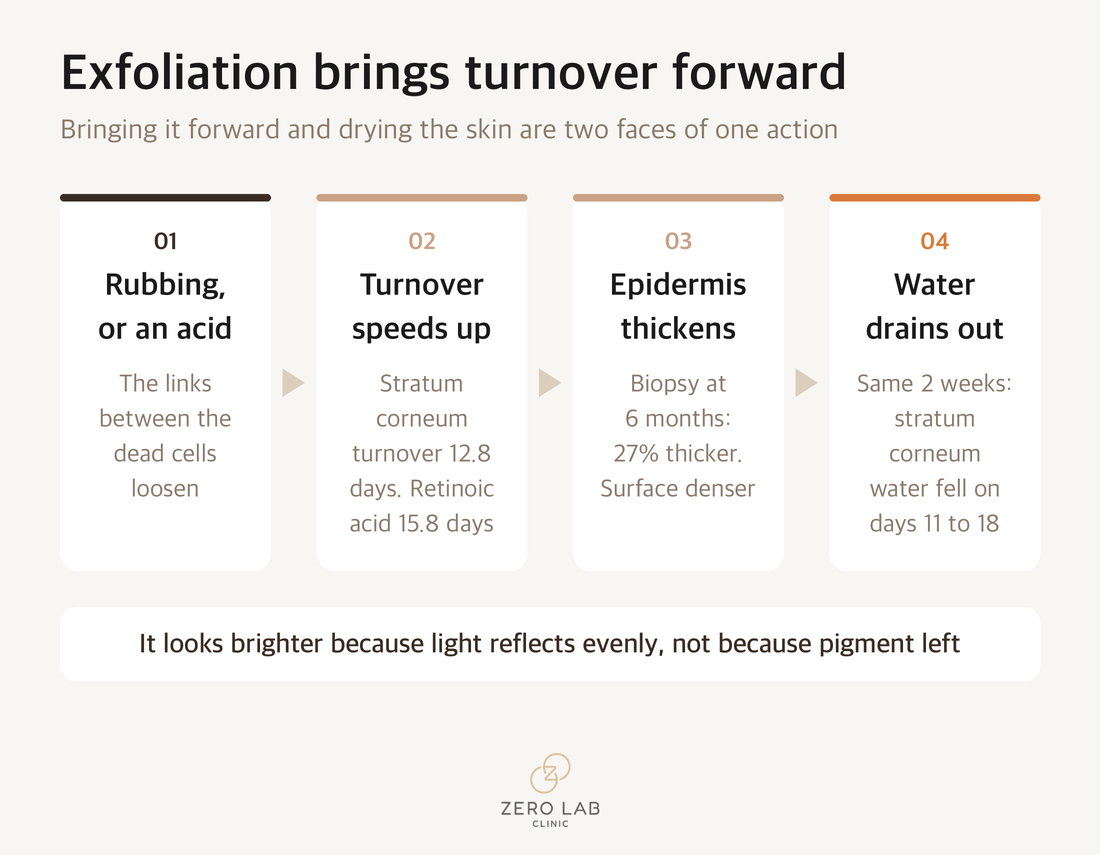
Exfoliation brings that cycle forward. There is a study that measured this directly in people.
The skin of 6 healthy volunteers was labelled with a fluorescent marker, and 12% glycolic acid was then applied once a day for 60 minutes over 2 weeks. The time it took for the fluorescence to disappear completely - that is, stratum corneum turnover - was 12.8 days. Measured the same way, 0.1% retinoic acid came to 15.8 days[1].
Glycolic acid was faster than retinoic acid. It is easy to think of exfoliation as “gentle care”, but measured purely by its power to drive turnover, it is not.
So it is true that the face looks brighter - but the reason is different
Done with a gap between sessions, the texture smooths and the face looks brighter. I see this in the clinic myself.
The reason, though, is not that “old pigment has been shed”. We could not find measured data showing that an acid at home-use concentrations reduced pigment. What the literature shows points elsewhere.
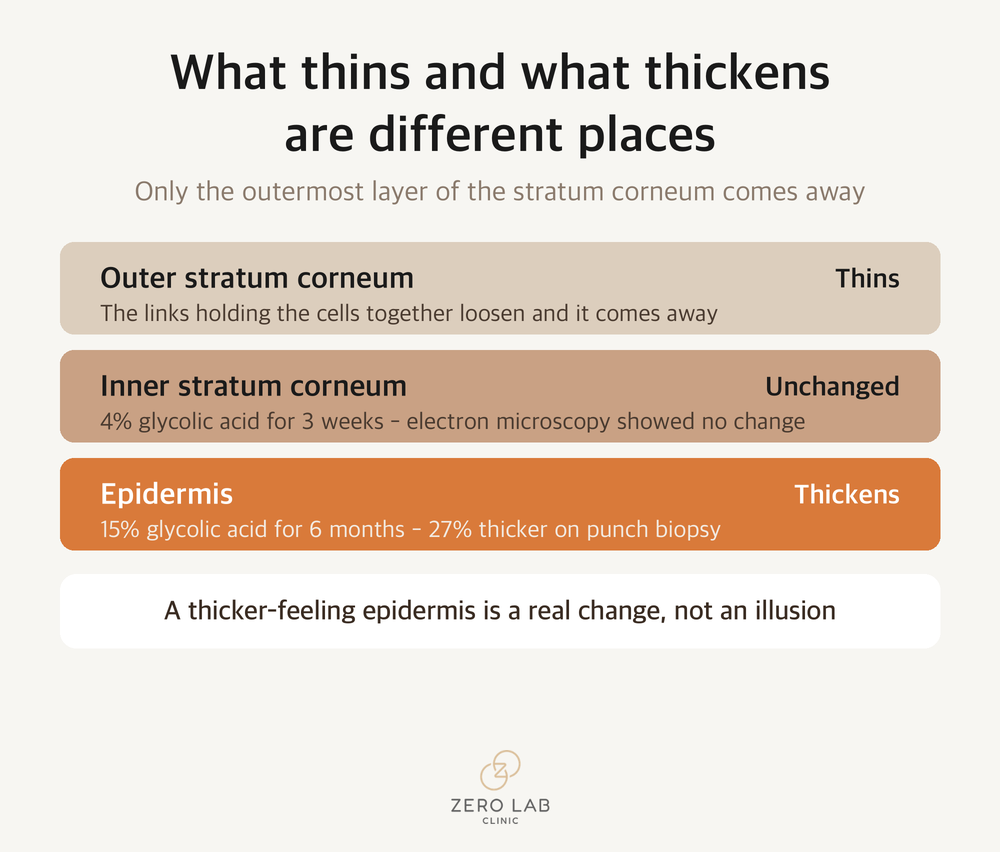
In a study that applied 4% glycolic acid twice a day for 3 weeks and then looked under an electron microscope, the stratum corneum had become histologically more compact. Only the outermost layer of the stratum corneum came away; the structure beneath it was untouched[2].
Below, in fact, it thickens. In a randomised double-blind study of 65 postmenopausal women, 15% glycolic acid was applied to one side of the face for 6 months and the skin measured by punch biopsy. The result: epidermal thickness increased by 27% (p = 0.005). In the same study, estradiol gave 23%[3].
To sum up: the surface is evened out and what lies below thickens. Light reflects evenly, so the face looks brighter; pigment has not been drawn out.
What changes when it is done often
That same study also produced the result on the other side of the ledger.
Over the 2 weeks in which turnover was brought forward, water loss rose, and between day 11 and day 18 the water content of the stratum corneum fell significantly (p < 0.05)[1]. Straight after application there was clear erythema as well.
The force that brings turnover forward and the force that dries the skin are two faces of the same action. You cannot take only one of them.
There is also data that looked at frequency itself. A study comparing the washing habits of 999 rosacea patients with those of 1,010 healthy controls produced these numbers[4].
| Habit | Odds ratio |
|---|---|
| Using a cleansing tool more than 4 times a week | 2.179 |
| Exfoliating with a product used every day | 2.435 |
| Washing more than once a day | 1.450 |
| Length of washing, type of cleanser | No association |
The spread of symptoms pointed the same way. For patients who exfoliated every day, the odds ratio for progressing to erythema was 2.01, to pustules and acne 2.28, and to telangiectasia 2.14.
This is a case-control study, though, so it is not causation. It cannot rule out the possibility that people washed more because their skin was already poor. Even so, the difference showed up in how often rather than in what was used - and that is worth noting.
Marks left by rubbing do not come out easily
This is the part I most want to get across. Rubbing the skin physically can leave a mark where the aim was to take pigment out.
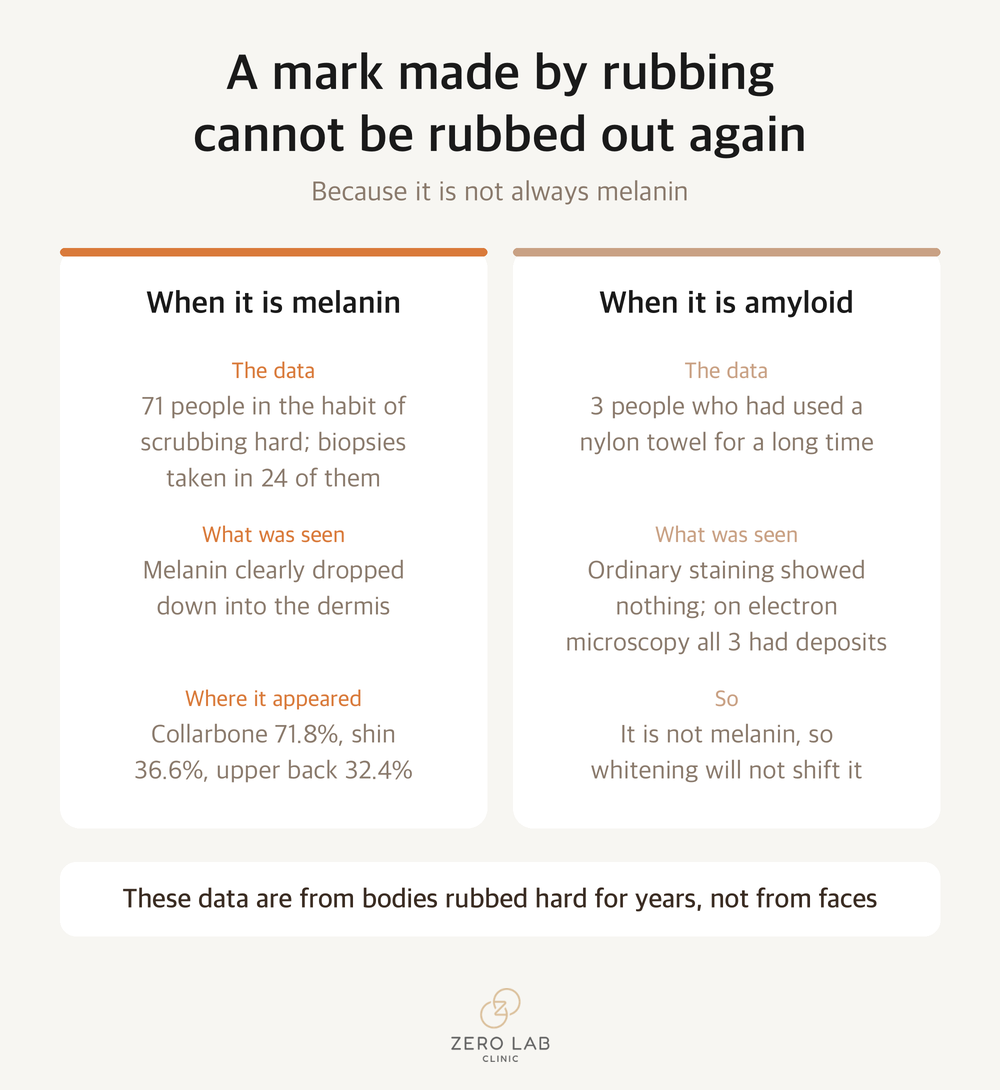
There is a study that gathered 71 people who were in the habit of scrubbing their bodies hard with a washing implement. All of them washed by rubbing vigorously, and the marks appeared on the collarbone in 71.8%, the shin in 36.6% and the upper back in 32.4%. Biopsies taken in 24 of them showed melanin clearly dropped down into the dermis[5].
There is something more important. In a study of 3 people who had used a nylon towel for a long time, ordinary staining showed nothing, yet under the electron microscope all 3 had amyloid deposited in the skin[6]. That is why it has been proposed that such cases be called friction amyloidosis rather than frictional melanosis.
If it is not melanin, whitening will not shift it. That is why trying to rub out a mark that rubbing created does not work well.
There is something I should state plainly here. These data are from bodies rubbed hard for years, not from faces. Both the strength of the irritation and the length of it differ from using a scrub on the face 1 to 2 times a week. We could not find a prospective study looking at facial exfoliating products on their own. Even so, I speak on the view that the direction is the same.
On the face, frictional melanosis is in fact rare. In data from dermoscopy of 100 people with facial pigmentary disorders, 2 had frictional melanosis[7]. Rare - but once it appears, it is the kind that does not come out easily.
So how long should the gap be
We suggest 2 weeks. I will give you the basis for that number as it stands.
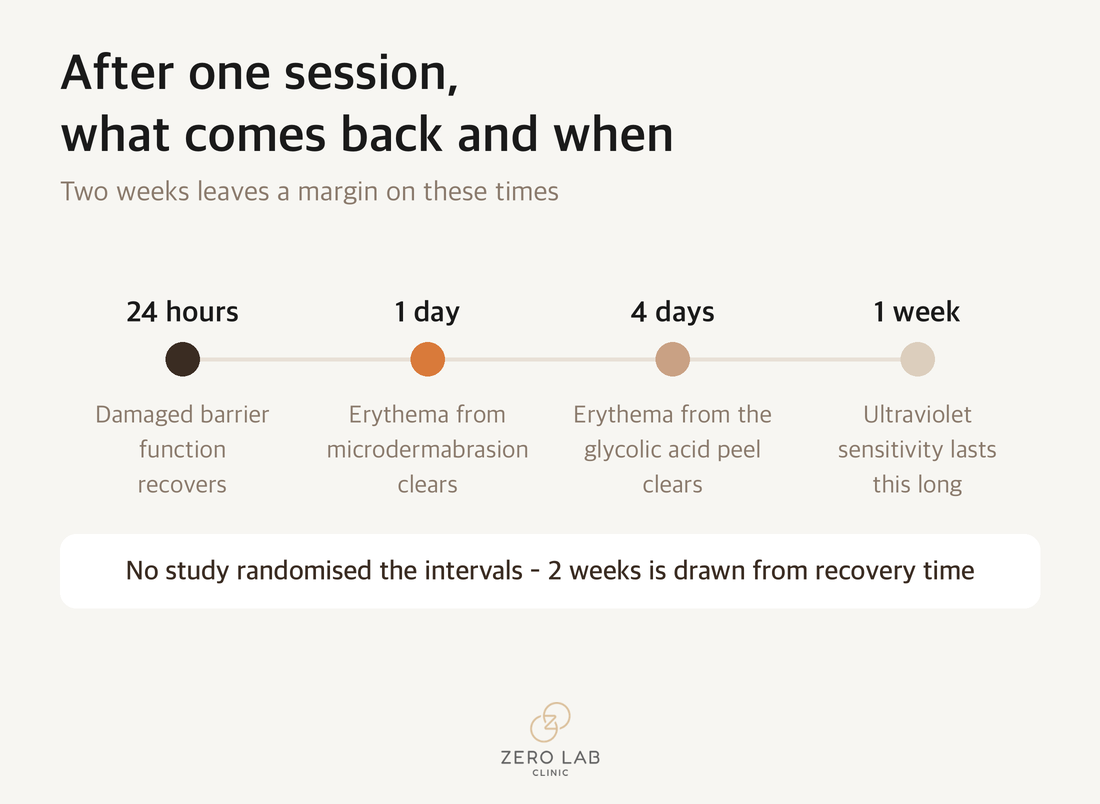
There is a study that applied 30, 50 and 70% glycolic acid peels and aluminium oxide microdermabrasion to the inner forearms of 13 women and tracked barrier function. Both procedures clearly damaged the barrier straight afterwards, but it recovered within 24 hours. Erythema cleared in 1 day after the microdermabrasion and in 4 days after the glycolic acid peel. From this the authors concluded that a 2-week interval gives the barrier enough time to recover[8].
To be honest with you, this is not a number obtained by comparing intervals. It is an inference drawn from measuring how long recovery takes. There are also studies that treated at 1-week intervals[9]. We could not find a study that randomised intervals and compared them head to head.
So 2 weeks is not a “proven optimum” but a number that leaves a margin on the time recovery needs. The standard we work to in the clinic is set to that.
One thing to add: sensitivity to ultraviolet light lasts longer than that. The US FDA recommends that AHA products carry a label telling users to apply sunscreen during use and for 1 week after use [10]. Leaving 2 weeks takes that period in naturally.
The same study had one more interesting result. The degree of erythema did not follow the order of concentration[8]. 70% was not redder than 30%. Which means strength cannot be judged from concentration alone.
Please do not use high-concentration products at home
Now and then someone gets hold of a high-concentration product sold for professional use and applies it themselves. This is not a question of interval; it is dangerous in itself.
The law has drawn a line. Korea's Enforcement Rule of the Cosmetics Act requires that products containing more than 10% AHA, or with a pH below 3.5, must carry the statement “this product contains a high concentration of AHA, so there is a risk of adverse effects; consult a specialist physician or similar”[11]. The US FDA and the CIR Expert Panel likewise put forward 10% or less, and pH 3.5 or above as the safety conditions for consumer products[10].
There is a reason the line for home use and the line for clinic use are different.
Actual incidents have been counted as well. In a report that reviewed 5 years of the US FDA adverse event reporting system, 18 cases of skin injury from chemical peel products applied by consumers themselves were identified. They were burns, wounds and swelling, and in some cases scarring and restricted range of motion were left behind. The authors' conclusion was that used without professional guidance, they are dangerous regardless of concentration[12]. A separate tally of unapproved removal products came to 38 cases, and of the 14 facial injuries among them, 4 were right beside the eye[13].
Why does it matter where you have it done
Some of the exfoliation treatments given at beauty salons cross the line the law has set.
This is not my opinion but a court ruling. The Supreme Court of Korea considered a skin-resurfacing (dermabrasion) procedure in which a skin care practitioner without a medical licence used a device containing an aluminium oxide abrasive to remove dead skin from the face and held as follows.
Where a person without specialist knowledge of the physiological structure of the human body performs this, there is a risk of causing harm to human life, to the body, or to public hygiene, and therefore it constitutes a medical practice and not a mere cosmetic technique[14]
The same ruling settled two further points. A non-medical person may not perform it even under a doctor's direction, and that this holds even where that person in fact has knowledge or procedural skill equal to a medical professional's. And the person punished in that case was the director of the clinic who had employed the skin care practitioner.
The current Medical Service Act Article 27 prohibits unlicensed medical practice in paragraph 1, and in paragraph 5, added in 2019, it provides that “no person shall cause a person who is not a medical professional to perform medical practice” - barring the party who gives the instruction as well[15].
There is one point to note before moving on. In the study I cited earlier as the basis for the 2-week interval[8], what was used was aluminium oxide microdermabrasion - exactly the method that appears in this ruling. On one side, people were measuring how long the barrier takes to recover; on the other, they were arguing over who may perform it at all.
Wherever you have it done, you can check whether the concentration and the device used in that place are ones that may be used there.
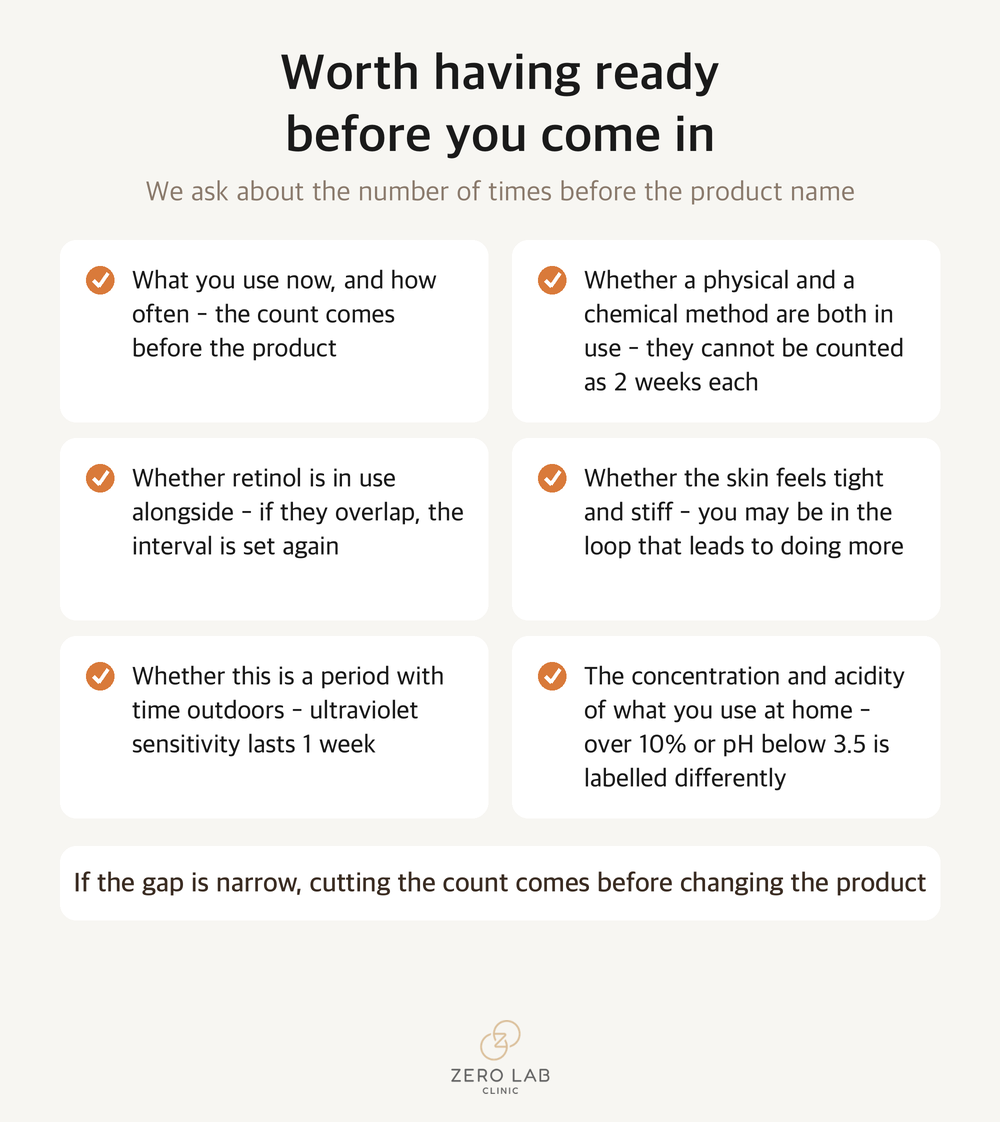
What we check at a consultation
- What you are using now, and how often - we ask about the number of times before the product name
- Whether you are using a physical and a chemical method together - some people use a scrub and an acid and count 2 weeks for each separately
- Whether you are using retinol alongside it - if they overlap, the interval has to be set again
- Whether the skin feels tight and stiff - often people are caught in a loop where flaking looks like a reason to do it more
- Whether this is a period with a lot of time outdoors - ultraviolet sensitivity lasts 1 week, so we count back from your schedule
To close
Many people think that the more they exfoliate, the cleaner the skin becomes. But that is hard to call true without qualification.
Exfoliation brings turnover forward, and the force that brings it forward and the force that dries the skin are two faces of the same action. With a gap, the surface is tidied and the epidermis beneath actually thickens. Narrow the gap and water is the first thing to go.
And a pigmented mark made by rubbing cannot be rubbed out again. Because in some cases it is not melanin.
The 2 weeks we give you is not a number nailed down by a paper but a standard that leaves a margin on the time recovery takes. If the interval you are keeping is narrower than that, then before changing the product, I think the order is to cut the number of times first.
References
[1] Effendy I, Kwangsukstith C, Lee JY, Maibach HI. Functional changes in human stratum corneum induced by topical glycolic acid: comparison with all-trans retinoic acid. Acta Derm Venereol. 1995;75(6):455-458. DOI: https://doi.org/10.2340/0001555575455458
[2] Fartasch M, Teal J, Menon GK. Mode of action of glycolic acid on human stratum corneum: ultrastructural and functional evaluation of the epidermal barrier. Arch Dermatol Res. 1997;289(7):404-409. DOI: https://doi.org/10.1007/s004030050212
[3] Fuchs KO, Solis O, Tapawan R, Paranjpe J. The effects of an estrogen and glycolic acid cream on the facial skin of postmenopausal women: a randomized histologic study. Cutis. 2003;71(6):481-488. PMID: 12839261
[4] Li G, Wang B, Zhao Z, et al. Excessive cleansing: an underestimating risk factor of rosacea in Chinese population. Arch Dermatol Res. 2021;313(4):225-234. DOI: https://doi.org/10.1007/s00403-020-02095-w
[5] Sharquie KE, Al-Dorky MK. Frictional dermal melanosis (lifa disease) over bony prominences. J Dermatol. 2001;28(1):12-15. DOI: https://doi.org/10.1111/j.1346-8138.2001.tb00079.x
[6] Wong CK, Lin CS. Friction amyloidosis. Int J Dermatol. 1988;27(5):302-307. DOI: https://doi.org/10.1111/j.1365-4362.1988.tb02357.x
[7] Solanki V, Bhatia S, Gupta M, et al. Dermoscopic evaluation of facial pigmentary disorders. J Cutan Aesthet Surg. 2024;17(2):112-123. DOI: https://doi.org/10.4103/JCAS.JCAS_48_23
[8] Song JY, Kang HA, Kim MY, Park YM, Kim HO. Damage and recovery of skin barrier function after glycolic acid chemical peeling and crystal microdermabrasion. Dermatol Surg. 2004;30(3):390-394. DOI: https://doi.org/10.1046/j.1076-0512.2003.30107.x
[9] Khunger N, Sarkar R, Jain RK. Tretinoin peels versus glycolic acid peels in the treatment of melasma in dark-skinned patients. Dermatol Surg. 2004;30(5):756-760. DOI: https://doi.org/10.1111/j.1524-4725.2004.30212.x
[10] U.S. Food and Drug Administration. Alpha Hydroxy Acids. FDA Cosmetic Ingredients. https://www.fda.gov/cosmetics/cosmetic-ingredients/alpha-hydroxy-acids
[11] Enforcement Rule of the Cosmetics Act of Korea, Annex 3 (relating to Article 19(3)), "Types of cosmetics and precautions for use", item 11: products containing alpha hydroxy acids
[12] Lardieri A, Kang H, Munoz M, et al. Skin injuries associated with chemical peel products applied by consumers. J Clin Aesthet Dermatol. 2025;18(11):41-43. PMID: 41446714
[13] Konkel K, Chen M, Menetrey A, et al. Serious adverse events associated with unapproved mole and skin tag removal products. J Clin Aesthet Dermatol. 2023;16(1):14-17. PMID: 36743972
[14] Supreme Court of Korea, judgment of 5 September 2003, Case No. 2003Do2903 (violation of the Act on Special Measures for the Control of Public Health Crimes — unlicensed medical business)
[15] Medical Service Act of Korea, Article 27 (Prohibition of unlicensed medical practice)
Of the 15 items above, 11 are papers indexed in PubMed; the rest are public documents from health authorities and the courts. This article provides general medical information; decisions about an individual’s condition are made through consultation.
This article was written directly by Zero Lab Clinic to provide medical information. Results of any procedure vary with individual skin condition, and side effects are possible. Please decide on a procedure only after an in-person consultation with a doctor.