

Zero Lab Treatment Information
They say never squeeze acne — so why does the clinic extract?
Hello, I am Dr. Dong Won Kim, Medical Director of Zero Lab Clinic, one minute from Hongdae (Hongik Univ.) Station Exit 1.
“You say we should not squeeze them, so why do you squeeze them here?” That is a question we get, and a fair one.
To give the answer first, squeezing is not in itself good or bad. What is squeezed, when it is squeezed and under what conditions it is squeezed are what carry through to the result. Today I want to show how far the literature backs up each of those three.
First, something I should say openly
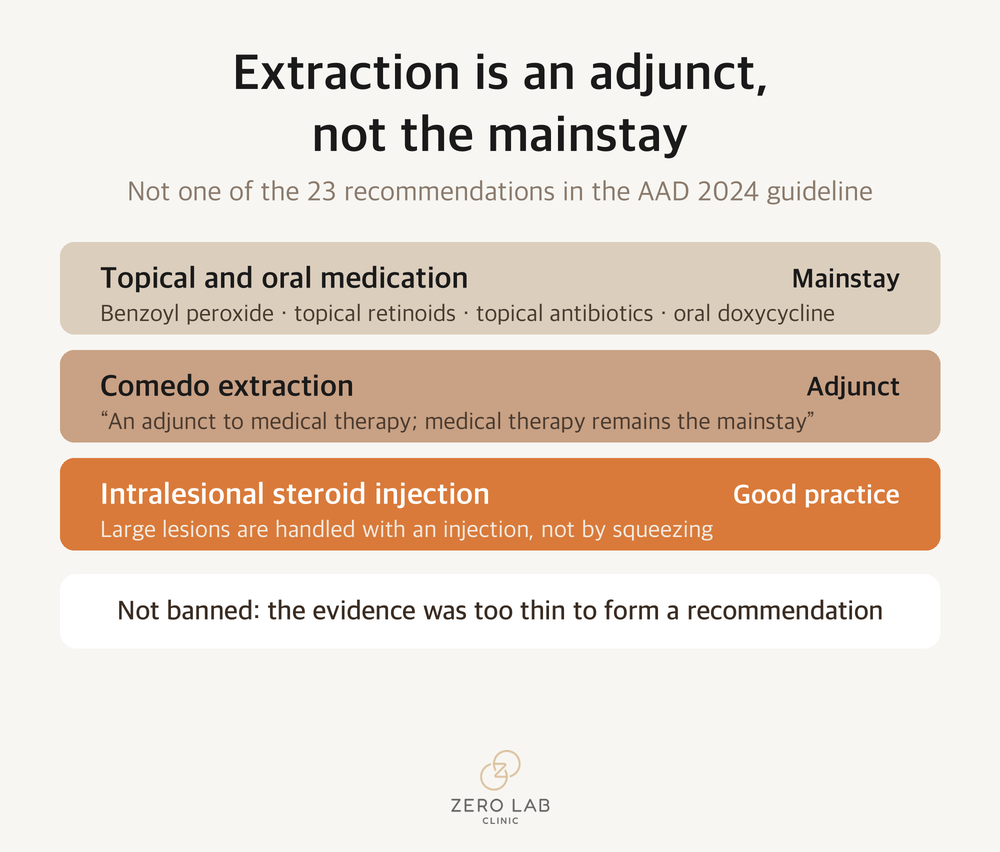
There is the American Academy of Dermatology's 2024 acne guideline. After a systematic review it set out 18 recommendations and 5 good practice statements. Benzoyl peroxide, topical retinoids, topical antibiotics and oral doxycycline are in there as strong recommendations.
Comedo extraction appears nowhere among those 23[1].
That said, this is not a “do not do it”. The guideline did put extraction among the things it assessed, and concluded that the evidence was insufficient to form a recommendation. Being prohibited and there being no evidence are two different things.
The Indian standard guidelines put it more plainly. “Surgical procedures are only an adjunct to medical therapy, and medical therapy remains the mainstay”[2]. A paper from 1983 carries the same sentence - “Acne surgery is only an adjunct to good medical therapy”[3].
Extraction is not the mainstay of treatment. Topical and oral medication are the mainstay, and extraction is laid on top of that. We see it that way too.
In practice, though, it is laid down as a baseline
A guideline carrying no recommendation and the thing not being used are, again, two different matters.
There is a Korean randomised trial comparing laser treatments in 44 patients with moderate to severe acne. Looking at the design, extraction was performed on both sides of the face before the laser[4]. It was not what was being compared, but a pre-treatment laid down on both sides alike.
In a multicentre trial in China comparing photodynamic therapy with low-dose isotretinoin in 152 patients, photodynamic therapy was likewise designed as a bundle in which, only after the comedones have been squeezed out by hand, does the light treatment begin[5].
Extraction is not recommended because it works; it is being used as the groundwork for doing something else - that is the accurate way to put it.
What is squeezed - this is the most important part
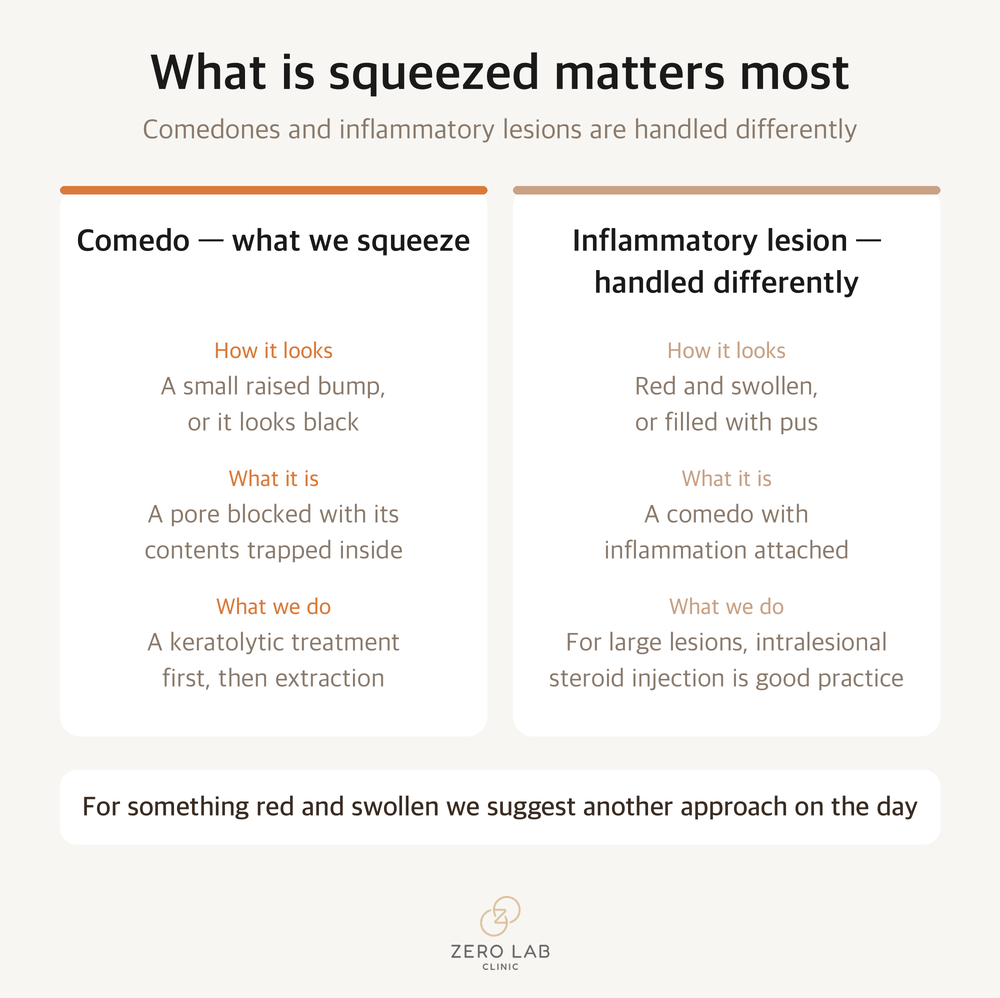
Comedones and inflammatory lesions are not the same thing.
A comedo is a pore that has become blocked with its contents trapped inside. On the surface it sits as a small raised bump or looks black. An inflammatory lesion is one with inflammation attached to it, red and swollen or filled with pus.
The 1983 paper puts it this way. “Acne surgery consists of comedo extraction of non-inflamed lesions, triamcinolone injection of some inflamed lesions, and the removal of milia”[3]. What is inflamed was written down separately, not as something to squeeze but as something to be handled by injection.
The 2024 guideline also lists adding intralesional steroid injection for large lesions as good practice[1]. Handling lesions differently according to type is itself supported.
So before we squeeze anything, we look at what it is. Even when someone asks us to squeeze something red and swollen, we will suggest a different approach for that spot on the day.
How much does extraction do?
There are numbers. They are not numbers that favour extraction, though.
There is a randomised trial in patients with dense comedones, treating one side of the face with a comedone extractor and the other with a carbon dioxide laser, 4 times at 2-week intervals. The assessor did not know which side was which.
| Comedone reduction | Proportion reduced by 50% or more | |
|---|---|---|
| Extractor | 46.36% | 37.5% |
| Carbon dioxide laser | 64.49% | 79.16% |
The extraction side was significantly lower (p < 0.001), and the pain score was higher[6]. The authors wrote that “the comedone extractor is widely used, but its effect is temporary and it can be irritating”.
It is not 0. Extraction on its own still reduced comedones by 46%. That said, there is a better method, and the effect does not last long - that is what came out of the same trial.
I will add that there is no randomised trial comparing “does adding extraction to topical treatment make it better”. We could not find one. Clinical trials on extraction at all can be counted on one hand.
The redness left behind after squeezing has a name
post-comedone extraction erythema is what it is called. It is the very thing patients worry about most, and it has a name as an object of study.
In a randomised trial in those aged 12-24, 35 people had 3 comedones squeezed on each side of the face, with a 595nm laser added on one side only. 3 paediatric dermatology specialists assessed the results without knowing which side was which. The erythema index on the laser-treated side was significantly lower at both 2 and 4 weeks (p < 0.001)[7].
Two sentences sit side by side in that paper's abstract. “extraction gives higher satisfaction than conventional treatment alone” and “but post-comedone extraction erythema remains a concern for patients”[7].
Both are true. It is true that squeezing brings a visible improvement, and it is true that the spot stays red for a while.
Squeezing after preparation and simply squeezing are not the same
This, too, has been measured.
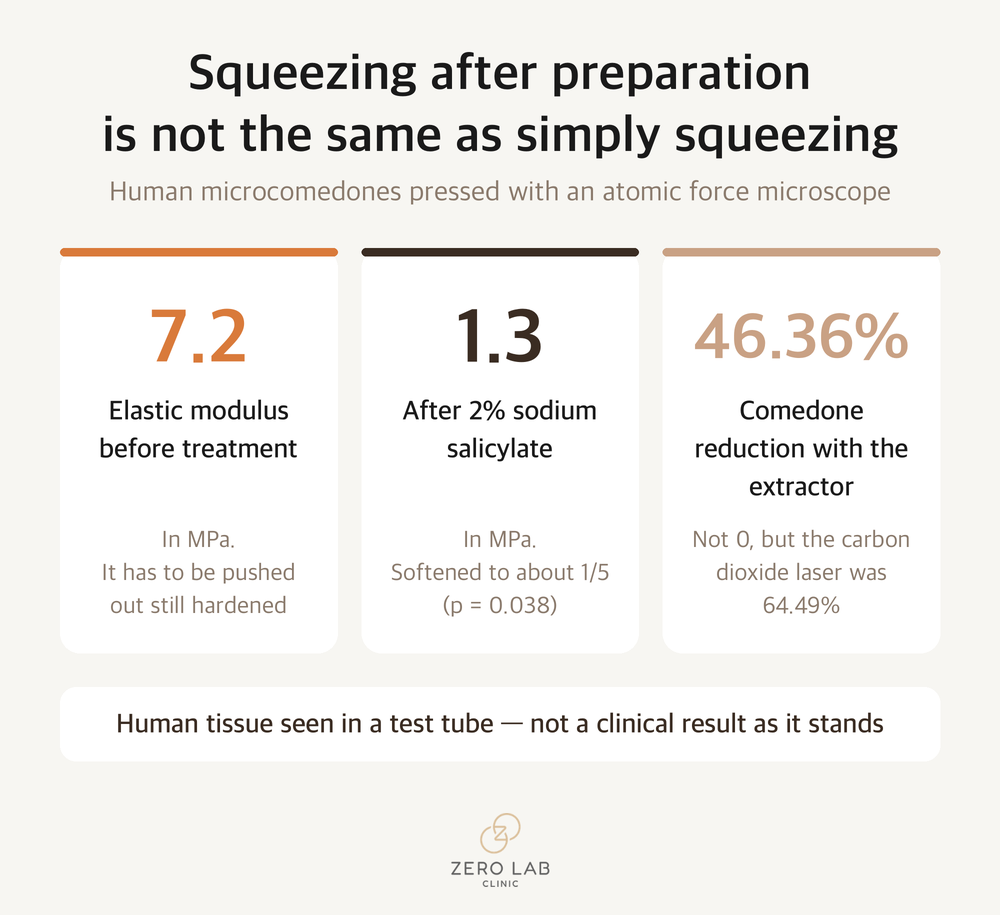
A study pressed on microcomedones lifted from human noses with tape, using an atomic force microscope. After treatment with 2% sodium salicylate, the elastic modulus fell from 7.2 MPa to 1.3 MPa (p = 0.038)[8]. They had softened to about 1/5.
This was an experiment on tissue taken from human skin and examined in a test tube, so it cannot be carried over to clinical results as it stands. Even so, squeezing after a keratolytic treatment and pushing out something still hardened are physically different things to do - that much is clear.
This is why we do not squeeze straight away but put a preparation step first. If it comes out with less force, the damage to the surrounding tissue is smaller as well.
Where and how it is done changes the result
There is one set of data worth using here.
A study tracked women who had facial treatments at 3 beauty salons in New Delhi - 142 women and 169 treatment sessions in all, tracked over 12 weeks.
- In 41 sessions (24.3%), comedo extraction after steaming was performed, and of those, 12 left persistent erythema at the extraction site. That is about 29% of the sessions in which extraction was done.
- 47 people (33.1%) developed an acneiform eruption 3-10 weeks after the treatment (mean 6.1 weeks). The predominant lesion was deep nodules, and they healed leaving pigmentation behind.
- Of those, 34 people (72.3%) had it recur every time they had a facial[9].
“more came up after it was squeezed, not less” - some people tell us this, and as far as we know this is the only data that puts a number on the phenomenon.
That said, this is 2002 data from beauty salons in India. We are not saying it applies as it stands to the situation in Korea now. Read it only for the direction: the setting and the method change the result.
On squeezing them yourself - let me state the evidence precisely
We could not find evidence to state flatly that “squeezing at home leaves scars and causes inflammation”. Plenty of articles write it that way, but there is no study that measured it prospectively.
What there is, is an association.
In a study of 225 acne patients in Thailand, 61.33% had scarring, and a habit of squeezing and picking was associated with scarring (adjusted odds ratio 2.69, p = 0.033). At 3.51 for moderate acne and 8.98 for severe and above, the effect of acne severity itself was larger[10].
A risk assessment tool for atrophic scarring developed by specialists has four items, and alongside worst-ever severity, duration and family history, “a habit of manipulating lesions” is one of them[11].
In a study carried out in 7 Asian countries including Korea, covering 324 acne patients, 58.2% had post-acne hyperpigmentation, more than half of them for over 1 year, and in 22.3% it persisted for 5 years or more. The researchers wrote that scratching behaviour may be a risk factor that education can change[12].
To put it together: it is a fact that more scarring is observed in people who squeeze and pick, and because that observation comes from cross-sectional data, causation cannot be claimed. That is as far as we can go.
The number that matters more is a different one
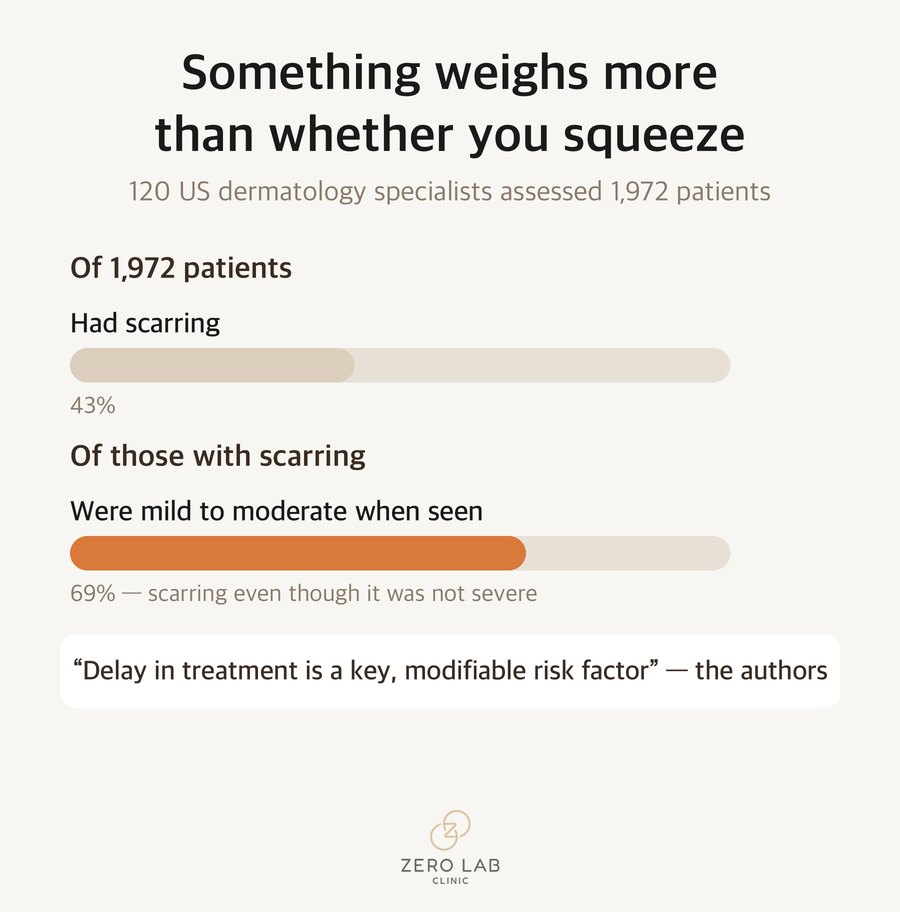
In the United States there is a study in which 120 dermatology specialists assessed 1,972 patients. 43% had scarring.
And yet 69% of those with scarring were mild to moderate at the time they were seen. It means scarring was there even though the acne was not severe. The authors' conclusion reads - “delay in treatment is a key, and modifiable, risk factor for scarring”[13].
This weighs more than whether or not you squeeze. We do see people who put it off because it was not severe and then come in with scarring.
What we check at a consultation
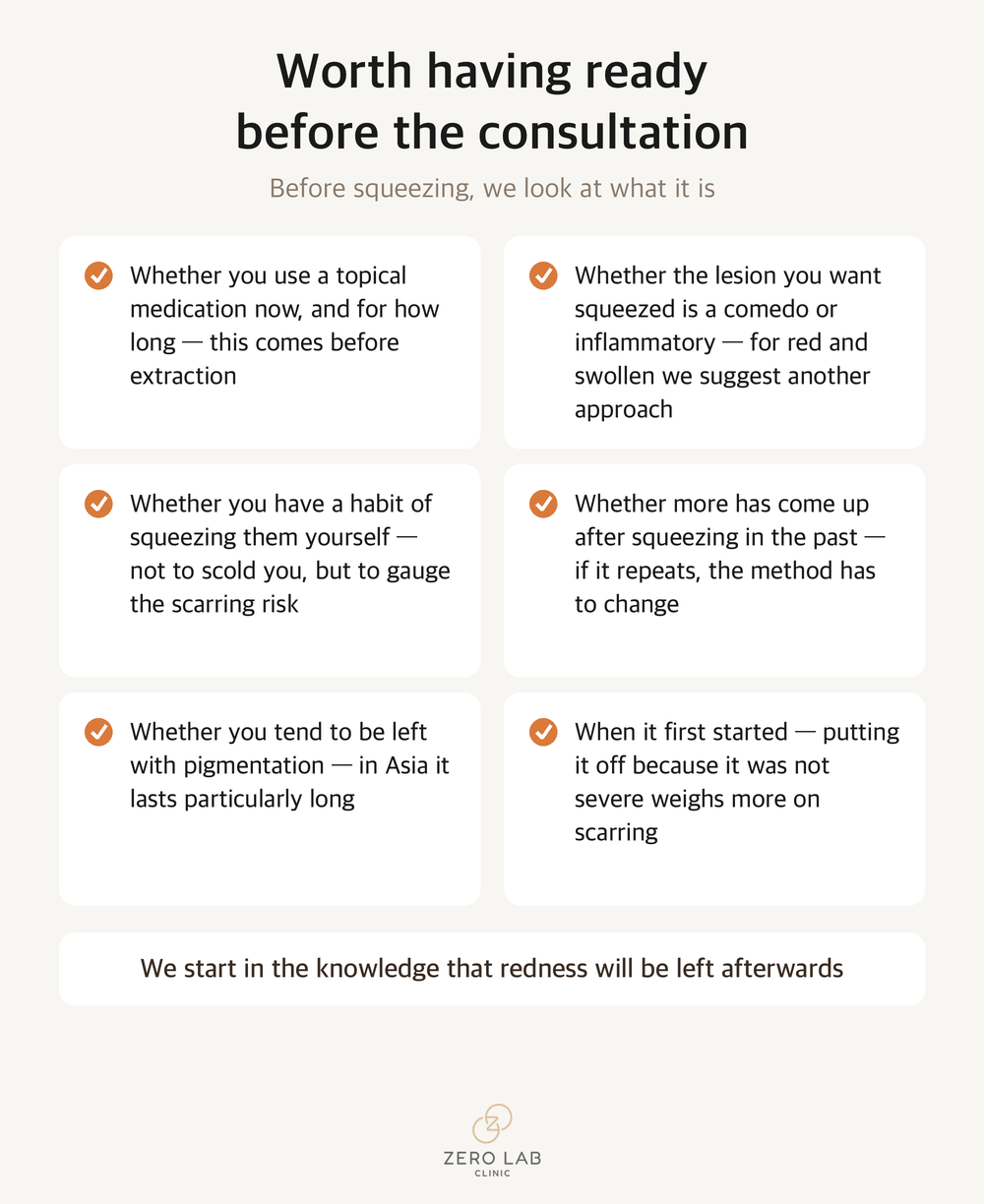
- Whether you are using a topical medication now, and for how long - this comes before extraction
- Whether the lesion you want squeezed is a comedo or inflammatory - for something red and swollen we will suggest a different approach
- Whether you have a habit of squeezing them yourself, and how much - this is not to scold you but to gauge the scarring risk
- Whether more has come up after squeezing in the past - if it repeats, the method has to change
- Whether you tend to be left with pigmentation - in Asia it lasts particularly long
In closing
Many people ask whether they should have extraction or not. A clear-cut answer is hard to give.
Extraction is an adjunct to medical treatment. The guideline has not yet been able to form a recommendation, and there is no evidence that extraction on its own makes things better. Even so, it reduces comedones by 46%, it serves as the groundwork for other procedures, and it raises patient satisfaction.
So it is not a question of whether to squeeze, but of what is squeezed, when, and under what conditions. Looking at whether it is a comedo or inflammation, preparing before squeezing, and starting in the knowledge that redness will be left afterwards - that is what we do.
And not putting it off because it is not severe weighs more heavily on scarring than the question of squeezing does.
References
[1] Reynolds RV, Yeung H, Cheng CE, et al. Guidelines of care for the management of acne vulgaris. J Am Acad Dermatol. 2024;90(5):1006.e1-1006.e30. DOI: https://doi.org/10.1016/j.jaad.2023.12.017
[2] Khunger N; IADVL Task Force. Standard guidelines of care for acne surgery. Indian J Dermatol Venereol Leprol. 2008;74 Suppl:S28-S36. PMID: 18688101
[3] Dilworth GR. Acne surgery. Can Fam Physician. 1983;29:955-958. PMID: 21283373
[4] Kim KY, Song SY, Jung YJ, et al. A randomized, split-face, comparative study of a combined needle radiofrequency/intense pulsed light device in moderate-to-severe acne patients. Ann Dermatol. 2024;36(5):266-274. DOI: https://doi.org/10.5021/ad.23.083
[5] Zhang L, Wu Y, Zhang Y, et al. Modified red light 5-aminolevulinic acid photodynamic therapy versus low-dose isotretinoin therapy for moderate to severe acne vulgaris: a prospective, randomized, multicenter study. J Am Acad Dermatol. 2023;89(6):1141-1148. DOI: https://doi.org/10.1016/j.jaad.2023.07.1023
[6] Yang MY, Qiao SM, Ning DC, Ding YH, Zeng WH, Wang Z. Treatment effect of ultra-pulse dynamic CO2 laser and comedone extractor in dense comedones: a prospective, randomized, split-face, evaluator-blind, controlled clinical trial. Lasers Med Sci. 2024;39(1):233. DOI: https://doi.org/10.1007/s10103-024-04104-0
[7] Bencharattanaphakhi R, Wananukul S, Tempark T, Chatproedprai S. A 595 nm pulsed dye laser as an adjuvant intervention for post-comedone extraction erythema and comedone reduction: a randomized, split-face controlled trial. J Cosmet Dermatol. 2024;23(5):1645-1653. DOI: https://doi.org/10.1111/jocd.16178
[8] Al-Rekabi Z, Rawlings AV, Lucas RA, Raj N, Clifford CA. Characterizing the nanomechanical properties of microcomedones after treatment with sodium salicylate ex vivo using atomic force microscopy. Int J Cosmet Sci. 2021;43(5):610-618. DOI: https://doi.org/10.1111/ics.12729
[9] Khanna N, Datta Gupta S. Rejuvenating facial massage — a bane or boon? Int J Dermatol. 2002;41(7):407-410. DOI: https://doi.org/10.1046/j.1365-4362.2002.01511.x
[10] Yan C, Phinyo P, Yogya Y, Chuamanochan M, Wanitphakdeedecha R. Risk factors associated with facial acne scarring in Thai patients with acne: a cross-sectional study. J Cosmet Dermatol. 2025;24(1):e16695. DOI: https://doi.org/10.1111/jocd.16695
[11] Tan J, Thiboutot D, Gollnick H, et al. Development of an atrophic acne scar risk assessment tool. J Eur Acad Dermatol Venereol. 2017;31(9):1547-1554. DOI: https://doi.org/10.1111/jdv.14325
[12] Abad-Casintahan F, Chow SKW, Goh CL, et al. Frequency and characteristics of acne-related post-inflammatory hyperpigmentation. J Dermatol. 2016;43(7):826-828. DOI: https://doi.org/10.1111/1346-8138.13263
[13] Tan J, Kang S, Leyden J. Prevalence and risk factors of acne scarring among patients consulting dermatologists in the USA. J Drugs Dermatol. 2017;16(2):97-102. PMID: 28300850
The 13 papers above are indexed in PubMed. This article provides general medical information; decisions about an individual's condition are made through consultation.
This article was written directly by Zero Lab Clinic to provide medical information. Results of any procedure vary with individual skin condition, and side effects are possible. Please decide on a procedure only after an in-person consultation with a doctor.